Unveiling the Best Places to Go in Italy
Italy stretches from Alpine pinnacles brushed with late snow to terraces in the far south where lemon trees overlook the Mediterranean Sea, and every region introduces new terrain, architecture, and tradition. Bronze Age grotto homes stand within sight of glass-clad museums, medieval ramparts guard modern campuses, and Renaissance façades host espresso bars that buzz well past sunset. A single itinerary can place a gondola on the Grand Canal in the morning, a hike along Liguria’s cliffs by afternoon, and dinner beside rolling olive groves before night falls. Such contrasts explain why the peninsula consistently ranks among the best places to visit in Italy for travelers who value culture, scenery, and variety.
The route that follows takes you along the Amalfi Coast, where cliffs cradle pastel villages and lemon groves, guiding north to Lake Como and Lake Garda for mirrored water, marble villas, and family-friendly promenades. Lake Maggiore, with its picturesque scenery and island gardens, is another notable lake destination in northern Italy. We explore the colorful houses of Cinque Terre, cypress roads unravel across the Tuscan countryside, and the storied streets of Rome, Florence, a gorgeous city, and Venice reveal layers of empire, art, and maritime ingenuity. Central Italy, including Tuscany and Lazio, offers a region rich in culture, history, and diverse landscapes. Beyond those classics lie Matera’s cave quarters, Puglia’s whitewashed towns, and the Dolomites’ limestone ridges, each showing another facet of the peninsula’s incredible diversity. Sicily, with its rich history, beautiful beaches, and unique cultural heritage, is also a captivating destination. Regional meals and clear travel logistics knit these places together, so every stop feels connected rather than scattered, and the journey builds toward a complete picture of this beautiful country’s enduring appeal. Throughout Italy, you’ll discover amazing food and the authentic feel of regions like Calabria or the truly authentic feel of Naples, making every experience memorable.
Some links in this post are affiliate links. That means we may earn a small commission, at no additional cost to you.


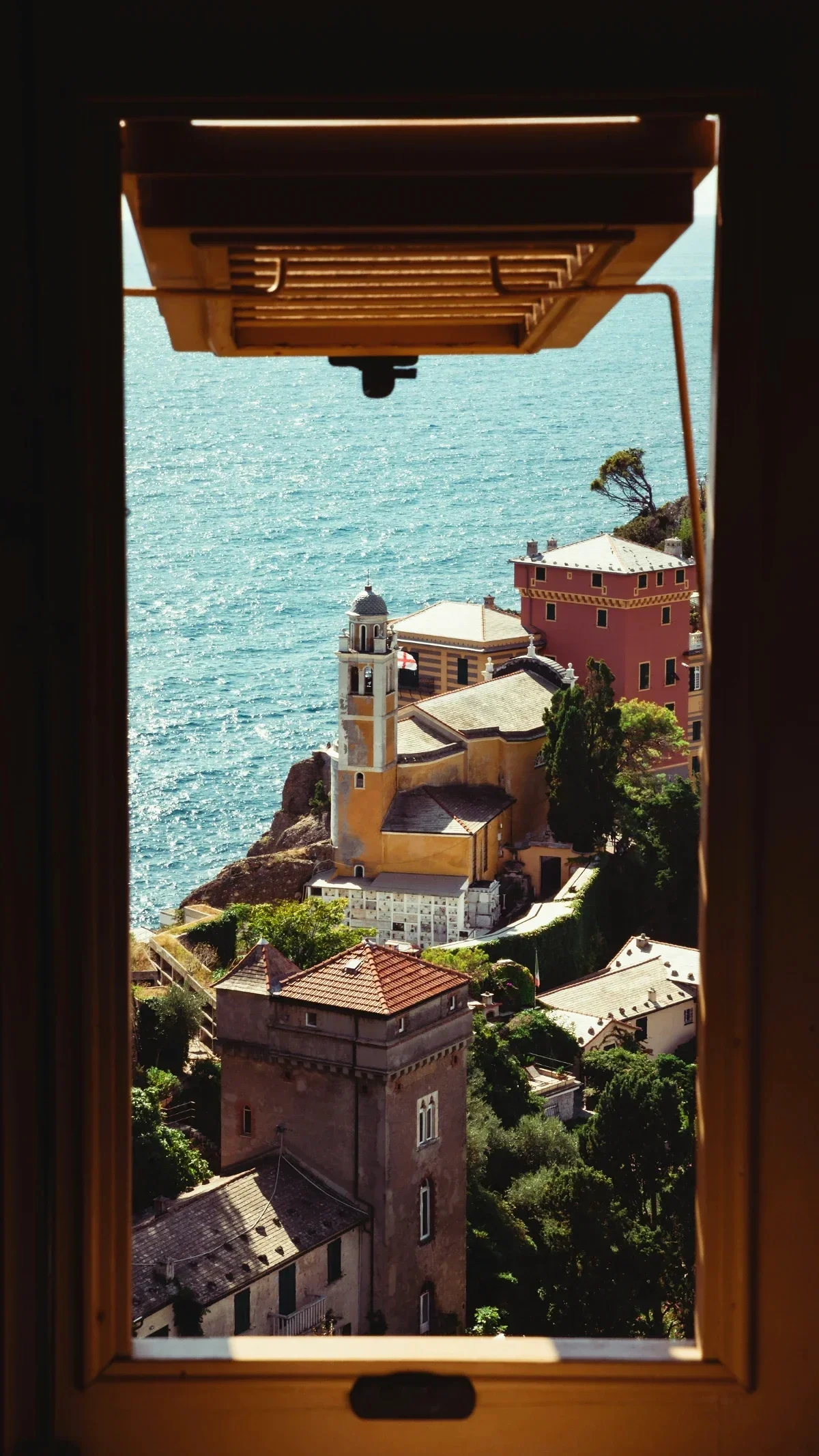
Seaside Ligurian village and turquoise water framed by an open window in golden afternoon light.
Almalfi Coast
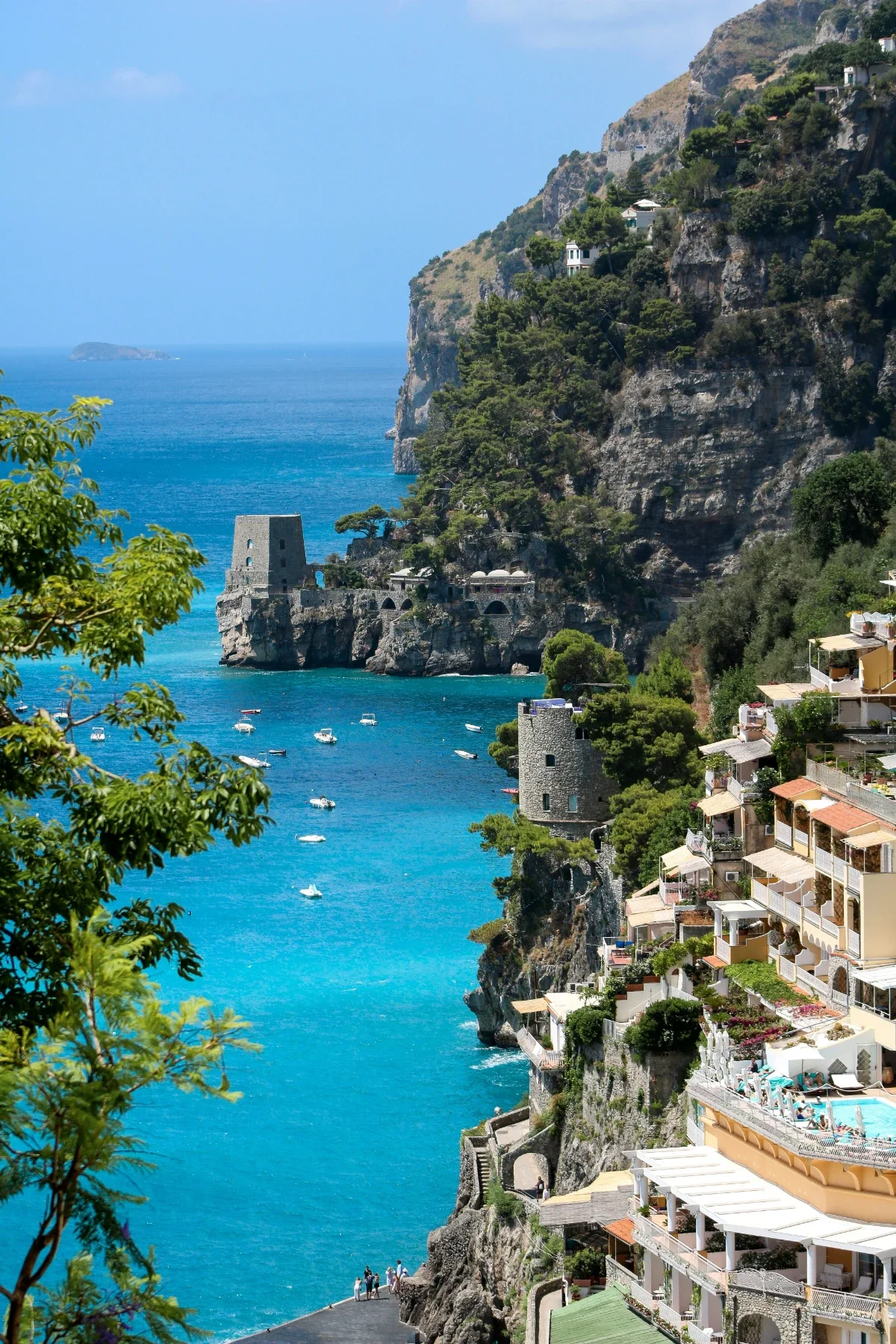
Turquoise Tyrrhenian Sea below dramatic Amalfi Coast cliffs dotted with towers, boats and pastel villas.
The Amalfi Coast, recognized as a UNESCO World Heritage Site, stretches for thirty-five miles along the southwest edge of mainland Italy, where limestone bluffs rise almost vertically from the Mediterranean Sea. A two-lane road follows every headland, and ferries trace the same shoreline, revealing a fresh panorama at each bend. Terraces of lemon groves step up the slopes beyond Vietri sul Mare, churches glow white against rugged cliffs, and coves hold water so clear that pebbles appear magnified beneath the surface. This blend of constant scenery and reliable sunshine secures the region among the best places to go in Italy for travellers seeking amazing views with easy access from Naples or Salerno.
Orientation, transportation and best time to visit
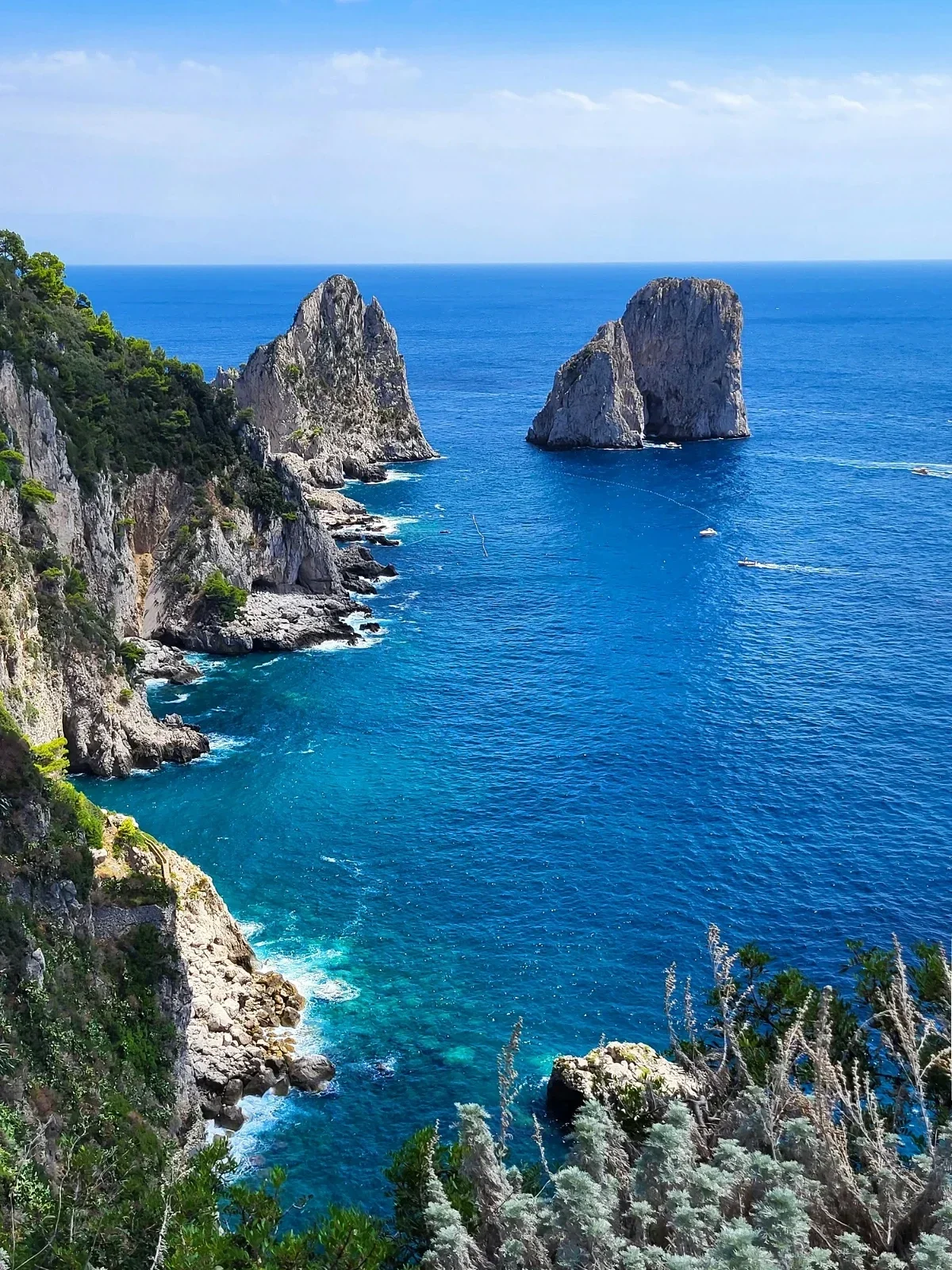
Dramatic Faraglioni sea stacks off Capri rise from bright-blue Tyrrhenian waters below rugged cliffs.
Fast ferries operate from early April through late October, departing every 30 to 60 minutes from Salerno, Amalfi, Positano, and the small island of Capri. The Salerno-to-Amalfi leg averages thirty-five minutes, and Amalfi-to-Positano another twenty, bypassing traffic on the coastal highway and delivering the postcard approach as each village appears from behind the next promontory. A year-round SITA bus covers the same loop, but road congestion near Positano and Amalfi peaks from ten in the morning until five in the afternoon. Drivers who insist on a car should reach the coast before eight and leave after seven to secure parking. Late April to early June and mid-September to mid-October mix warm swimming temperatures, full ferry schedules, and lighter queues at cafés, beach clubs, and trailheads, ideal shoulder periods for a first trip.
Noteable towns from West to East
The incredibly picturesque Positano is the first stop for drivers coming from Sorrento. Pastel houses and colorful houses spill toward Spiaggia Grande, so expect long flights of steps rather than flat streets and pack sturdy shoes. Continue five miles to Praiano, a quieter fishing village where the small harbor at Marina di Praia still launches working boats each dawn and restaurants serve grilled bluefish at sunset. Another six miles brings you to Amalfi, the historic center of the coast. Here, Piazza del Duomo anchors the town with café tables and a central fountain, and steep steps rise to the striped Cathedral of Saint Andrew. Behind the square, a short lane enters the Valle dei Mulini, where restored water wheels explain how local families turned rags into paper for medieval merchants. From Amalfi, a twenty-minute taxi or bus ride climbs to Ravello, a hill town set one thousand feet above the sea. Cooler air and wide horizons shape its appeal: Villa Rufolo offers Moorish courtyards and manicured terraces, while Villa Cimbrone ends in the Terrace of Infinity, a marble balustrade that frames uninterrupted coastline. Classical and jazz concerts fill these gardens from June through early September, adding evening culture to the coastal itinerary.
Land-based routes for walkers and hikers
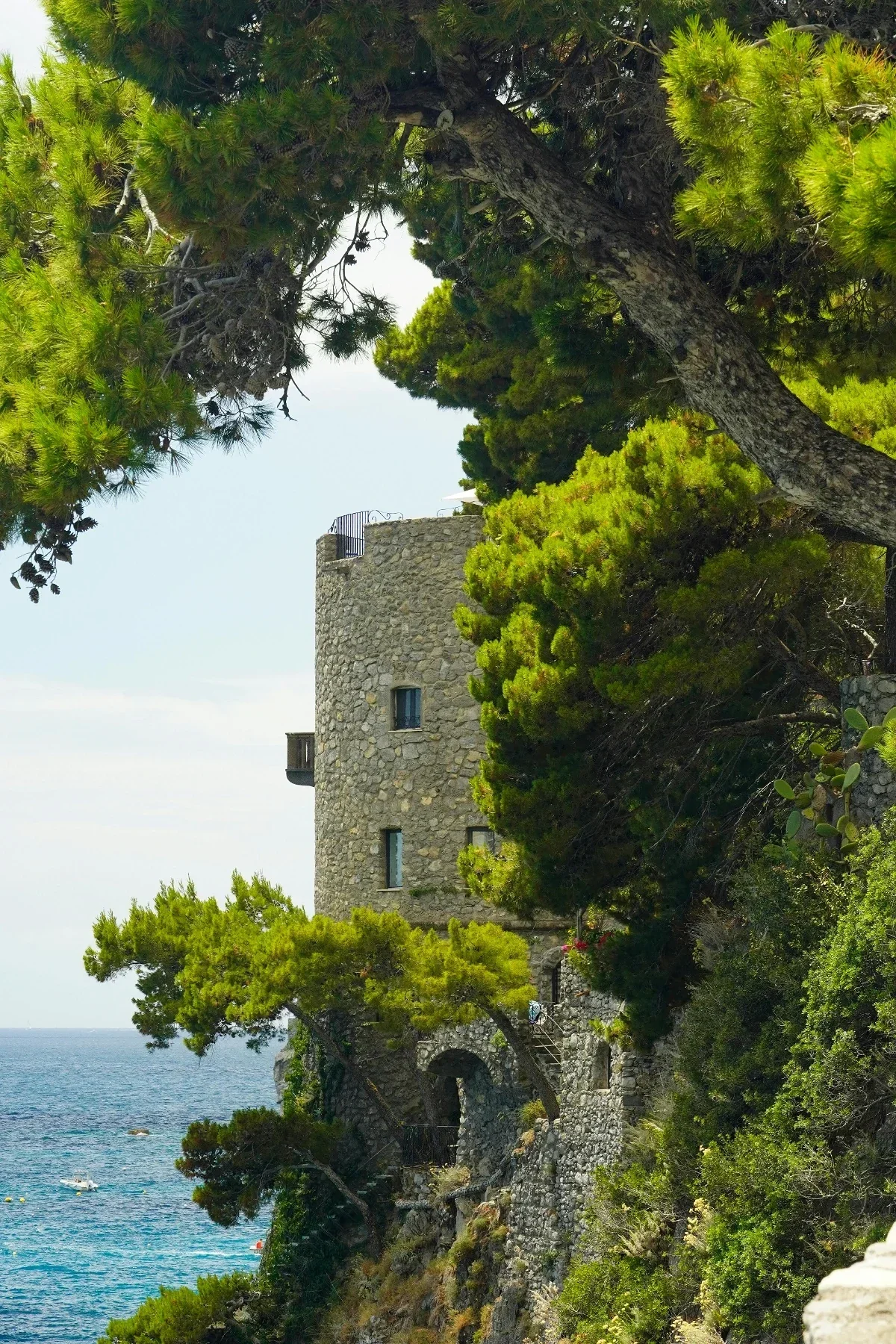
Medieval stone watchtower peeks through pine branches along dramatic Amalfi Coast cliffs near Positano.
The Sentiero degli Dei starts in Bomerano, gains only 650 feet across six kilometres, and ends on stone stairs in Nocelle above Positano. White-and-red markers make navigation easy, yet sun exposure is constant, so water and a hat are mandatory. Near Colle Serra the path overlooks the whole line of cliffs toward Capri, justifying its status as the coast’s finest balcony walk. Public buses connect Nocelle, Positano, and Bomerano hourly; private transfers cut the return time during peak season. An easier alternative, the Path of the Lemons, links Maiori and Minori in ninety minutes through orchards of Sfusato Amalfitano citrus, growers sell chilled lemonade at farm gates from April to July. Ambitious hikers head inland from Amalfi to the Valle delle Ferriere nature reserve where three waterfalls cool canyons lined with prehistoric ferns; the four-hour loop ends at Pontone, whose café serves goat-milk gelato.
Water adventures
Half-day kayak outings leave the Amalfi at eight in the morning, reaching the quiet beach of Santa Croce before ferries arrive, and pause under the narrow span of Lovers’ Arch. Snorkelling boats anchor off Li Galli, an uninhabited trio of rocky islets halfway to Capri, where grouper and damselfish patrol ledges. Dive centres at Capo di Conca guide certified visitors to Roman pillars resting at sixty feet, while beginners practise skills on a sheltered reef. Small-group fishing charters depart Maiori pre-dawn, troll for amberjack beyond the marine reserve, then arrange to grill the catch at a partner trattoria. Private skippers offer sunset boat tour circuits around Capo d’Orso, timing the limestone to blush pink as the lighthouse beam appears. These options balance village exploring with hours spent on the water or high above the shoreline, adding a layer of beautiful nature that photos alone cannot supply.
Planning Your Stay
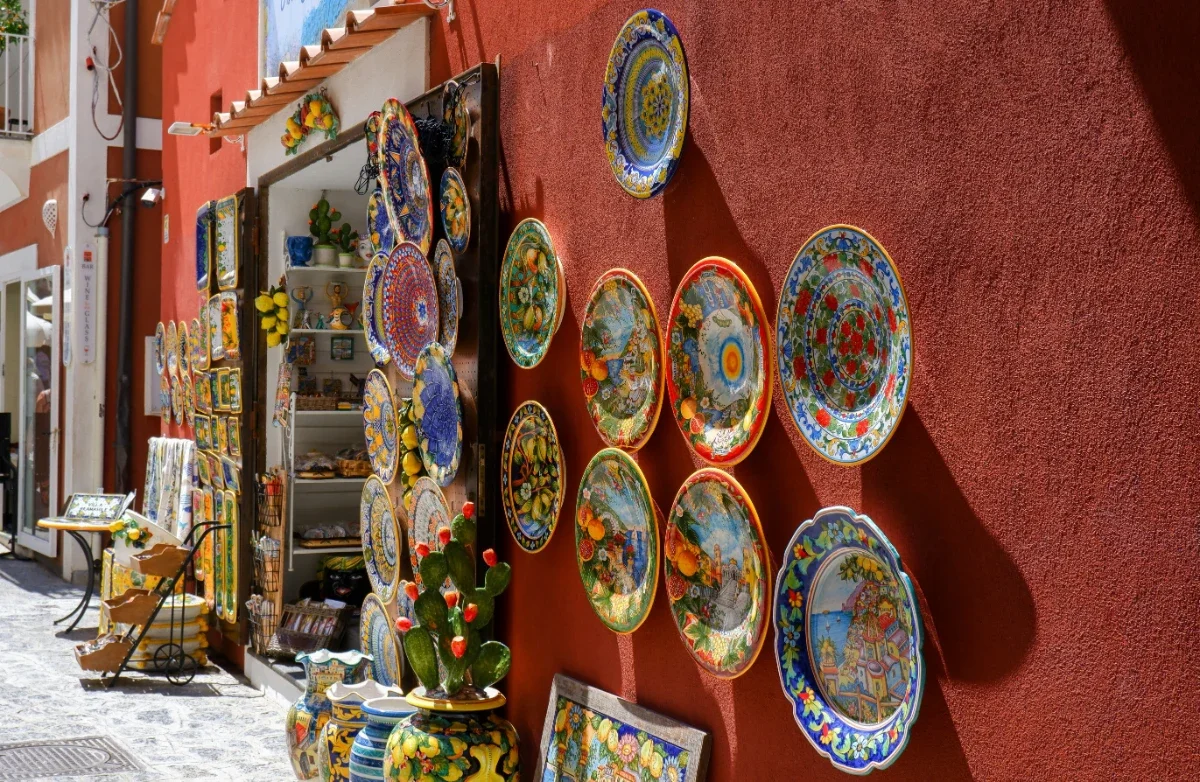
Sunlit ceramics shop with vivid hand-painted plates and lemons on a red stucco wall in the Amalfi Coast.
Plan on spending a few nights, at least three, to explore the landmark towns, hike a signature trail, and still fit in a day on the water without rushing. Day one tours Amalfi and Ravello before a late-afternoon swim. Day two covers the Sentiero degli Dei, followed by dinner in Positano. Day three leaves room for a ferry to Capri or to quieter fishing ports such as Cetara. That rhythm lets you catch dawn silence, midday bustle, and the blue-hour hush when church bells echo off stone, and the coast feels less like a string of tourist traps and more like a set of working communities. Add extra nights for cooking classes in Minori, wine tastings in Tramonti, or a day trip to Pompeii that enriches a second trip with Roman context and volcanic landscapes.
Lake Como
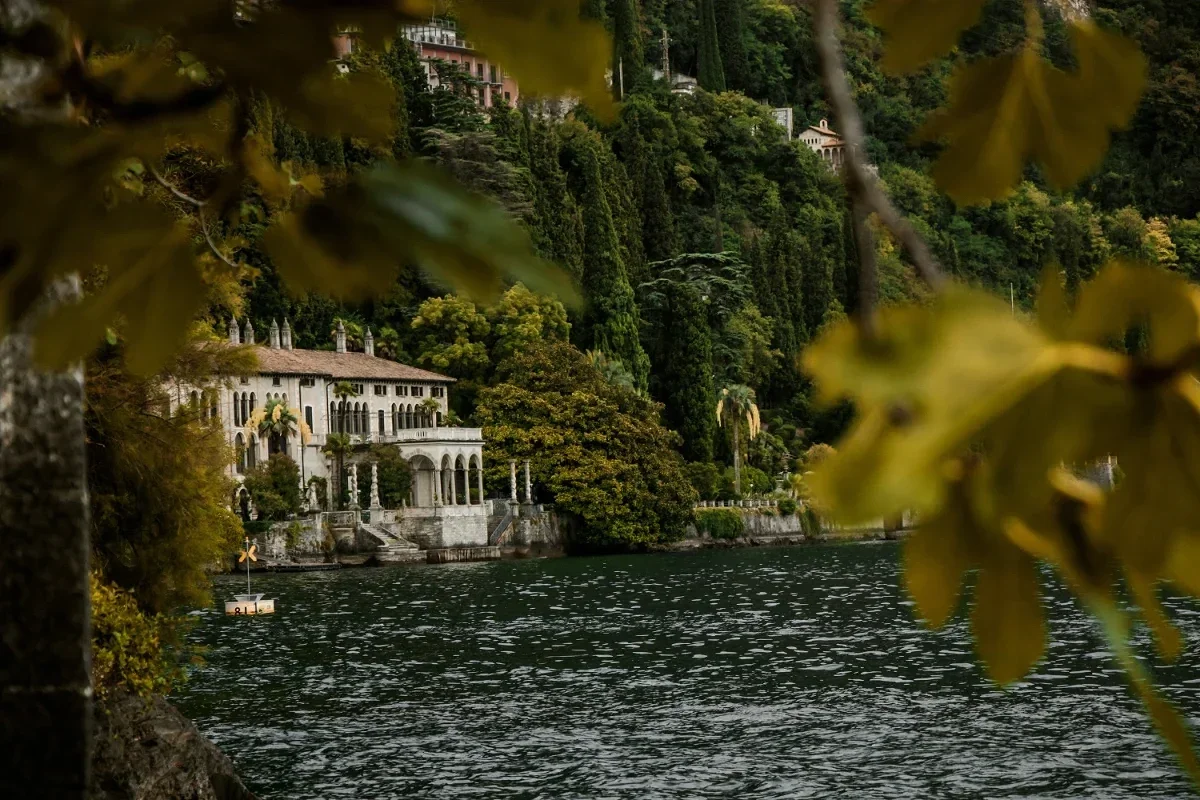
Historic lakeside villa framed by cypress and lush forest on the tranquil shores of Lake Como.
Lake Como ranks among Italy’s most celebrated destinations because it blends natural drama with cultivated elegance in a setting that filmmakers, architects, and celebrity homeowners have showcased for two centuries. The lake occupies a deep glacial trench that splits into three arms shaped like an inverted Y; their calm surface mirrors Rhaetian Alpine ridges that collect snow well into May. Silk barons and Lombard nobility began building waterfront estates here in the seventeenth century, and that tradition of refined living remains visible along the western shore. Villa del Balbianello, familiar from Star Wars and James Bond films, tops a vine-draped promontory and opens gardens and loggia to the public from March through early January. Two miles north, Villa Carlotta combines Canova marbles with terraces that explode each spring in azalea, rhododendron, and giant bamboo. Across the central basin, Varenna wraps fishermen’s cottages around an oleander promenade, and a fifteen-minute climb reaches Vezio Castle for a clear southward view of Bellagio poised at the lake’s crossroads. Add nightly sunsets that turn the water liquid copper, and it becomes clear why artists from Liszt to Hitchcock drew inspiration here and why modern visitors still list Lake Como among the world’s most beautiful places located in Italy.
Water Ferries
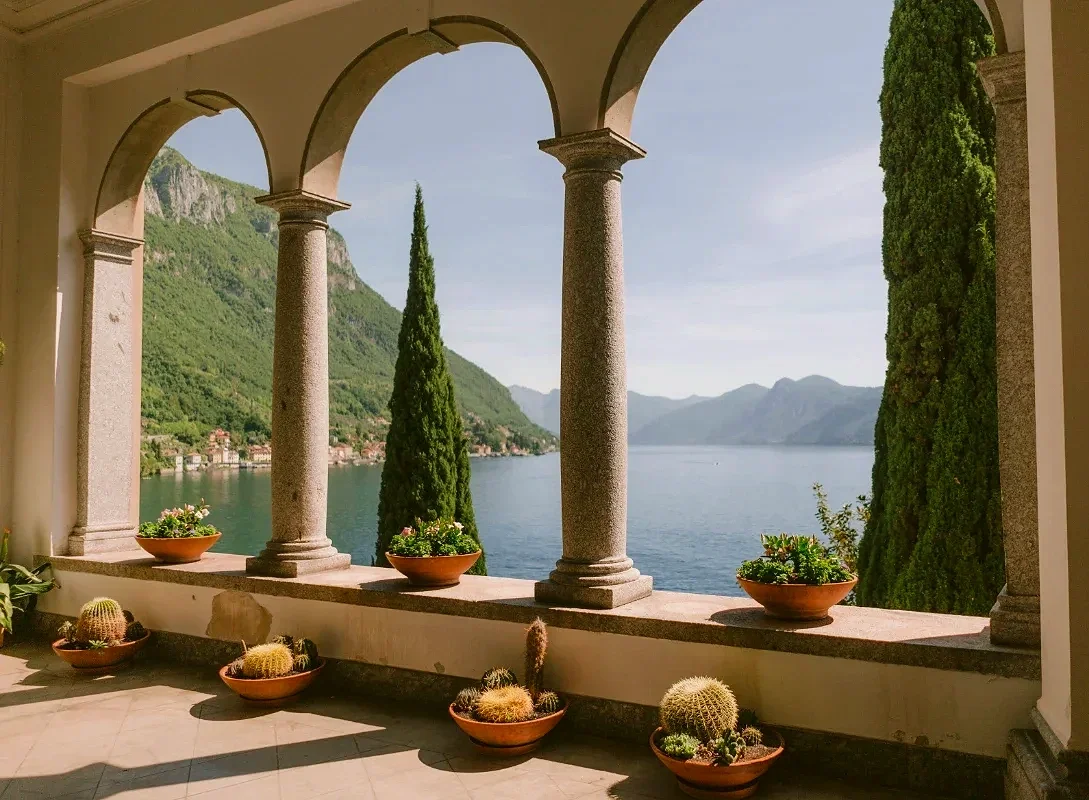
Stone arch loggia with cactus pots and cypress trees overlooks Lake Como from Varenna.
The lake’s rhythm comes from movement on the water. Navigazione Laghi ferries run year-round between Como city, Tremezzo, Bellagio, Varenna, and Menaggio; the mid-lake shuttle operates every thirty minutes in high season. Purchase a “giornaliero” day pass at the pier for unlimited stops, or choose a two-hour boat tour on a covered launch that pauses at Andreoli waterfalls and the Art Nouveau pier in Moltrasio. Hydrofoils, noted as “rapido” on the timetable, halve travel times but require a supplement and seat assignment. Private mahogany boats depart from Bellagio’s Lungo Lario Manzoni quay for one-hour sunset circuits that circle Balbianello and time the return with villa lights reflecting on the water like braided gold.
Land Excursions
Bellagio occupies the cape where Lake Como’s three arms divide. Cobbled lanes climb past silk boutiques toward a Romanesque church whose bell tower frames snow peaks. Five minutes by ferry, Menaggio offers a level lakeside promenade ideal for families, while Varenna preserves medieval alleys that descend to the Lovers’ Walk, a crimson gangway skirting rock ledges above deep green water. Hikers trace the Greenway del Lago di Como for ten kilometres from Colonno to Griante, crossing olive terraces and Roman milestones; allow three hours plus time for cappuccino stops. The 1894 funicular rises from Como city to Brunate in seven minutes, and a level path continues for forty minutes to Faro Voltiano lighthouse with a 360-degree sweep toward the Swiss border. Cyclists rent e-bikes in Menaggio to follow the quiet Via Regina north to the customs hamlet of Gandria, turning a lakeside ride into an effortless international day trip.
Planning Your Stay
Allow three nights so the itinerary breathes. Use Day One to sample the mid-lake triangle: board an early ferry from Bellagio to Varenna, wander the waterfront lanes, cross to Menaggio for lunch on the promenade, then ride the shuttle back to Bellagio for sunset on the Punta Spartivento. Dedicate Day Two to the west shore villas. Tour Villa Carlotta’s gardens mid-morning, continue by water taxi to Villa del Balbianello for its terraced loggia, and finish with the Como-Brunate funicular for a skyline view that reaches the Swiss peaks. Keep Day Three flexible: walk the ten-kilometre Greenway del Lago, rent an e-bike and coast north to the Gandria border for an effortless international day trip, or charter a private boat tour to swim beneath Nesso’s waterfall and visit coves inaccessible by road. This rhythm blends ferries, light hiking, and shoreline dining and shows why Lake Como’s mix of elegant villas, beautiful nature, and incredibly picturesque villages endures as a highlight of any first trip to Italy’s lake district.
Lake Garda
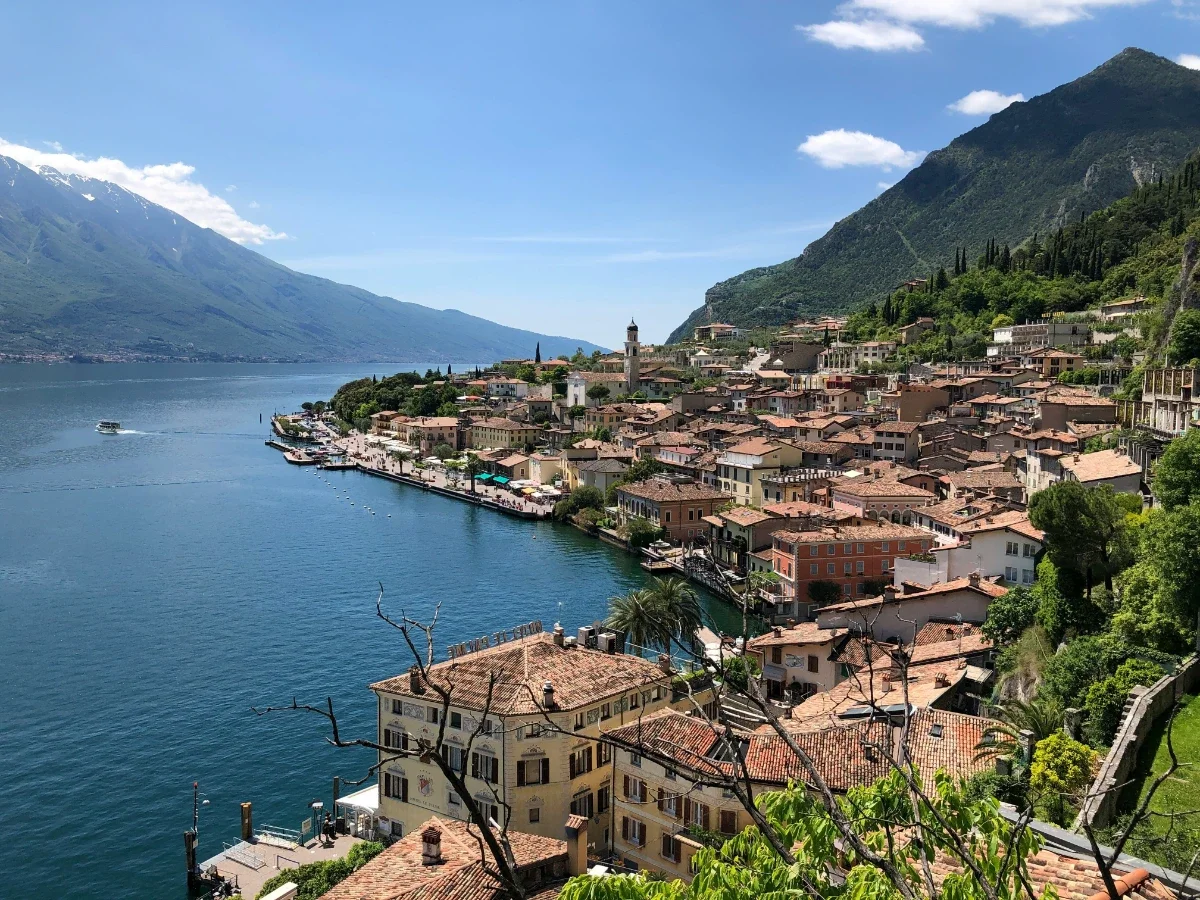
Scenic lakeside town with terracotta roofs and bell tower along deep-blue Lake Garda backed by alpine ridges.
Lake Garda is Italy’s largest lake and anchors the transition between Alpine foothills and the Veneto plain. The northern basin narrows into steep rock walls and deep cobalt water, giving windsurfers the steady Ora breeze each afternoon. Toward the south the shoreline opens into low hills planted with olives and vines that yield crisp Lugana and light Bardolino wines. This north-to-south change in climate lets travellers move from mountain sports to beach idling in under an hour, a range that keeps Lake Garda high on lists of travel destinations that please the whole family.
Towns Worth Visiting
Sirmione occupies a four-kilometre peninsula that juts from the southern shore. Scaligero Castle guards the only land entrance, its moat still filled by lake water so clear that the reflection looks photographic. Thermal pools inside Aquaria spa reach 37 °C, and the Roman poet Catullus once soaked in springs that still bubble near the Grotte di Catullo ruins at the peninsula tip. Moving clockwise, Desenzano offers an old town with a Roman villa mosaic, a bustling Friday market, and ferries that run late into the evening. Mid-lake, the walled harbour of Torri del Benaco lights lanterns along stone quays where restaurants grill perch caught hours earlier. Malcesine, farther north, spreads beneath a thirteenth-century castle whose tower frames the icy summit of Monte Baldo. A rotating cable car climbs the mountain in twelve minutes; summer hikers find gentian meadows, while winter visitors strap on snowshoes. At the very head of the lake, Riva del Garda mixes regatta marinas, limestone via ferrata ladders, and a lakeside bike park that rents child trailers and full-suspension rigs.
Choosing Your Season
Driving the full loop requires about three hours without stops, yet ferries let visitors swap asphalt for deck chairs and amazing views. Collect a full-day ticket at any pier and hop on or off as the schedule suits. Passenger hydrofoils link Desenzano with Riva in under two hours, and car ferries cross the mid-lake narrows between Torri and Toscolano every half hour in summer. July and August bring beach weather but also traffic; families who prefer thinner crowds should target late May through June or early September when water temperature still holds near 72 °F, and the Garda Jazz Festival fills evening promenades with saxophone echoes.
Outdoor Activities
North-shore windsurfers congregate at Torbole by ten each morning when the Pelèr blows south; by afternoon, the Ora reverses direction, so beginners book early lessons and advanced riders wait for the stronger return breeze. Climbing guides in Arco supply helmets and harnesses for via ferrata routes graded from easy ladders with wire handrails to exposed traverses that overlook the entire lake. Families choose the Strada del Ponale, a nineteenth-century mule track converted into a gravel cycle path that clings to rock walls ten metres above turquoise water. South of Bardolino, easy terrain suits vineyard e-bike tours that pause for Lugana tastings beneath vine-covered pergolas. On the water, one-hour boat tour loops leave Sirmione every forty minutes and circle the peninsula past the sulphur springs that cloud the shallows; private skippers extend the circuit to Isola del Garda, a neo-Gothic villa set in terraced gardens accessible only by boat.
Planning Your Stay
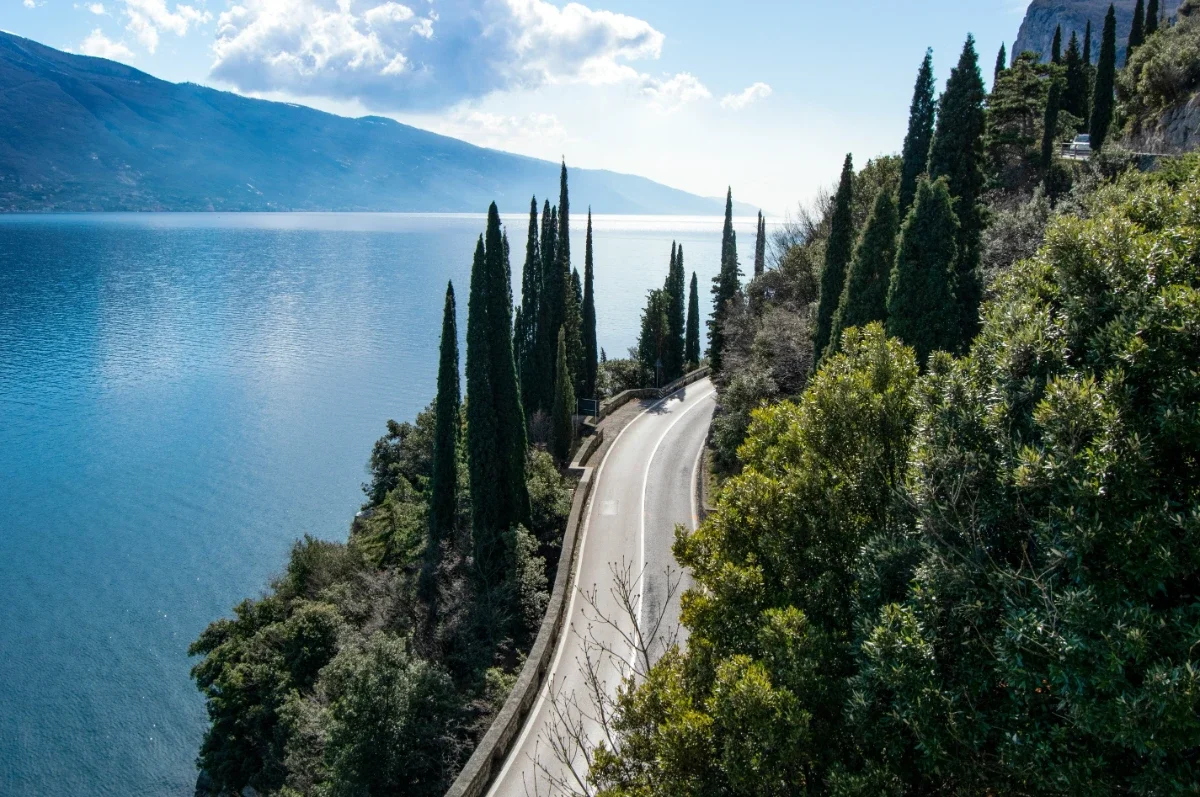
Curving lakeside road lined with tall cypress trees along sparkling Lake Garda with alpine ridges beyond.
For a balanced visit, book three to four nights. Day one explores Sirmione’s castle and thermal pools before an evening ferry to Desenzano for market browsing and dinner. Day two rides the cable car above Malcesine in the morning and returns by mid-lake car ferry to Torri for a lantern-lit perch supper. Day three turns north to Riva del Garda: cycle the Ponale path before lunch, then choose windsurf lessons or a via ferrata sampler in the afternoon. Reserve day four for Gardaland or Caneva if children need a thrill, or replace the parks with vineyard stops around Lazise for adults travelling without kids. This circuit shows why Lake Garda’s mix of Alpine sport, Mediterranean ease, and convenient transport makes it the rare family-friendly destination that satisfies both toddlers and teenagers while still delivering scenery that ranks among Italy’s beautiful nature highlights.
Cinque Terre
Cinque Terre occupies six rugged miles of the Ligurian west coast of Italy, where steep schist ridges descend without warning into a series of turquoise coves. The national park and the coastline together hold UNESCO World Heritage Site status, and Cinque Terre is especially known for its colorful villages and breathtaking coastal scenery. The medieval drystone terraces anchor vines and lemon trees to near-vertical slopes. Nowhere else in Italy packs so much beautiful nature into so little horizontal space, and the constant contrast between bright stucco, green vineyards, and rugged cliffs explains why many lists rank Cinque Terre among the most beautiful places to visit in Italy. The five charming villages are connected by famous scenic hiking trails, offering visitors a unique way to experience the region. Alongside the stunning views, Cinque Terre is also renowned for its amazing food, making it a top destination for regional meals and unforgettable experiences.
Five Notable Villages
Riomaggiore
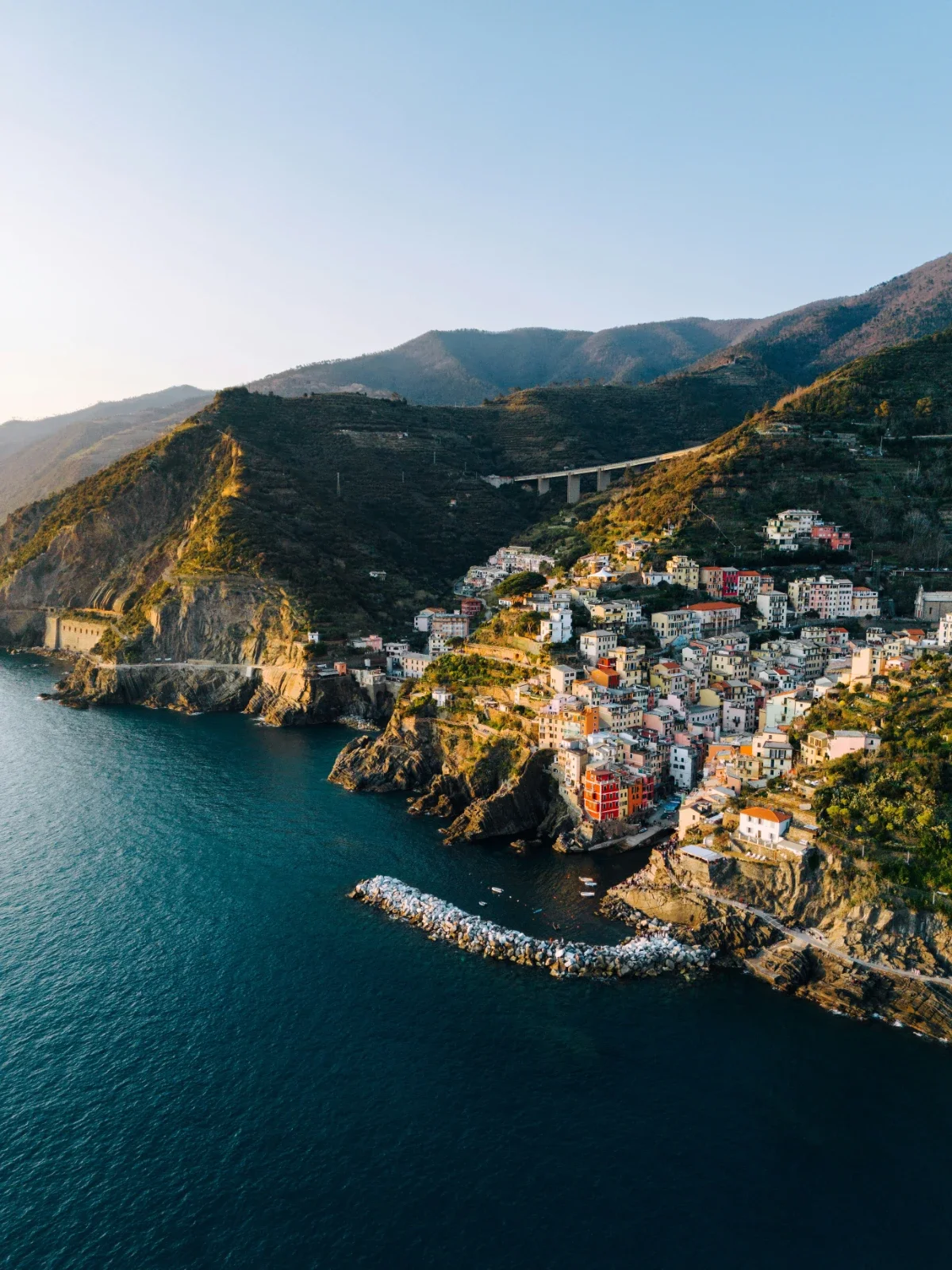
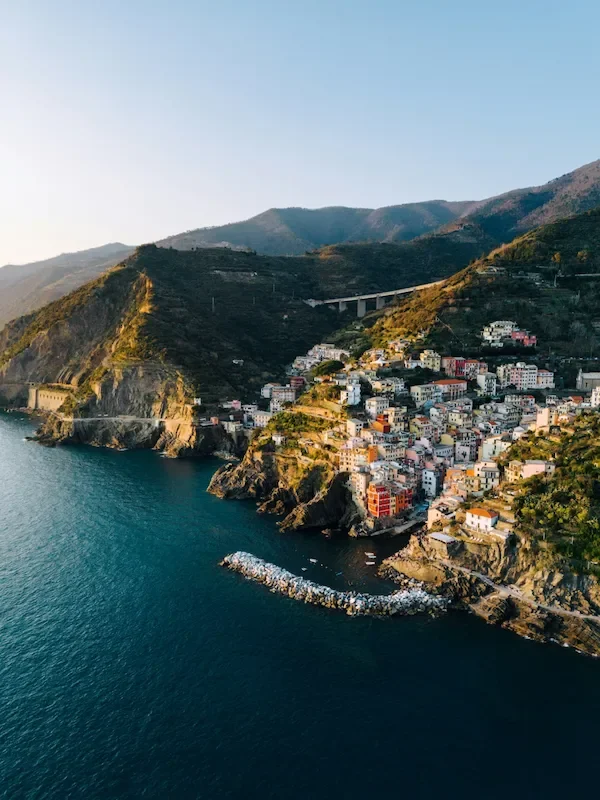
Drone view of multicoloured Riomaggiore houses climbing steep cliffs above dark Ligurian Sea at sunset.
The southeastern gateway to Cinque Terre presses tall, slender houses, painted ochre, coral, and sage, into a narrow ravine that drops abruptly to a tiny marina. Fishing skiffs bob beside the wave-smoothed rocks while seagulls swoop over stalls selling fried anchovies in paper cones. A short climb up Via Colombo reveals wine bars, grocery shops, and murals that testify to the village’s maritime past. Evening light turns the colorful houses honey gold and invites photographs from the ferry landing, where the full sweep of rugged cliffs frames the cove. Riomaggiore feels compact yet authentic, making it an easy place to settle for the night before tackling the trails.
Manarola
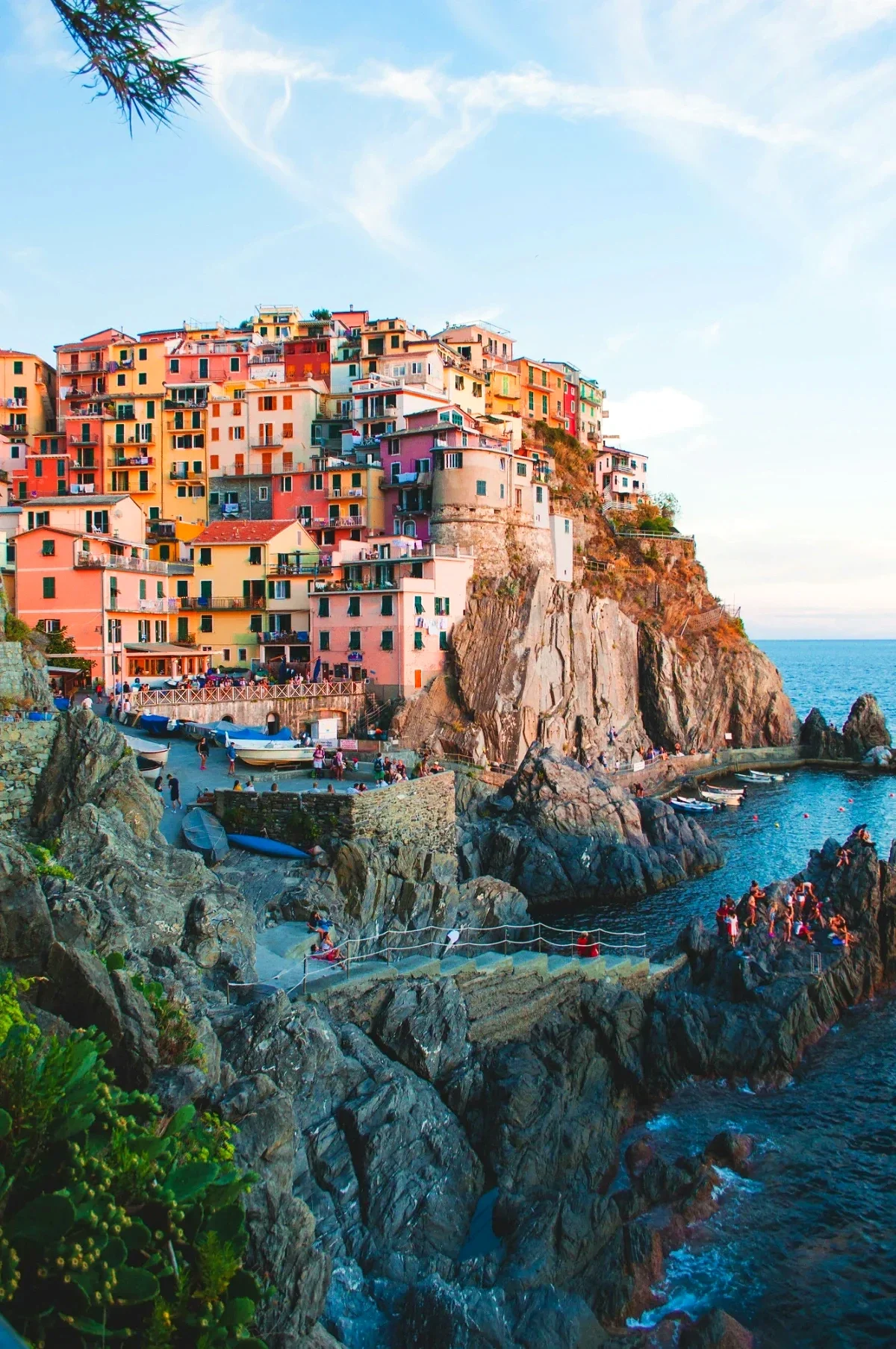
Golden-hour light on Manarola’s stacked cliffside houses overlooking the rocky Ligurian coastline.
Just one train stop north of Riomaggiore, Manarola spills toward a stone quay that hosts sunbathers by day and cliff divers at dusk. The quaint village’s single main street runs from the station through pastel lanes straight to the water, where swimmers share space with fishing boats pulled high against winter swell. Steep terraced vineyards climb the slope behind the houses and supply grapes for Sciacchetrà, the prized local dessert wine; guided tastings begin at the cooperative winery on the upper lane. A ten-minute walk up the headland reaches Nessun Dorma, a cliff-top café that offers pesto workshops and frames one of Cinque Terre’s most amazing views back toward the multicolored façade of the village. After dark, harbor-side restaurants serve trofie al pesto while the sound of waves echoes across the quay.
Corniglia
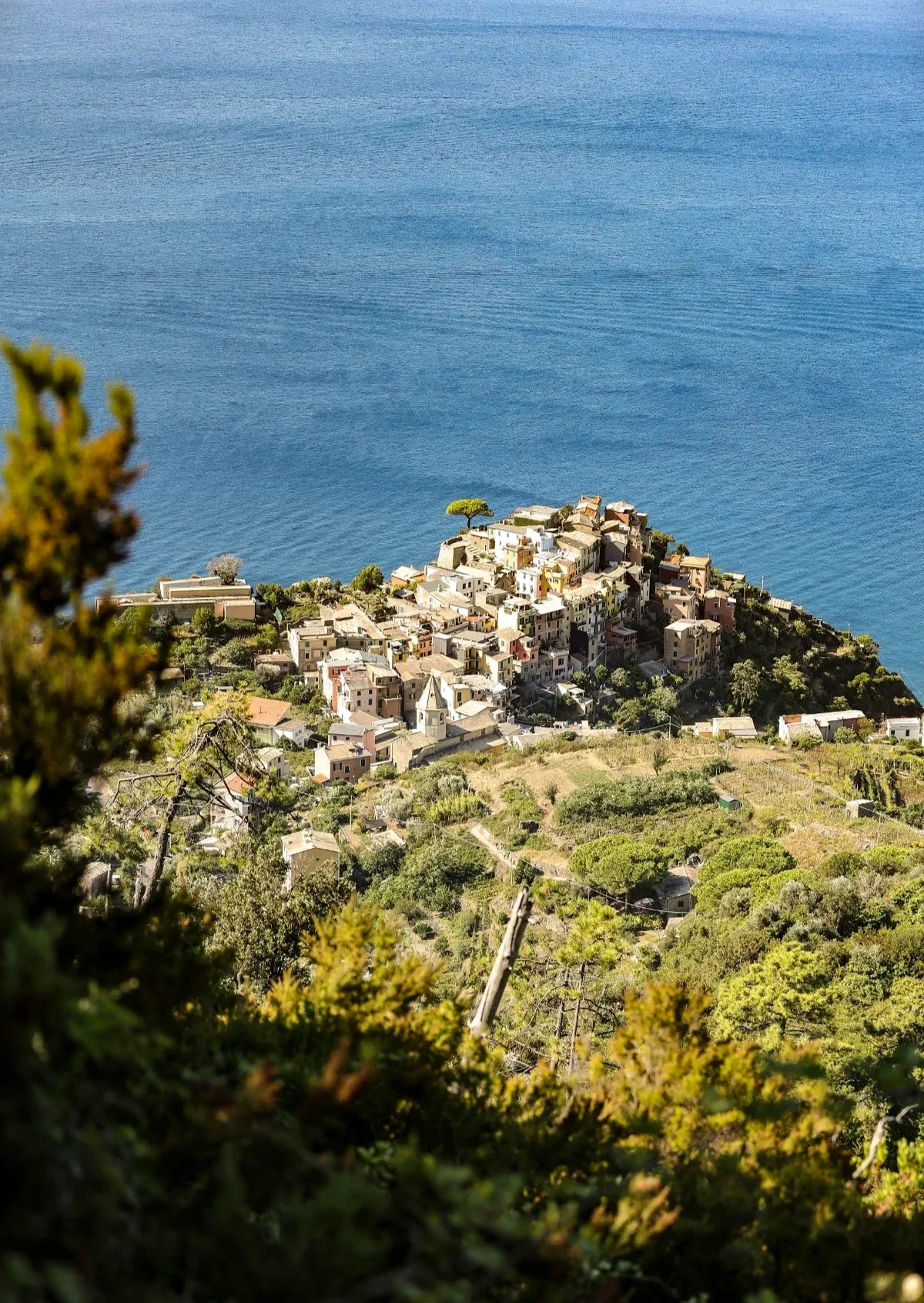
Cliff-top Corniglia village and terraced vineyards seen from above against the wide blue Ligurian Sea.
Perched one hundred metres above sea level, Corniglia is the only village without a harbour. Visitors climb the three-hundred-eighty-two-step Lardarina stairway from the station or ride a small shuttle bus that zigzags through olive groves. Narrow lanes converge at Largo Taragio, where the Gothic façade of San Pietro church watches over wine bars pouring crisp Vernaccia di Corniglia. Terraces above the village supply basil and lemons to kitchen windows; lower slopes carry vines right to the cliff edge. The height guarantees panoramic sea views and a quieter scene than the shorefront settlements, making Corniglia ideal for travellers who value space over beach access.
Vernazza
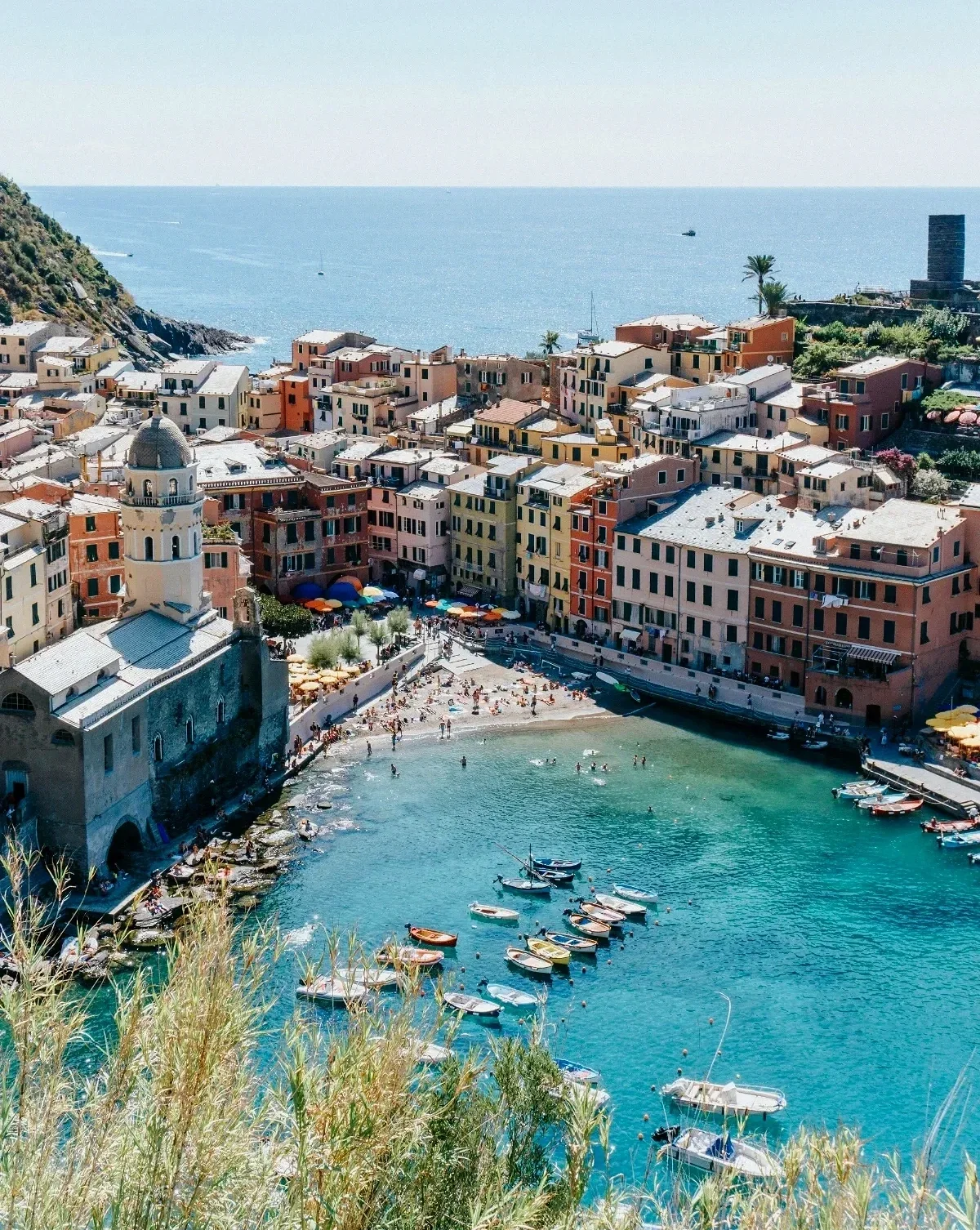
Sunlit Vernazza bay with swimmers, bobbing boats and pastel houses encircling the tiny beach on Cinque Terre coast.
Often referred to as the most photogenic of the five, Vernazza curves like a painter’s palette around a sheltered harbour. Fishing skiffs tether to buoy lines that mirror pastel façades in still water. A short climb to Doria Castle’s cylindrical watchtower earns a 360-degree panorama of terraces, coves, and the next village north. Cafés encircle Piazza Marconi, serving focaccia di Recco and glasses of local Vermentino under striped umbrellas. Small group boat tour operators depart from the jetty, rounding the headland for sunset photographs that capture cliffs glowing amber in low light.
Monterosso al Mare
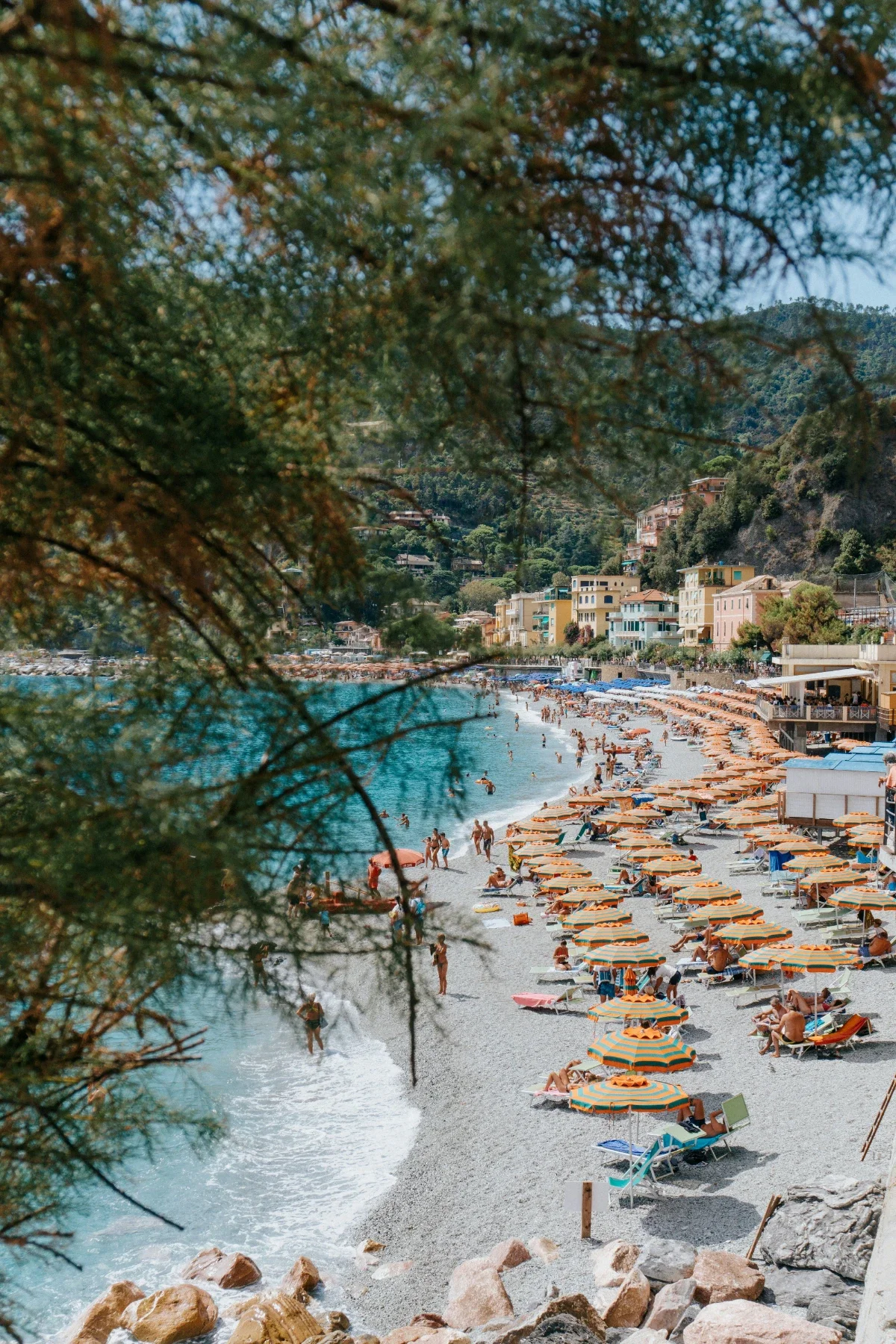
Rows of orange-yellow umbrellas line busy pebble shore at Monterosso al Mare with green hills beyond.
The northernmost village splits into two parts: medieval Monterosso Vecchio and the newer Fegina quarter. It claims the coast’s only golden beaches, shaded in patches by umbrella pines and backed by a promenade dotted with gelaterie and lemon trees. Families appreciate the level streets, playgrounds, and rental kayaks that launch directly from the sand. Above the old town, the Convent of Cappuccin friars shelters a sixteenth-century crucifix attributed to Van Dyck, while the surrounding hills cultivate citrons used in the annual Lemon Festival each May. With its broad shore, ample lodging, and evening passeggiata, Monterosso offers the most traditional resort feel in Cinque Terre yet still delivers signature turquoise water and cliff-top vineyards.
Tuscan Countryside
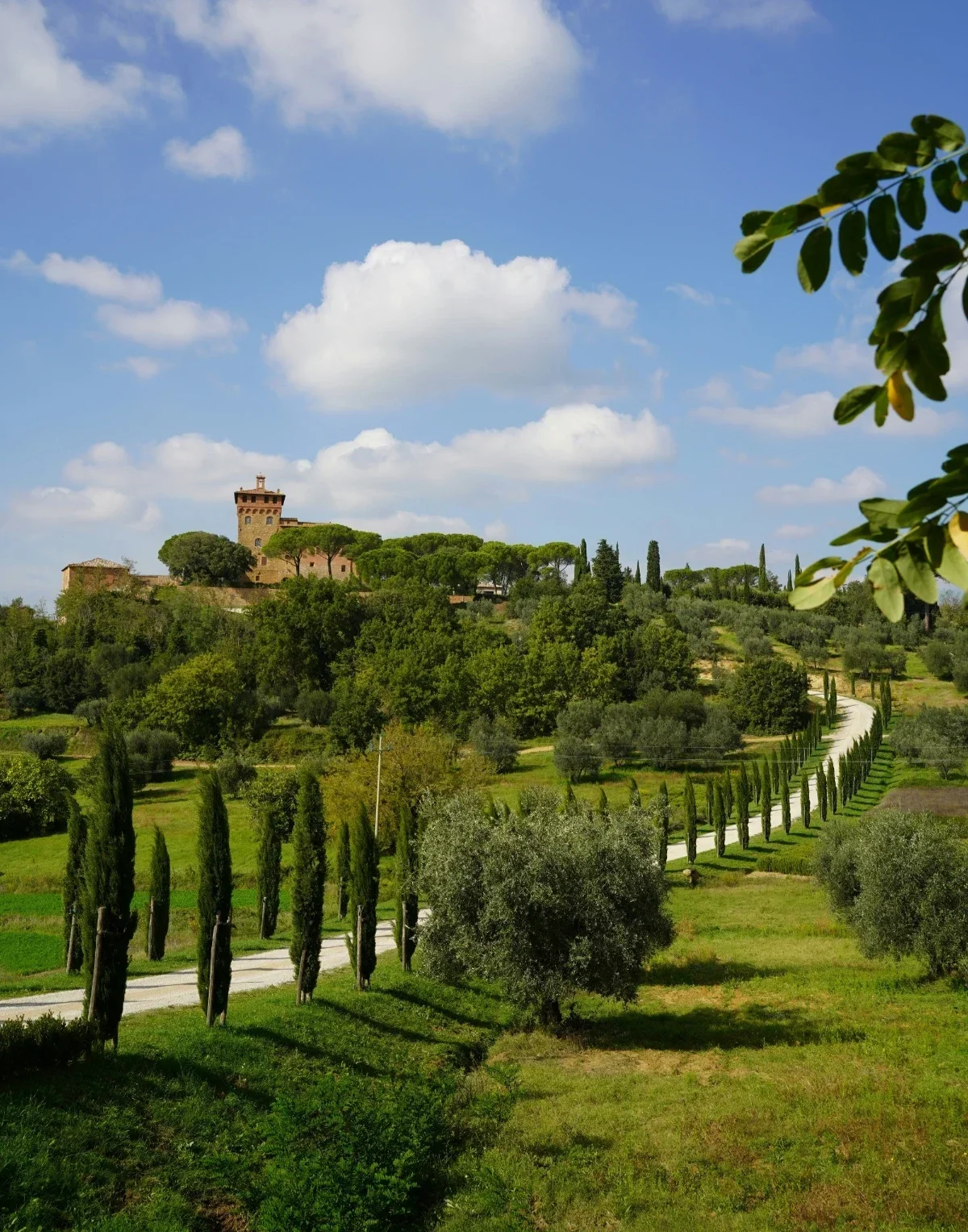
Beyond Florence, the Tuscany region unfolds in gentle undulations, its rolling hills rising like folds of a vast quilt stitched with silvery olive groves, tawny wheat stubble, and arrow-straight cypress rows. This enchanting landscape is part of central Italy, a region celebrated for its cultural richness, historical significance, and diverse scenery. Dawn mist pools in hollows until sunlight exposes the mosaic beneath: farmsteads of golden sandstone, gravel lanes bordered by poppies, and lush vineyards that glint metallic green under a high sky. Turning off the Strada Regionale 222 onto any white-gravel strada bianca leads past hand-painted signs for pecorino, saffron, and fresh olive oil, then rejoins the main road outside San Gimignano, where fourteen medieval towers still vie for height above the Elsa Valley.
South of those towers, the Via Cassia bends into Siena. Inside its brick walls, Piazza del Campo curves like a shell, and twice each summer bareback racers thunder across its clay surface during the Palio. West of the city, the landscape sinks into the Val d’Orcia, a UNESCO-listed basin whose wheat slopes glow ochre in July and whose vines ignite copper during the October vendemmia. Woodsmoke scents the clear air while tractors lift crates of Sangiovese destined for the cooperatives of Montalcino. Stone ramparts there overlook neat rows that produce Brunello, and tasting rooms pour deep garnet vintages beside platters of finocchiona and almonds roasted with rosemary.
Twenty kilometres east, a spur road climbs to Montepulciano, where vaulted cellars age Vino Nobile in Slavonian oak beneath Renaissance palaces. South of town, Pienza appears theatrical in its perfect symmetry, its limestone façades fronting lanes perfumed by wheels of aging cheese. Beyond Pienza, a side road reaches Bagno Vignoni, where mineral springs steam even in mid-winter and, after dark, the pool beside the old mill mirrors Orion as crisply as any observatory.
Seasonal palettes complete the picture: lush greenery in April and May, a sunflower sea in July, and a russet haze of turned soil in November, each confirming why this corner of Italy defines rural beauty for travellers worldwide. Driving these backroads, pausing at roadside farm stands for cinghiale salami, then ending the evening on an agriturismo terrace with homemade pici tossed in garlic oil, allows visitors to feel the living rhythm of Tuscany rather than simply observe it. Cooking classes and food tours, including pasta-making classes and wine tastings, are also popular activities for travelers looking to immerse themselves in the authentic flavors of Tuscany.
Need help booking a seamless journey to your destination?
Let our Travel Atelier craft a slow, sensory itinerary that honors the spirit of each place, treads lightly on the planet, and moves in harmony with your own natural cadence. Through our affiliation with Fora Travel , you unlock VIP upgrades, daily breakfast, and insider perks at no extra cost.
- Flight planning and booking support.
- Bespoke hotel and villa curation.
- Eco-conscious routing and local guides.
- 24 / 7 support from departure to return.
Complimentary discovery call · No planning fees for Terra Selene readers.
Cities To Visit In Italy
Rome
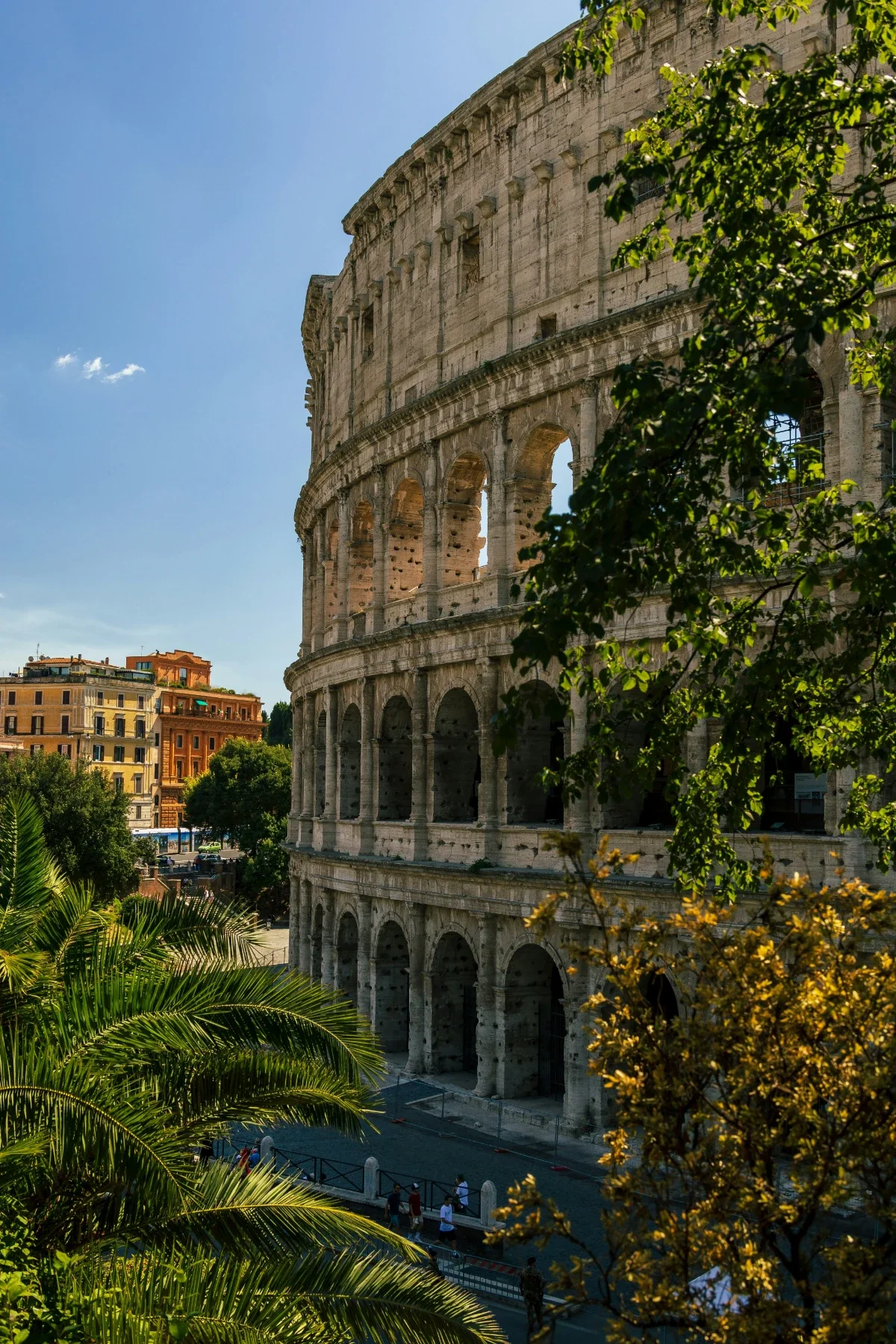
Partially shaded view of Colosseum with foreground palm fronds and city buildings.
Rome layers the imperial grandeur of Italy over a living metropolis where scooter horns mix with church bells and the scent of espresso drifts past marble fountains. Two millennia of history press close together: ancient aqueducts arch over commuter rail lines, and Renaissance palaces now house ministries and fashion ateliers. Yet even with that density, the city breathes; evening light settles on travertine façades, turning them the color of honey, and the Tiber reflects the dome of Saint Peter’s as reliably as it did in Bernini’s day. Travelers who linger beyond the headline attractions discover neighborhood markets in Testaccio, leafy courtyards in the Jewish Ghetto, and murals brightening the former industrial quarter of Ostiense, proof that Rome renews itself without shedding its past.
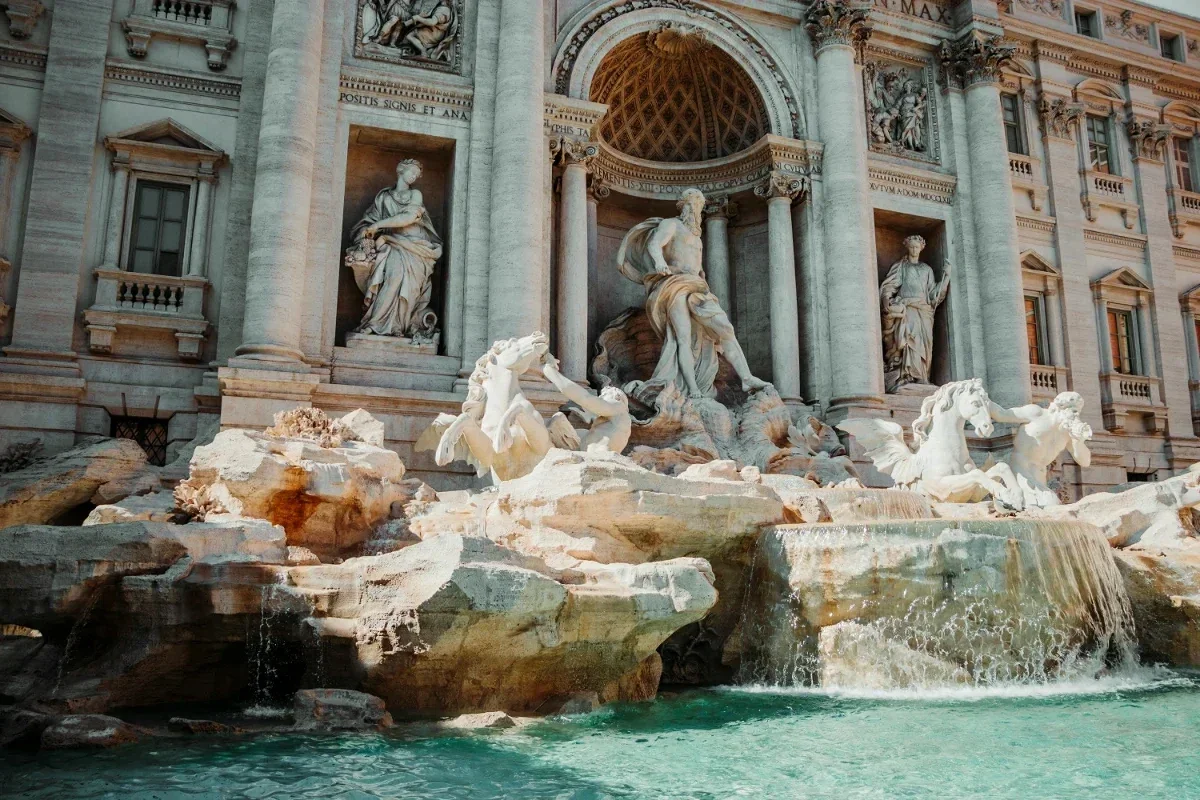
Baroque sculptures and turquoise pool of Trevi Fountain with water cascading over travertine rocks.
A well-planned circuit begins at the Colosseum just after opening, when the corridors still echo, and the arena floor feels cavernous. From there, a short walk reaches the Roman Forum, where the Via Sacra rises toward the Arch of Septimius Severus and the Curia Julia. North of the Capitoline Hill stands the Pantheon, whose unreinforced concrete dome has spanned the ages without steel. Ten minutes west, Piazza Navona frames Bernini’s Fountain of the Four Rivers; cafés here charge for the view, but the setting merits at least one espresso. The Spanish Steps are another must-see site, drawing visitors to their iconic staircase and lively surroundings. Crossing the Tiber leads to Castel Sant’Angelo and the Vatican Museums, where timed tickets shorten entry to the Sistine Chapel and Raphael Rooms. South of Vatican City, the long straight line of the Appian Way reveals basalt paving worn by chariot wheels, catacombs frescoed with early Christian symbols, and grassy meadows dotted with ruined tombs. Rome is known for its ancient ruins, grand Renaissance architecture, and vibrant atmosphere. Evenings end in Trastevere or Monti, where trattorias plate cacio e pepe and oxtail stew before a late passeggiata to the Trevi Fountain. Historical tours in Italy often focus on cities like Rome, highlighting their rich cultural heritage.
Florence
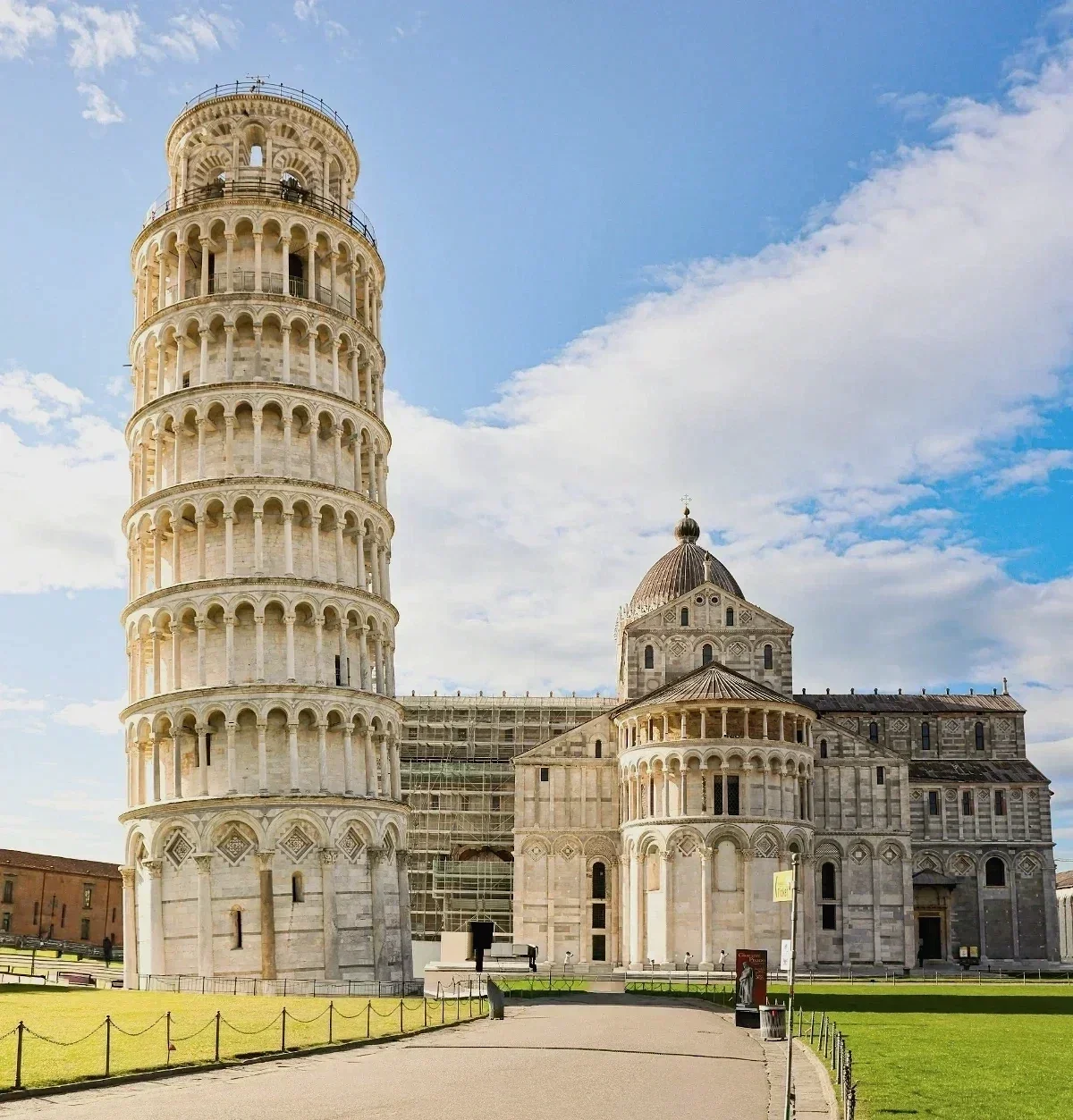
Leaning Tower of Pisa and Pisa Cathedral shining under a bright blue sky in late afternoon.
Florence, a gorgeous city nestled among Tuscan hills, feels intimate despite its cultural weight, with Renaissance churches, artisan workshops, and riverside paths compressed into a walkable bowl. Morning light gilds the green and white marble of Santa Maria Novella, while shop shutters rise on Via Tornabuoni, revealing silk ties and gold leaf frames. By afternoon, the Arno glints beneath the arches of the Ponte Vecchio, and by night, violins echo off stone façades in Piazza della Signoria. The city’s compactness invites deep attention: stand beneath Brunelleschi’s dome, and the smell of wax from devotional candles mixes with the distant clang of a blacksmith’s hammer in the Oltrarno, underscoring the continuity between historic craft and living trade.
Art pilgrimage here begins at the Duomo complex, where Santa Maria del Fiore, Giotto’s campanile, and the octagonal Baptistery form a single sculptural ensemble. The Uffizi Gallery, ten minutes on foot, unveils Botticelli’s Primavera, Michelangelo’s Tondo Doni, and rooms of Northern masters often missed by hurried visitors. Leonardo da Vinci, one of the most influential figures of the Renaissance, left a lasting legacy in Florence, and his masterpieces can be found among the city’s iconic artworks. Across the river, Palazzo Pitti’s Palatine Gallery glows with soft Baroque light, and the adjoining Boboli Gardens spread ordered terraces above cypress groves. The Accademia enshrines Michelangelo’s David and displays the unfinished Prisoners, which reveal the sculptor’s chiseling process step by step. Florence is known as the birthplace of the Renaissance and features world-class museums like the Uffizi and Accademia. A climb to San Miniato al Monte grants a quieter panorama than Piazzale Michelangelo and frames the city against distant Apennine ridges. Day excursions range from Greve in Chianti for cellar tastings of Sangiovese to Pisa, where the Leaning Tower tilts beside the marble cathedral and baptistery, forming a trio of white monuments that gleam under Tuscan sunlight.
Venice
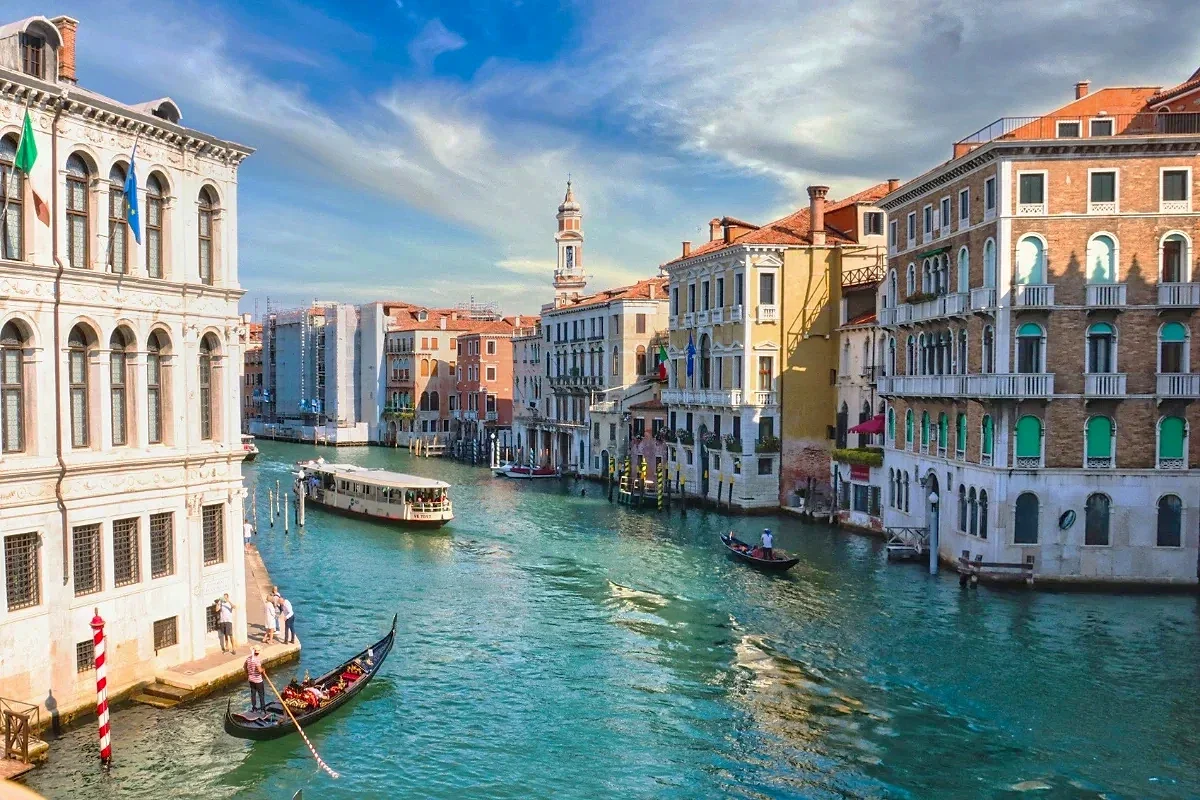
Gondola and vaporetto glide along the Grand Canal of Venice, framed by Renaissance palazzi and a bright blue sky.
Venice presents a theatrical blend of water, light, and stone, its rhythm set by the tide, inviting a more intentional pace of travel, and it remains a romantic place even during the bustle of peak season. The city wakes early: fishmongers shout prices in the Rialto Market while vaporetto pilots idle engines at wooden moorings. By noon, sunlight flickers across canal walls and climbs the façades of marble palaces whose paint has weathered into muted pastels. Sea fog sometimes drifts in by late afternoon, muffling footsteps and turning alley lamps into halos, so that even routine errands feel cinematic. Though millions visit each year, Venice retains quiet corners where laundry flutters above narrow canals and fishermen mend nets beside their front doors.
First-time visitors should reach Saint Mark’s Square at opening to view Byzantine mosaics in relative calm before ascending the campanile for a compass-like view of the lagoon. The Doge’s Palace next door narrates five centuries of maritime rule through gilded council chambers, Tintoretto ceilings, and the enclosed Bridge of Sighs. Boarding vaporetto line 1 near the piazzetta, ride the full length of the Grand Canal to Santa Lucia Station; along the route, Gothic, Renaissance, and Baroque façades alternate in a catalog of architectural history. Disembark at San Polo for the Scuola Grande di San Rocco, where Tintoretto’s canvases envelop viewers in swirling chiaroscuro. A separate day can focus on outer islands: Murano’s glass furnaces, Burano’s lace workshops and striped fishermen’s homes, and Torcello’s tenth-century cathedral whose apse mosaic reflects gold light onto worn brick. Reserve a gondola ride after dusk when lantern reflections dapple the water and the only sounds are the dip of the oar and distant church bells.
Naples
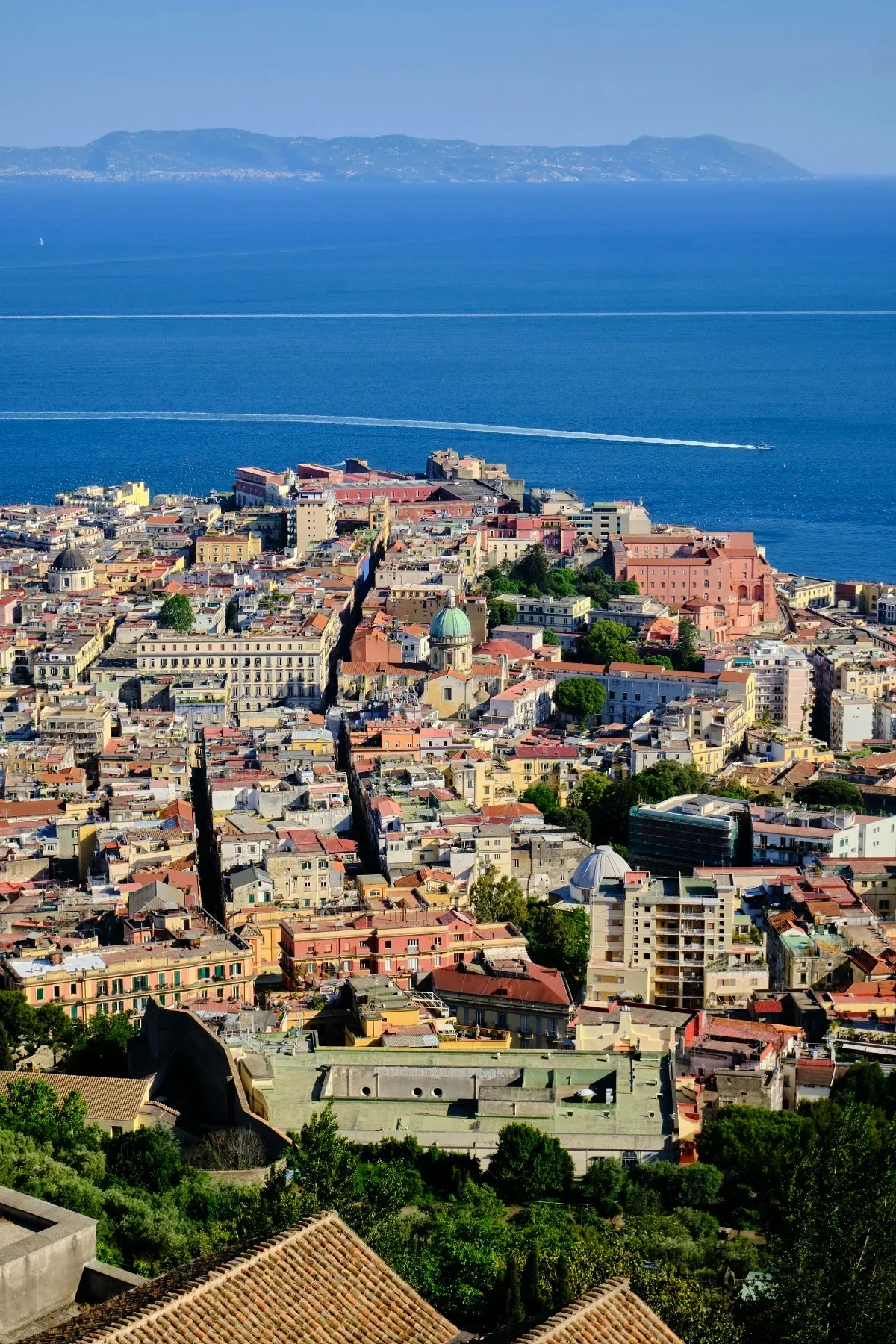
Panoramic aerial of Naples stretching to the Tyrrhenian Sea with Capri on the horizon.
Naples spreads around a crescent bay watched by the simmering cone of Mount Vesuvius, and its streets pulse with an energy that feels older than the volcanic rock beneath them. Church bells mingle with scooter horns, laundry flutters above baroque balconies, and the aroma of wood-fired pizza rises from corner bakeries that still follow recipes perfected in the Spanish Bourbon era. Marble facades sit beside street shrines lit by blue neon, and every alley seems to reveal another layer of Greek foundations, Roman arches, or Aragonese ramparts. The city’s character pairs raw immediacy with artistic grandeur, giving Naples a truly authentic feel that offers a sense of real Italian life beyond typical tourist spots, making it both a birthplace of UNESCO-listed cuisine and a living archive of Mediterranean history.
A single day can touch on many highlights. Begin in the UNESCO-protected historic center where Spaccanapoli cuts a straight line past the Gothic Church of Santa Chiara and the Baroque splendor of Gesù Nuovo. Two blocks north, the Cappella Sansevero guards the Veiled Christ, a marble illusion of gauze carved in 1753. The nearby Museo Archeologico Nazionale shelters mosaics and bronzes from Pompeii and Herculaneum, while Castel dell’Ovo and Castel Nuovo flank the waterfront with views across the bay. South of Piazza del Plebiscito, the Royal Palace of Naples displays Bourbon apartments, and the adjacent Teatro di San Carlo ranks as one of Europe’s oldest opera houses. Underground tours descend into Napoli Sotterranea, a maze of Greek quarries and World War II shelters, while the Catacombs of San Gennaro reveal frescoed tombs carved into soft tuff. Finish the day with a pizzaiolo’s Margherita in the Quartieri Spagnoli, then ride the funicular to Castel Sant’Elmo for sunset panoramas that stretch from Procida and Ischia to the darkening slopes of Mount Vesuvius. The lovely people of Naples, with their genuine warmth and lively street life, add to the city’s unique charm.
Milan
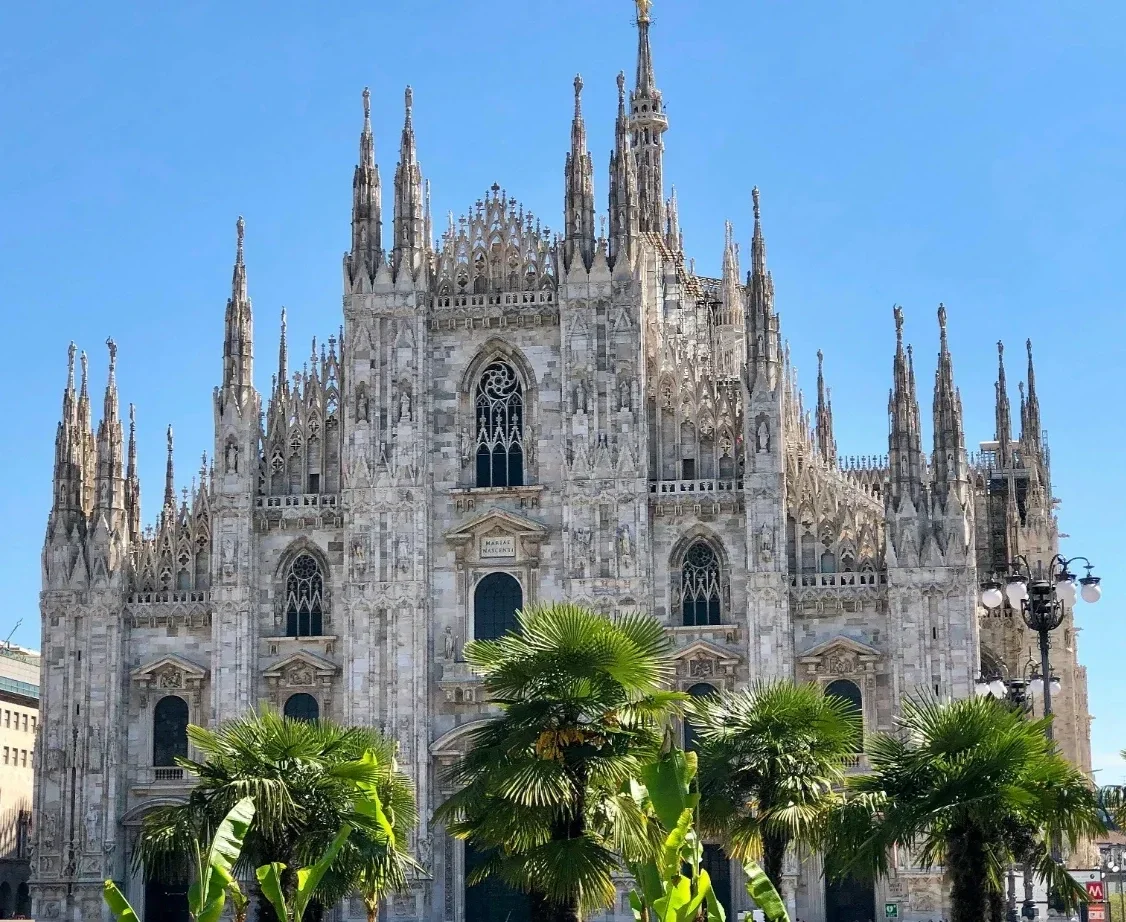
Ornate Gothic marble façade of Duomo di Milano framed by palm trees against a clear blue sky.
Milan moves at a faster cadence than most Italian cities, driven by finance, technology, and fashion. Glass towers rise beyond bastioned gates, cocktail bars share streets with Renaissance churches, and public art installations appear overnight in former factory yards. Yet history persists: the city walls still delineate the centro storico, and the marble Duomo remains the spiritual and geographic heart. At sunrise, pinnacles catch soft pink light; by midday, the piazza fills with office workers, and at twilight, the façade glows a warm ivory under floodlights while café tables clink with Aperol spritzes.
Begin beneath the cathedral’s marble vaults, then ride the lift to its terraces where carved saints gaze toward the Alps. Walk through the Galleria Vittorio Emanuele II, an 1870s arcade whose iron and glass dome shelters flagship boutiques and the historic camparino bar. A five-minute stroll leads to La Scala opera house and its museum of scores, costumes, and portraits. North of the center, the Brera district combines the Pinacoteca’s Andrea Mantegna canvases with designer showrooms and fragrance ateliers. West along the canalised Porta Ticinese, the Navigli district comes alive after sunset: galleries open late on Via Corsico, jazz filters from courtyard stages, and trattorias serve saffron risotto brightened by marrowbone. Secure Last Supper tickets at Santa Maria delle Grazie months ahead; only 15 minutes are allotted per viewing, though the quiet contemplation justifies the planning. High-speed trains place Lake Como or Verona within an hour, allowing visitors to balance metropolitan energy with a lakeside or medieval-town interlude.
Bologna
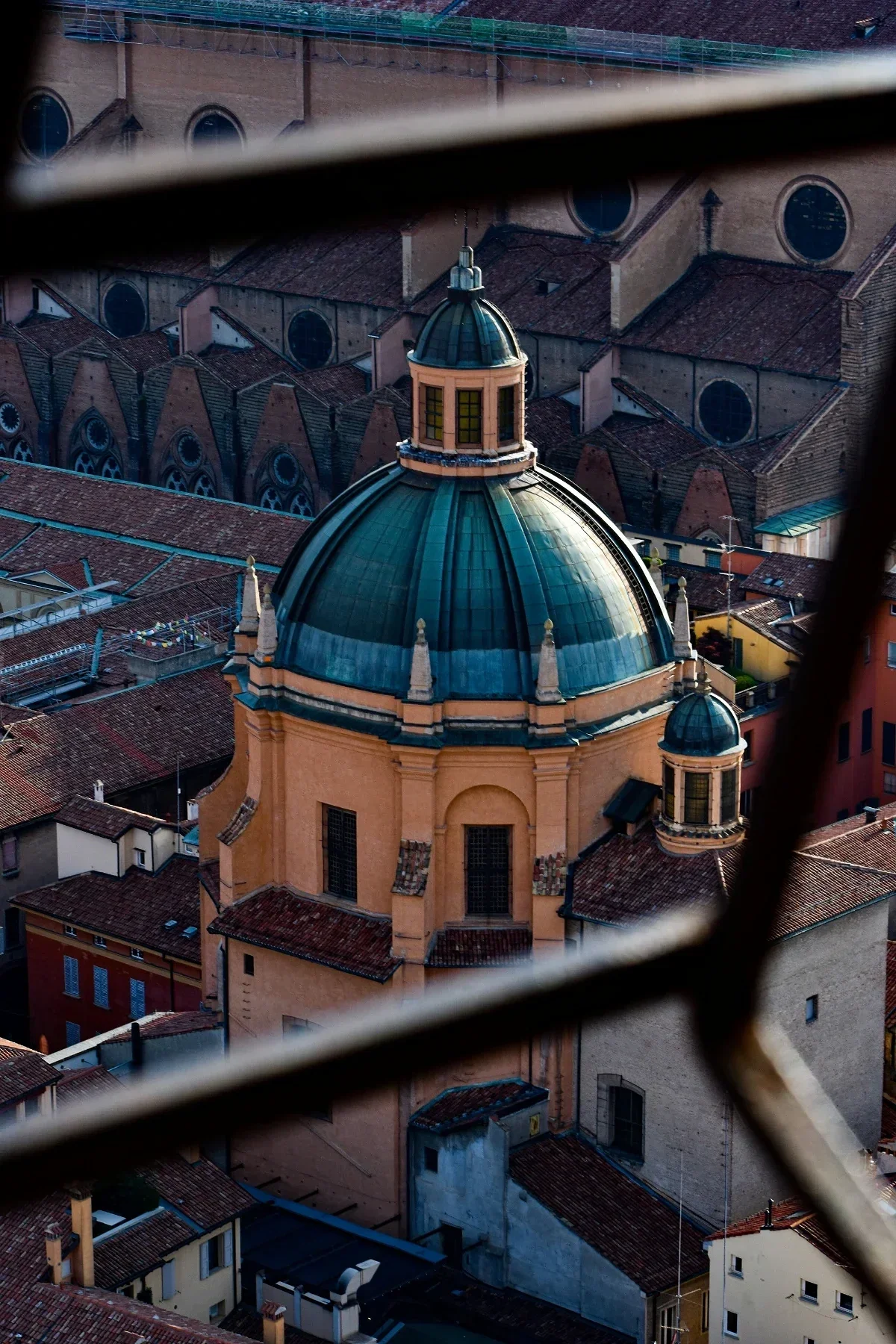
Latticed viewpoint over terracotta rooftops to a teal-green church dome crowning historic Bologna.
Bologna exudes warmth, from the red earth in its bricks to the generosity of its cuisine. Forty kilometers of porticoes shield pedestrians from summer heat and winter drizzle, connecting medieval towers to Renaissance libraries in a covered promenade unmatched in Italy. Students from the world’s oldest university enliven street corners with guitars and open debates, and the aroma of simmering ragù drifts through shuttered windows in late afternoon. Twilight tints terracotta roofs a deeper crimson, and the city’s nickname, La Rossa, seems as much about atmosphere as color.
Orientation starts in Piazza Maggiore, bordered by the Gothic Palazzo d’Accursio and the vast, unfinished façade of San Petronio Basilica. From here, Via Rizzoli leads toward the twin towers, Asinelli and Garisenda; climbing the former rewards visitors with a panorama that spans cathedral domes to distant Apennines. Descend into the Quadrilatero market where butchers hang mortadella, cheesemongers split Parmigiano wheels, and stalls display tortellini hand-folded each morning. Museums include the Archiginnasio with its seventeenth-century anatomy theater, MAMbo for contemporary art, and the Ducati motorcycle museum just outside town. Evenings center on food: tagliatelle ribboned with ragù arrives glossy and rich, tortellini float in capon broth, and crescentine fried breads accompany cured meats and fizzy Lambrusco along Via del Pratello. Film festivals light Piazza Maggiore each July, and portico walks continue into the night, proving that Bologna balances scholarly tradition with a street-level liveliness that invites visitors to linger.
Most Beautiful Places Off The Beaten Path
Matera
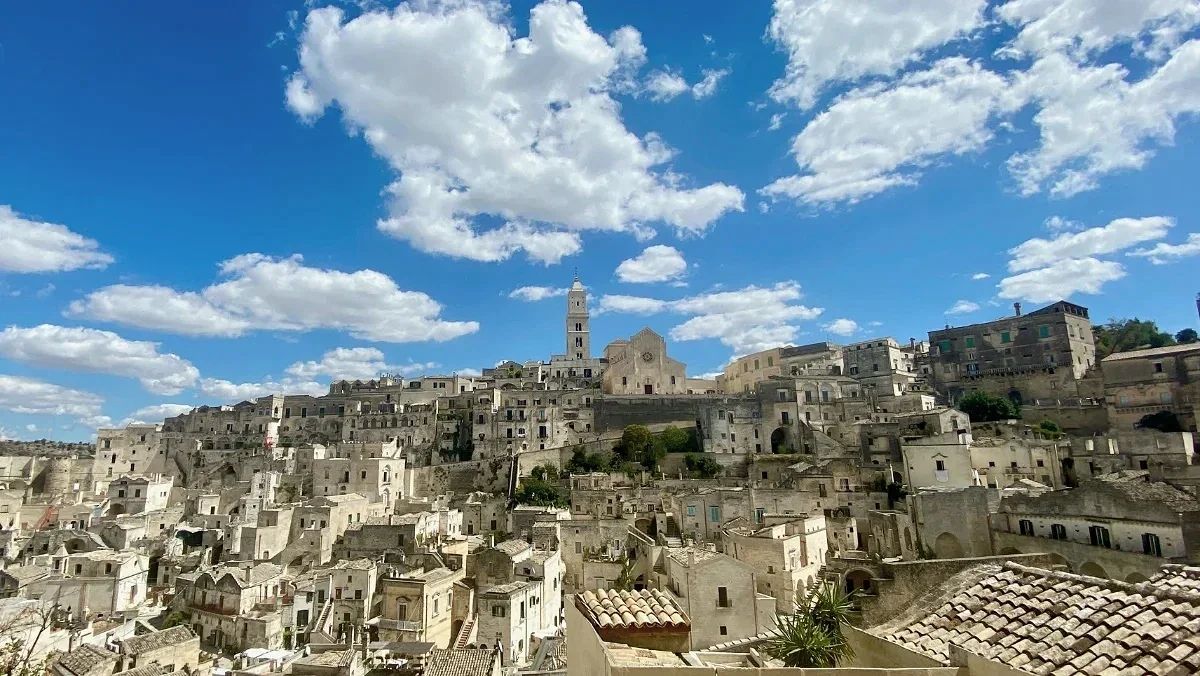
Sunlit stone Sassi cave homes and cathedral tower shape Matera skyline beneath a vivid blue sky.
Carved into the chalk ravines of Basilicata, Matera’s Sassi districts present a labyrinth of grotto houses, rock-hewn stairways, and cave churches whose faded frescoes recall the reach of Byzantine monks. Sunset turns the pale tuff a deep amber, lanterns appear along balcony ledges, and the ravine below echoes only with owl calls, an atmosphere unlike any other in southern Italy. UNESCO recognition has spurred discreet restoration, so visitors can now sleep in vaulted cave suites, taste Aglianico poured beside stone ovens baking pane di Matera, and follow guided routes that descend to the rock crypt of Santa Maria di Idris before climbing again to panoramic terraces above the Gravina River.
Alberobella and the Valle d'Itria
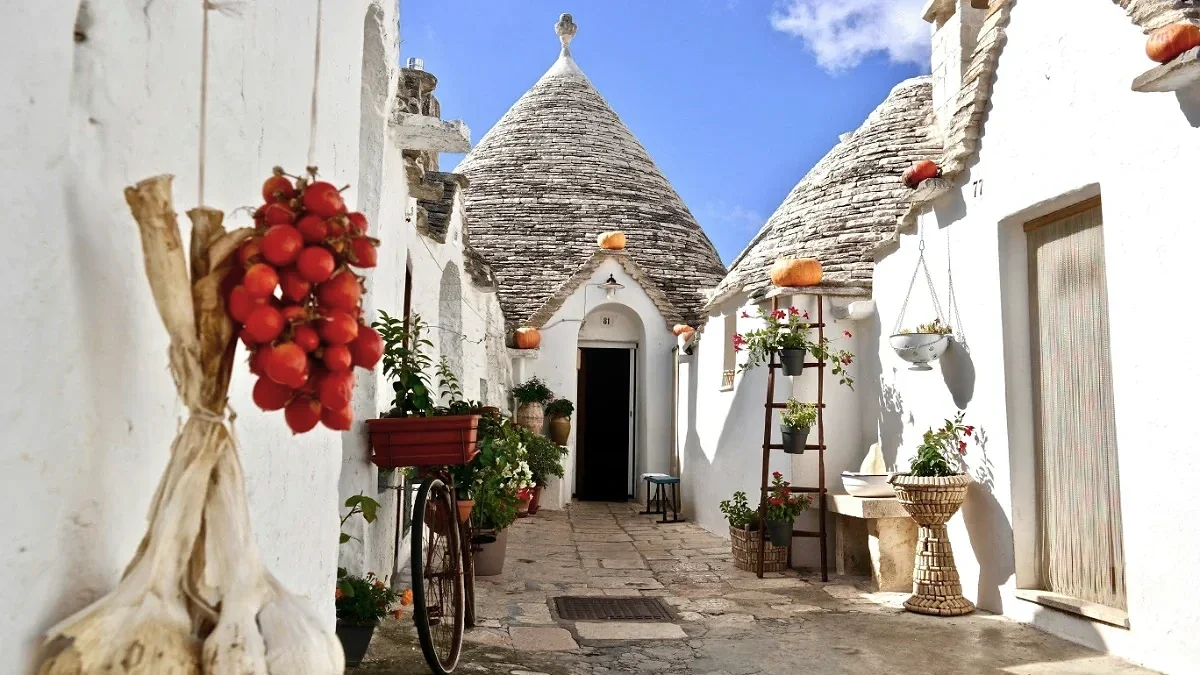
Whitewashed trulli in Alberobello line a sunny lane, garnished with hanging tomatoes, pumpkins and potted flowers.
Fifty miles east, the Valle d’Itria rolls into orderly vineyards and olive groves punctuated by dry-stone walls. Alberobello anchors the valley with nearly two thousand trulli, whitewashed, conical-roofed cottages protected as a UNESCO World Heritage Site. Walking the Rione Monti district feels like stepping into an architectural fairy tale: pinnacles bear pagan or Christian symbols, smoke curls from rooftop chimneys, and courtyards overflow with pots of geranium. Nearby villages such as Locorotondo and Martina Franca share the same limestone and the same slow rhythm, serving orecchiette pasta dressed in tomato and basil at midday when shutters close against the Apulian sun.
Puglia
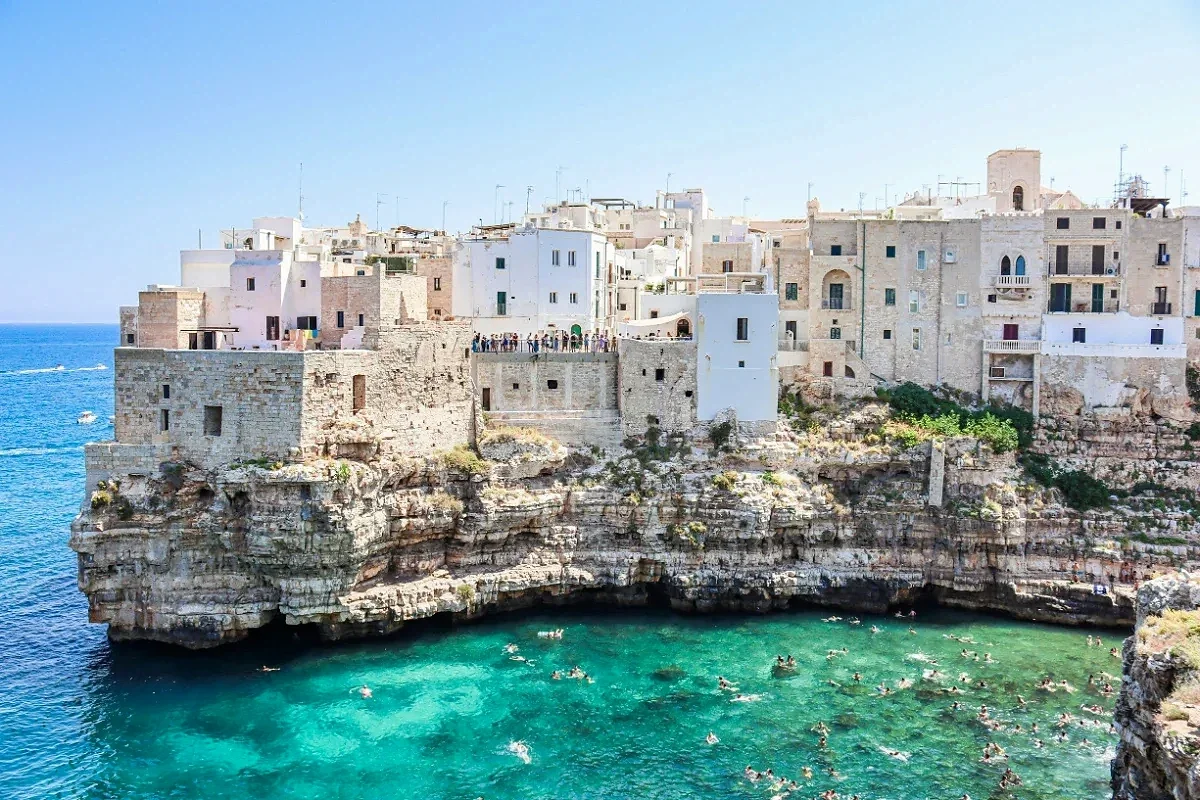
Cliff-top white stone houses of Polignano a Mare overlook swimmers in the clear turquoise Adriatic.
Puglia spans the sun-drenched heel of the Italian boot, a long ribbon of limestone pressed between the Adriatic and Ionian seas. Gargano’s forested promontory drops to pebbled Adriatic coves, while farther south the Salento peninsula alternates white-sand Ionian beaches with cliffs where turquoise water surges into grottoes. Inland, cone-roofed trulli cluster around Alberobello, and dry-stone walls divide vineyards from wheat fields speckled in spring with red poppies. Lecce earns its “Florence of the South” nickname through exuberant façades festooned with cherubs and vine scrolls, whereas Ostuni, the White City, gleams at sunset above endless rows of gnarled olive trees. Kitchens showcase bruschette rubbed with just-pressed oil, orecchiette tossed in tomato and basil, and burrata so fresh its cream still trembles inside the pouch. Paired with crisp Primitivo or mineral-bright Verdeca, these flavors confirm Puglia’s appeal as a region where simple ingredients and coastal light shape an experience distinct from the country’s better-known north.
The Dolomites
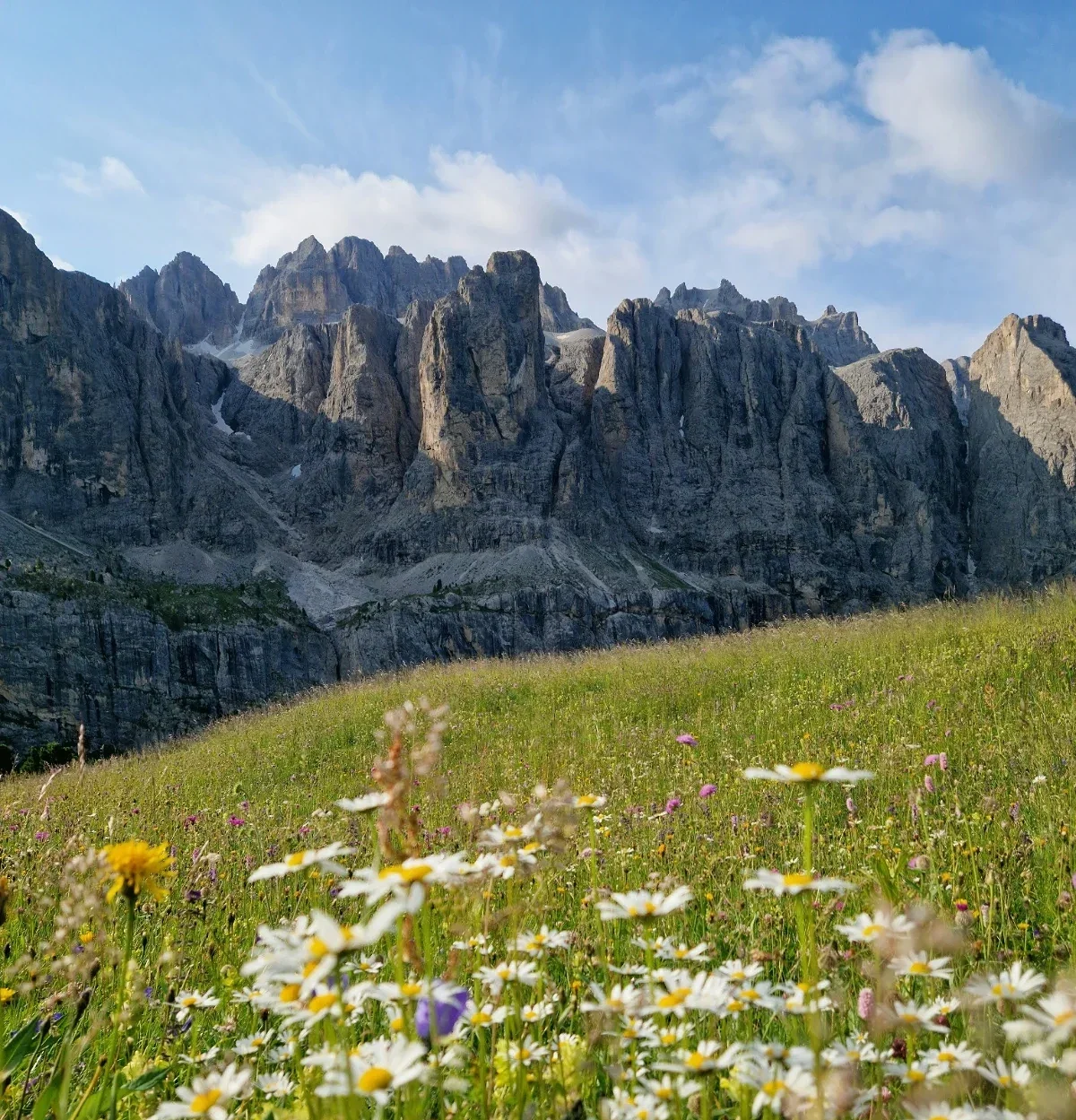
Daisies sway in a summer alpine meadow below the jagged limestone peaks of the Dolomites.
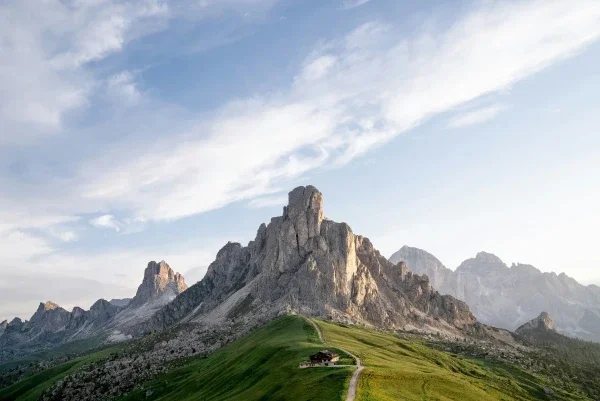
In the far north, the Dolomites rise in serrated limestone spires that glow pink at dawn and dusk, a phenomenon locals call enrosadira. Summer hikers tackle the Tre Cime di Lavaredo loop, crossing World War I tunnels and alpine meadows dotted with edelweiss before pausing in rifugi for polenta crowned with mushroom ragù. Winter drapes the same crags in powder; skiers link perfect arcs along the Sella Ronda circuit while ice climbers ascend frozen waterfalls that crack under morning sun. Villages such as Ortisei and Cortina blend Tyrolean carvings with Italian trattorie, proving the range’s multicultural weave. Whether viewed from a cable-car window or a high-altitude terrace with steaming bombardino in hand, the Dolomites confirm how much dramatic diversity fits inside this beautiful country.
The Italian Way: Food and Culture
Italian cooking evolved through layered periods of influence: Roman patricians simmered garum and honeyed dormice, Arab traders later introduced citrus and durum wheat that reshaped southern breads, and Renaissance courts in Florence and Ferrara codified banquet etiquette while diffusing new world tomatoes and corn across the peninsula. Unification in 1861 encouraged regional dishes to travel, so Neapolitan pizza left Naples for Turin factory canteens, Bolognese ragù crossed the Apennines in railway dining cars, and Milanese risotto alla saffron joined Venetian seafood risotti on early cook-tourism menus. Today visitors pursue Parmigiano wheels tapped in Parma warehouses, Ligurian pesto ground with marble mortar, Roman cacio e pepe spun from three pantry staples, and tiramisù that restaurant owners in Treviso began serving only in the 1960s. Gelato parlors count fruit provenance on blackboards, and espresso bars calibrate roasting curves with the precision of watchmakers, proving that historic depth coexists with constant innovation.
Italian culture extends beyond the plate yet keeps the same attention to craft and tempo. Streets stage nightly passeggiate where families and friends trade news rather than calories burned, piazzas serve as outdoor living rooms furnished with stone benches and Renaissance fountains, and artisans from Murano glassblowers to Umbrian cashmere weavers train apprentices for years before signing work. Public holidays foreground community: Venice’s Redentore fireworks commemorate plague deliverance, Siena’s Palio merges civic pride with medieval pageantry, and Palermo’s Feast of Saint Rosalia threads baroque floats through Arabic-planned lanes. Conversation values measured rhetoric and wit; silence often signals contentment rather than awkwardness, and personal space yields easily to affectionate greetings. Whether you watch nonnas folding tortellini in Bologna’s Quadrilatero or orchestras tuning beneath Verona’s Roman arches, the shared priority remains celebrating beauty in skillful effort and allowing time, la dolce vita, to register every shade of it.
How To Visit Italy
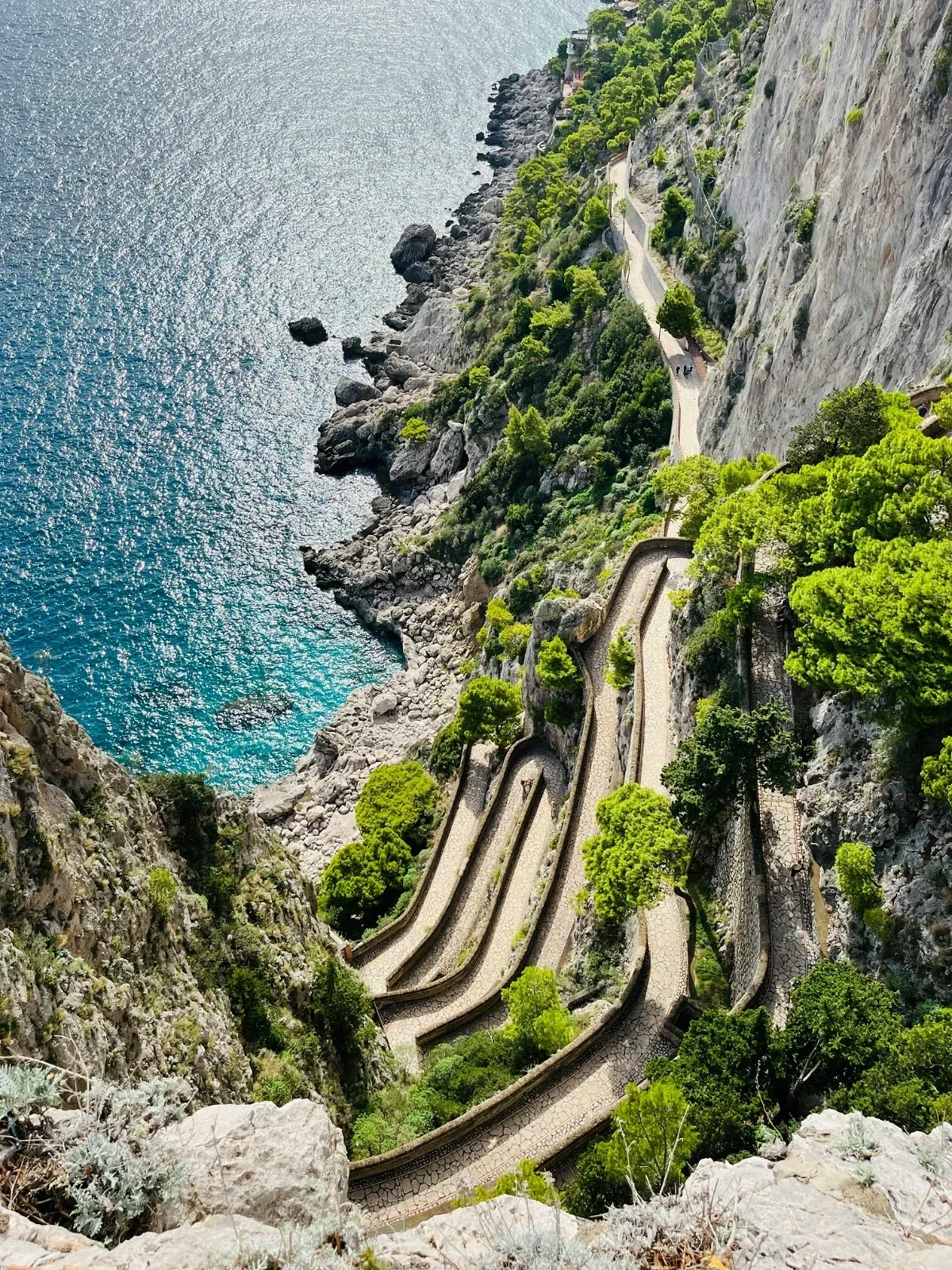
Aerial view of serpentine Via Krupp descending Capri’s limestone cliffs beside sparkling turquoise water on Capri.
April through June and September through October offer mild weather and shorter queues at landmarks. These shoulder seasons are the best time to visit Venice, Florence, and Rome because the heat is gentle and airfare is reasonable. High-speed Frecciarossa trains link great cities within hours, while InterCity lines reach towns that time almost forgot. Ferries serve the Amalfi Coast and the Aeolian archipelago. Hydrofoils ripple Lake Como every half hour. Renting a car unlocks Tuscan byroads, remote white sand beaches in Calabria, and olive labyrinths in Puglia, but drivers should watch for Zona Traffico Limitato cameras posted at historic gates. Paper tickets need validation in yellow machines before boarding trains. Coins still operate parking meters in hill towns. Travel insurance that covers volcanic ash is sensible after eruptions a few years ago. Booking Vatican Museums, Uffizi, or Last Supper slots online weeks ahead guards daylight for wandering. Staying in the town center gives easy access to cafés, old town markets, and evening strolls. A second trip might focus on small islands such as Elba or Maddalena, where turquoise waters wash granite capes.
Lasting Impressions
Italy rewards travelers who rise early enough to hear bells ripple across vacant piazzas and who linger past midnight to savor gelato flavored with Sicilian pistachios beneath lamplight. Lemon terraces glitter above the Amalfi Coast, Lake Como reflects snowy peaks under a waxing moon, and Dolomite ridges cradle an alpenglow that flushes limestone pink. Each scene becomes a thread in a tapestry woven through centuries of work, faith, and celebration.
Return after a few seasons and the country offers fresh layers: truffle hunts in misty Umbrian hills, volcanic vineyards on Etna’s black slopes, or an autumn sail across the Venetian lagoon while reeds rustle like parchment. The lessons endure. Patience invites discovery, savoring magnifies joy, and respect for craft transforms ordinary mornings into quiet celebrations of la dolce vita. Carry that Italian way home, and every meal, conversation, and journey will gain deeper flavor.
Related Posts