Discovering Modernist Furniture: Timeless Designs for Every Space
Last updated April 2, 2026
Modernist furniture unites form and function, refining each piece to its most purposeful shape. Forged in Bauhaus studios during the industrial revolution, designers traded carved ornament for tubular steel, bent plywood, and hand-stitched leather. Mid-century modern furniture further softened this furniture design style with tapered legs and organic curves, letting warm wood grain temper the cool precision of metal. Every piece champions clarity of purpose, encouraging easy movement through uncluttered space and proving that practicality can still stir subtle delight.
The foundational ideas of modernist furniture - simplicity, function, and innovation - continue to shape contemporary design, influencing how designers approach materials, forms, and the purpose of each piece. Today, the story continues. Designers pair reclaimed oak with 3-D-printed joints, weave recycled PET into sculptural lounge seats, and revisit mid-century classics through a sustainable lens. That founding principle endures while function leads, and beauty earns its place through daily application.
Some links in this post are affiliate links. That means we may earn a small commission, at no additional cost to you.


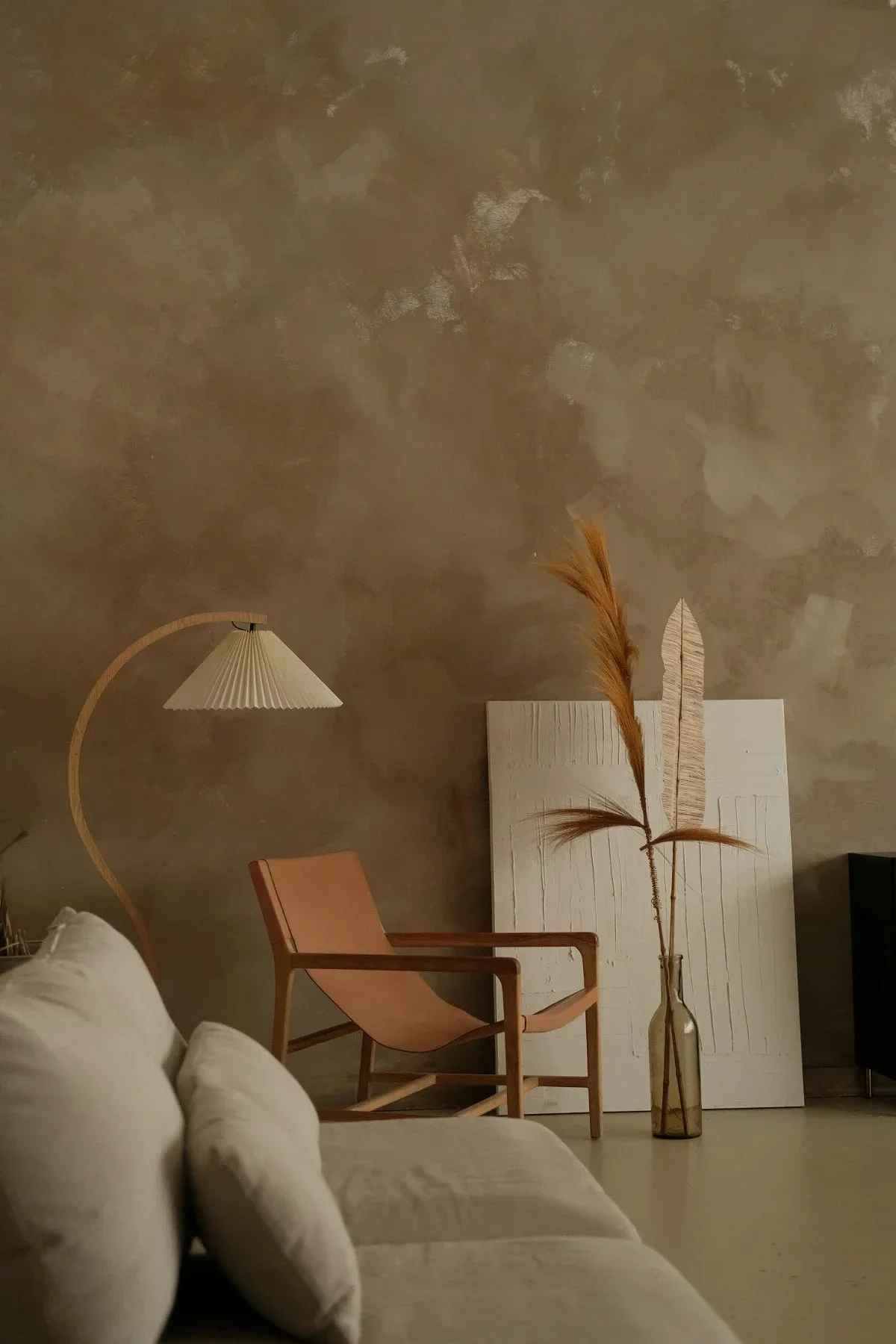
Earth-toned living space with tan leather sling chair, pleated arc floor lamp and dried grasses against a textured khaki wall.
Introduction to Modernist Furniture
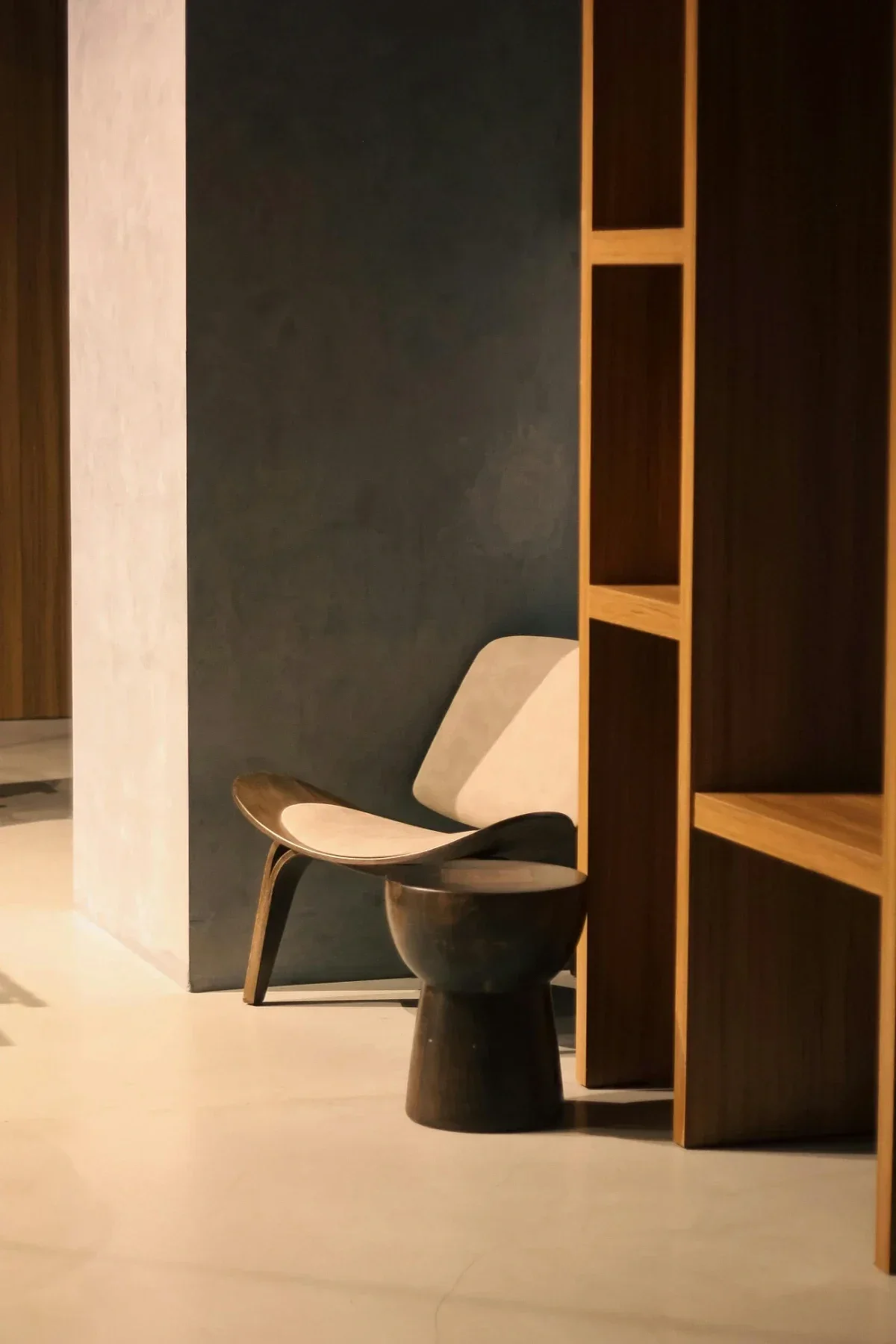
Cozy alcove featuring a low sculptural lounge chair with cream cushion, dark wood stool and built-in shelving.
Modernist furniture design emerged in the early twentieth century, shaped by the Industrial Revolution and a decisive shift in how objects were conceived and produced. As manufacturing advanced, designers began to reject the ornate, historically derived styles that had dominated the nineteenth century, turning instead toward clarity, efficiency, and purpose. The Bauhaus school crystallized this transition, establishing a framework where clean lines, functional forms, and the innovative use of materials such as steel, glass, and molded plywood defined a new aesthetic. Furniture was no longer designed for decorative purposes, it became an exercise in precision.
This new approach was further reinforced by movements such as De Stijl, which reduced design to its most essential elements, geometry, proportion, and controlled use of colour. At the same time, advances in industrial techniques made it possible to experiment with tubular steel, cantilevered structures, and lightweight forms that felt radically different from the heavy, carved furniture of the past. Designers such as Le Corbusier and Marcel Breuer, trained as architects, applied structural thinking to furniture, creating pieces that echoed the logic of modern buildings.
At its core, modernist furniture is defined by a disciplined balance between form and function. It prioritises usability, material honesty, and construction integrity, ensuring that each piece integrates seamlessly into the way a space is lived in. As the movement evolved, mid century modern furniture introduced a softer, more organic interpretation - tapered legs, curved silhouettes, and the warmth of natural wood, leather, and metal - without abandoning the underlying principles. Today, contemporary furniture design continues to build on this foundation, incorporating new materials and technologies while remaining grounded in the same ethos. Modernist furniture, therefore, is not simply a historical style but an enduring design philosophy, one that continues to shape how furniture is made, experienced, and understood in modern interiors.
Origins and Principles
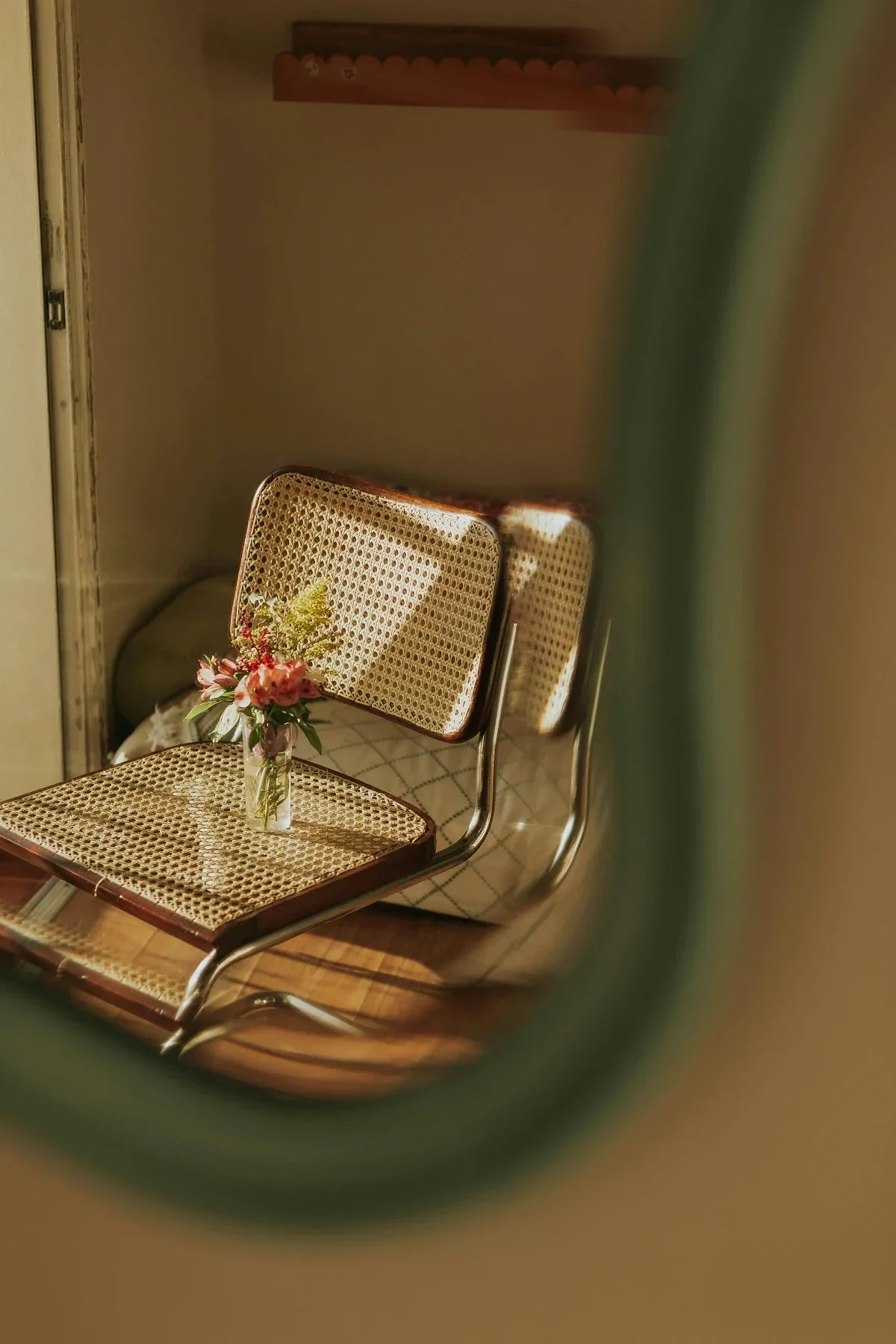
Chrome-framed cane chair seen through mirror reflection; sunlight highlights a small bouquet resting on the seat.
Modernist furniture design took shape at the intersection of industrial advancement and a broader cultural shift toward rational thinking in the early twentieth century. As cities expanded and lifestyles changed, interiors transformed into living spaces that needed to support efficiency, movement, and daily use. Designers began to question not just how furniture looked, but why it existed in its current form. This marked a fundamental departure from tradition, where historical reference had long dictated design. Instead, modernist furniture was conceived through logic, proportion, and purpose.
Central to this evolution was the influence of industrial production, particularly in early twentieth-century Europe, where designers began working directly with manufacturers to create furniture that could be efficiently produced without reliance on traditional craftsmanship. The ability to manufacture at scale introduced new constraints and opportunities, forcing designers to simplify forms and eliminate unnecessary detail. Furniture needed to be repeatable, structurally sound, and materially efficient. This led to a design language where construction became visible rather than concealed, and where materials were used for their inherent properties rather than decorative effect. Steel was not treated to resemble something else; it was left exposed to express strength and precision. Wood was shaped for its structural capacity, not carved for ornament.
The principles that emerged from this period remain foundational. Simplicity was a disciplined reduction to what was essential. Function dictated form, ensuring that every element served a clear purpose within the object and the space it occupied. Proportion and balance became critical, allowing furniture to sit comfortably within increasingly open-plan interiors. Accessibility also played a role, as designers sought to create pieces that could be produced efficiently and used widely, rather than reserved for a privileged few. What defines modernist furniture, then, is not only how it appears, but how it is resolved. It is the outcome of a design process rooted in clarity, material honesty, and structural logic. These principles established a framework that continues to inform modern furniture design today, shaping pieces that are efficient, enduring, and intrinsically aligned with the way contemporary spaces are lived in.
Key Movements and Influences
The Bauhaus
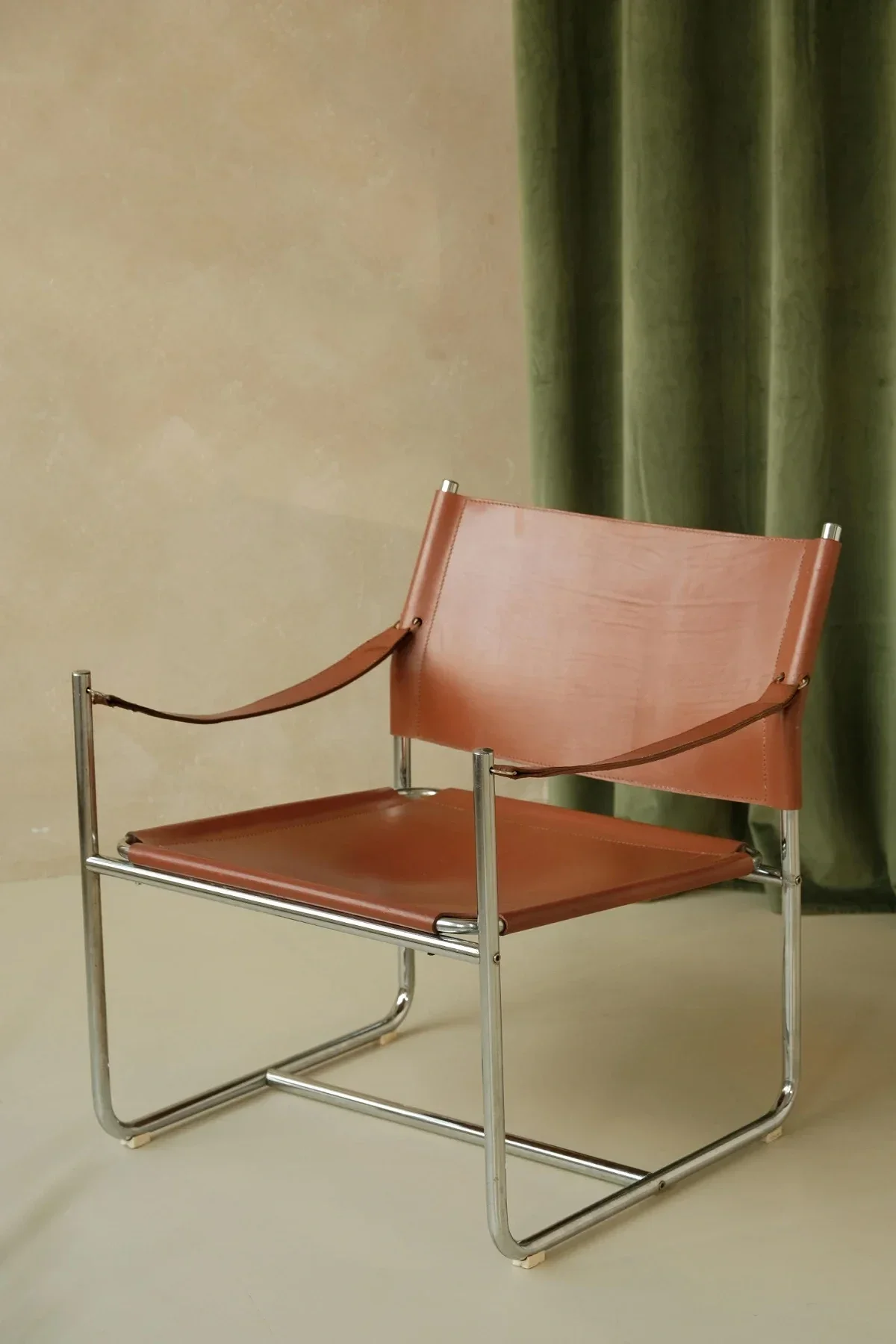
Vintage brown leather sling chair on chrome frame set against a textured wall and green velvet curtain backdrop.
The Bauhaus, founded in 1919 in Germany, stands as the most influential force behind modernist furniture design. It established a unified approach that brought together art, craft, and industry, redefining how furniture was designed, produced, and understood. At its core was the belief that design should be functional, accessible, and suited to modern life, principles that directly shaped the evolution of modern furniture design.
Rather than treating furniture as decorative objects, Bauhaus designers approached each piece as a problem of structure and use. Forms were reduced to their essentials, resulting in clean lines, geometric clarity, and a complete absence of unnecessary ornamentation. Materials such as tubular steel, glass, and plywood were embraced not only for their durability, but for their ability to be mass-produced with precision. This marked a significant departure from traditional craftsmanship, positioning furniture within an industrial context while maintaining a high level of design integrity.
Equally important was the Bauhaus emphasis on standardisation and repeatability. Furniture was designed to be produced efficiently and used widely, aligning with a broader social aim of making well-designed objects accessible beyond elite circles. This framework established the foundation of modernist furniture, where form follows function, materials are used honestly, and design responds directly to the conditions of contemporary life.
Art Nouveau
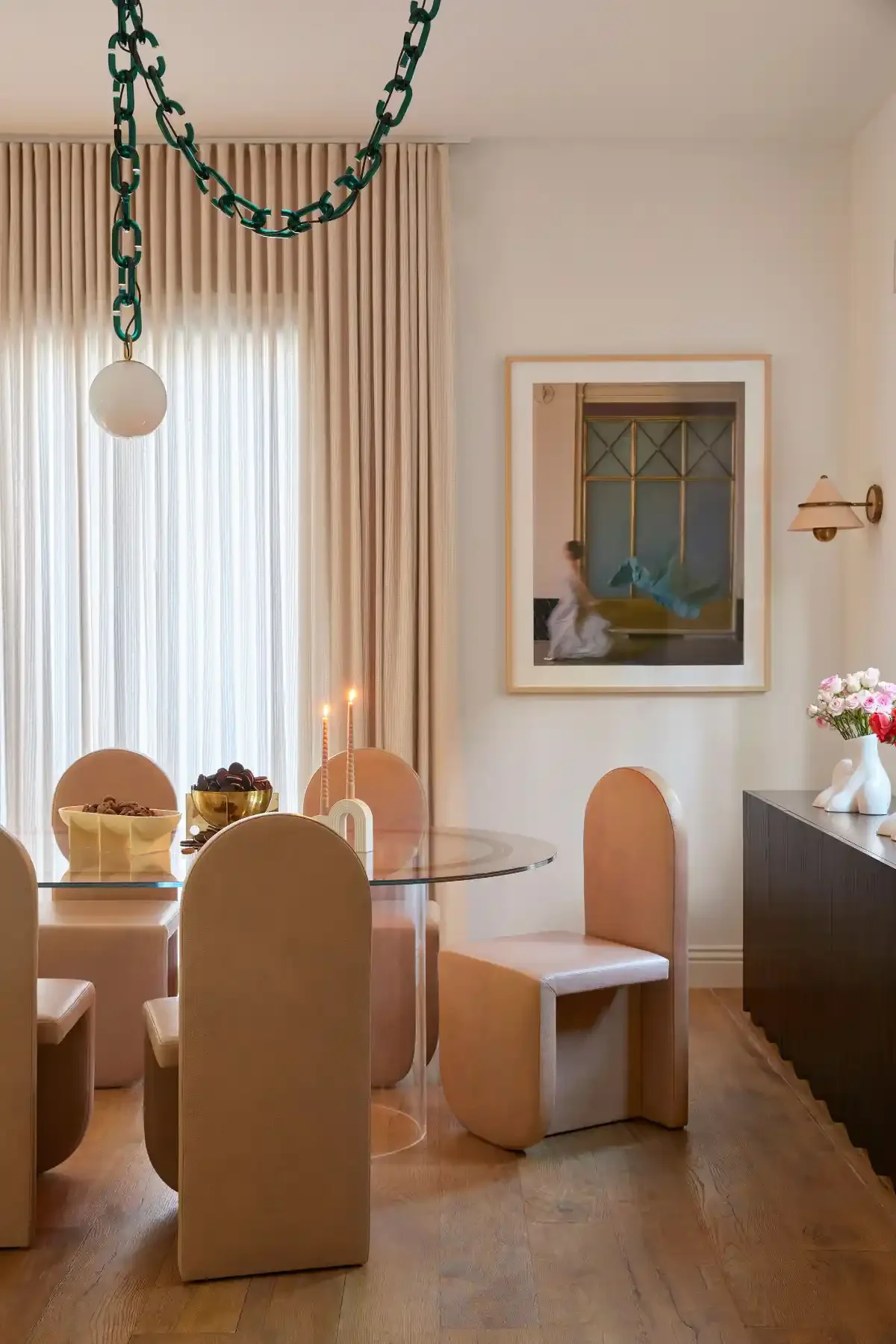
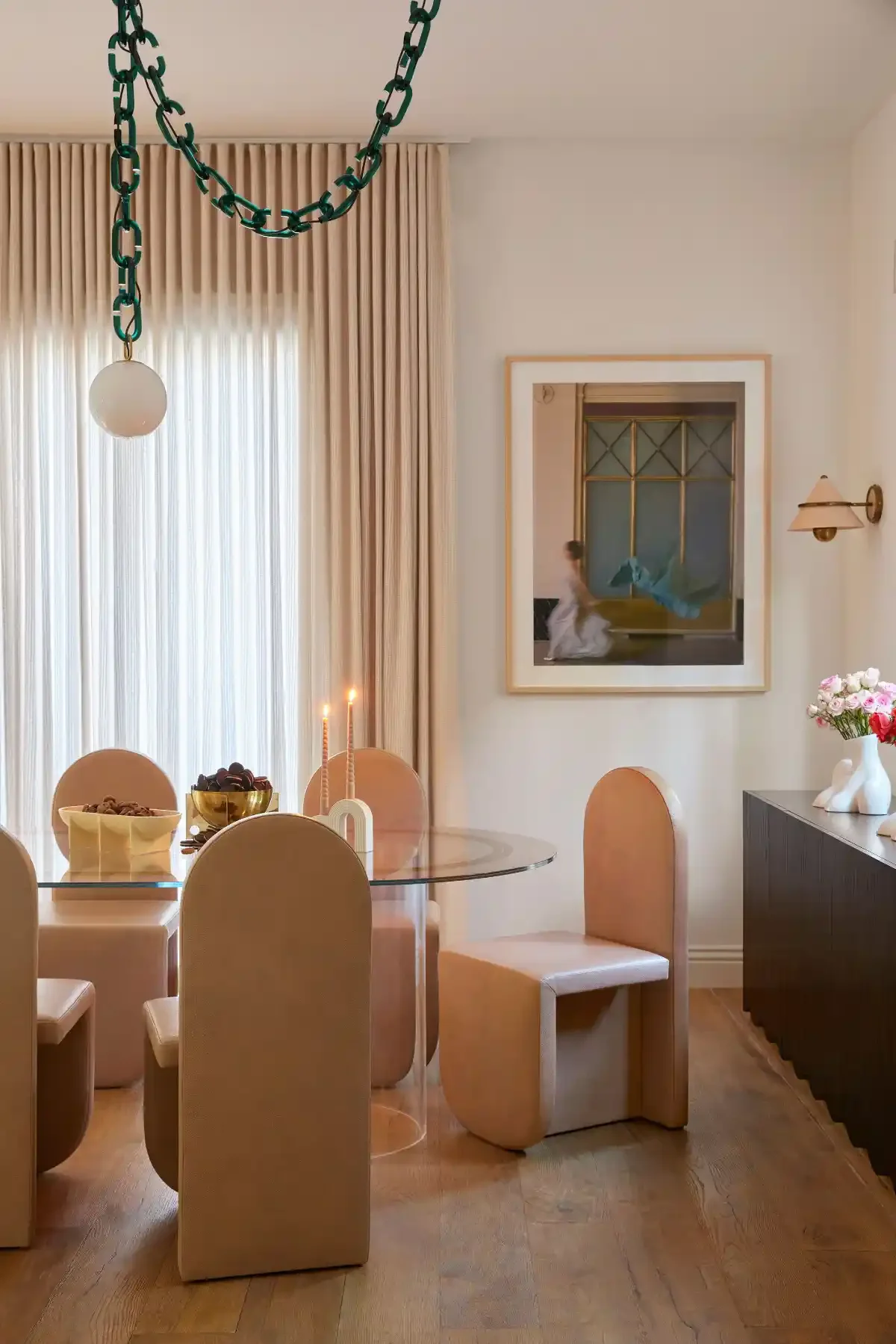
Warm contemporary dining space with camel leather chairs, glass table, green chain pendant and soft drapery light.
Art Nouveau emerged at the turn of the twentieth century as one of the first movements to break away from rigid historical styles, laying important groundwork for modernist thinking. Defined by its flowing lines, organic forms, and references to nature, Art Nouveau sought to create a total work of art where architecture, interiors, and furniture were conceived as a unified whole. While visually decorative, it introduced a crucial shift: designers began to move away from imitation of past eras and instead explored original forms shaped by structure and material.
Advances in industrial techniques played a key role in this development. Bentwood, wrought iron, and early glasswork allowed designers to experiment with fluid, continuous lines that could not have been achieved through traditional craftsmanship alone. Furniture became more integrated, often designed to fit specific spaces rather than exist as standalone objects. Although modernist designers would later reject Art Nouveau’s ornamentation, they retained its emphasis on innovation, material exploration, and the idea that design should reflect its time.
In this sense, Art Nouveau can be understood as a transitional movement, bridging decorative tradition and modernist clarity. It challenged convention, expanded the possibilities of industrial production, and set the stage for a more disciplined approach to form that would define modernist furniture.
De Stijl
De Stijl, a Dutch movement founded in 1917, introduced a radically reduced approach to design that had a lasting influence on modernist furniture. Rooted in abstraction, it sought to express harmony and order through the use of straight lines, right angles, and a limited palette of primary colours. Furniture was no longer decorative but conceptual, constructed as a composition of planes and structure rather than surface detail.
Designers such as Gerrit Rietveld translated these principles into three-dimensional form, most notably through the Red and Blue Chair. This piece exemplified the De Stijl philosophy, breaking furniture down into intersecting elements that appeared almost architectural in their clarity. Each component was visually distinct, reinforcing the idea that structure itself could define the aesthetic.
While De Stijl furniture was often more experimental than widely practical, its influence on modernist design was profound. It reinforced the importance of reduction, proportion, and spatial balance, encouraging designers to strip objects back to their most essential elements. These ideas carried forward into broader modernist furniture design, where simplicity and structural clarity became defining characteristics.
Mid Century Modern
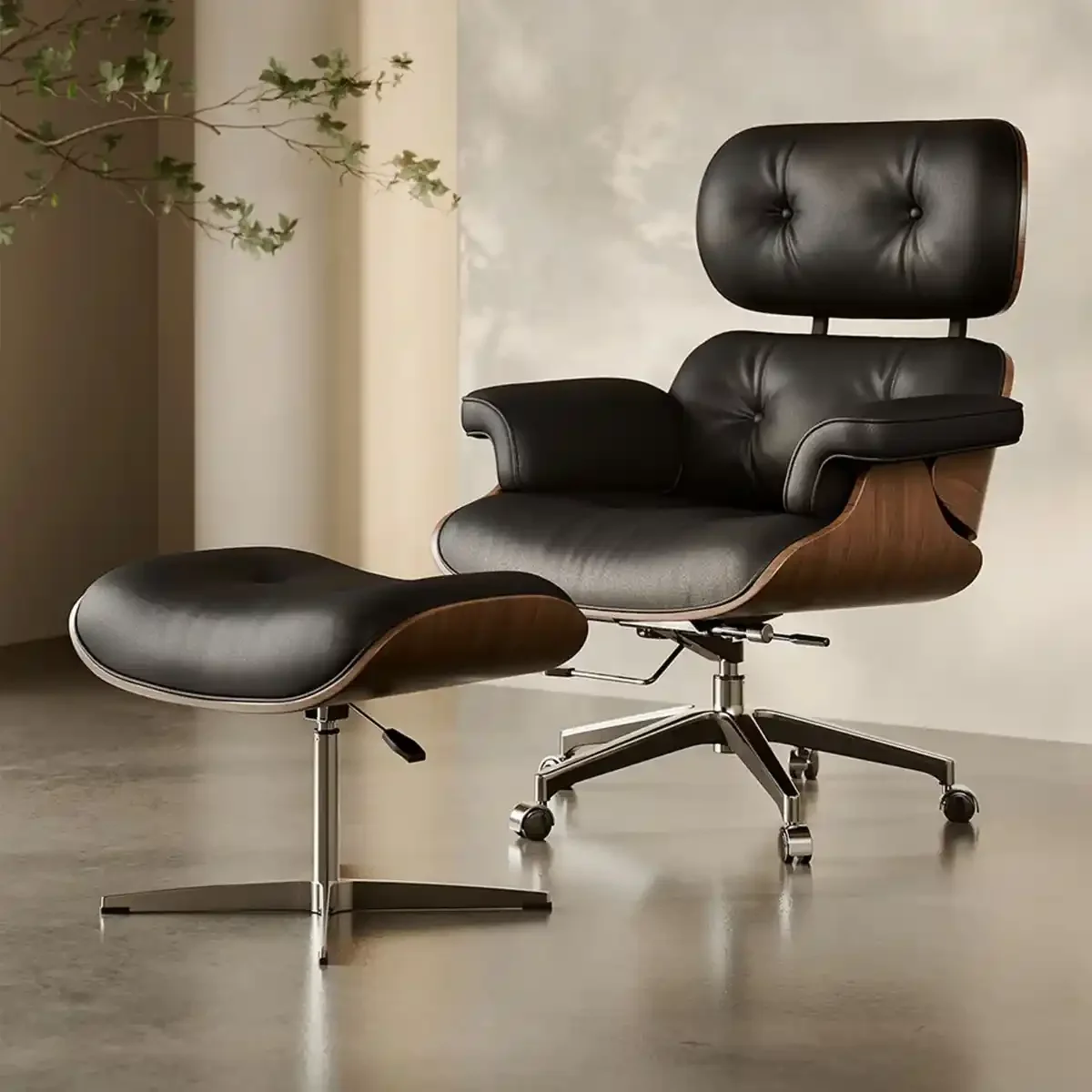
Mid-century Eames lounge chair in black leather with matching walnut ottoman.
Mid-century modern furniture emerged in the 1940s and 1950s as a natural progression of modernist principles, shaped by post-war reconstruction, technological advancement, and a growing emphasis on accessible design. As economies recovered and suburban living expanded, there was a clear demand for furniture that was not only functional but adaptable to smaller, more informal interiors. Designers responded by refining modernist ideals into forms that felt lighter, more approachable, and closely aligned with everyday life. Mass production became more sophisticated during this period, allowing high-quality furniture to reach a broader audience without sacrificing design integrity.
At the centre of this movement were designers such as Charles and Ray Eames, Eero Saarinen, and George Nelson, who explored new materials including molded plywood, fiberglass, and aluminium. These materials enabled fluid, organic shapes that moved away from rigid geometry while maintaining structural precision. The Eames lounge chair exemplifies this approach, combining an ergonomically contoured seat with molded wood and leather to create a piece that balances comfort, craftsmanship, and industrial innovation. Similarly, Saarinen’s pedestal tables eliminated the visual clutter of multiple legs, introducing a more seamless and sculptural form into dining and living spaces.
The defining characteristics of mid-century modern furniture - tapered legs, low profiles, and minimal ornamentation - reflect a continued commitment to functionality and clarity. Yet what distinguishes this period is its ability to introduce warmth into modernist design. Natural materials such as wood and leather were used for their ability to soften interiors and create a sense of ease. Open-plan living further influenced these designs, with furniture scaled to maintain visual flow and support more relaxed, social environments.
Today, mid-century modern furniture remains one of the most enduring expressions of modern design. Its balance of innovation, accessibility, and craftsmanship continues to inform contemporary furniture design, where clean lines meet organic form and practicality is elevated through considered detail.
Scandinavian Design

Scandinavian dining nook featuring a pale-oak chair beside a small round table with tray, mug and single-stem vase.
Scandinavian design emerged in the mid-twentieth century as a regional interpretation of modernist principles, distinguished by its emphasis on warmth, craftsmanship, and human-centred design. While it adopted the clean lines and functional approach of modernism, it softened these elements through the use of natural materials, organic forms, and a deep respect for traditional woodworking techniques.
Designers in Denmark, Sweden, and Finland worked extensively with wood, particularly teak and oak, shaping it into fluid, tactile forms that balanced precision with comfort. Furniture was designed not only to be functional, but to enhance daily living through thoughtful detail and material quality. Unlike the more industrial aesthetic of earlier modernism, Scandinavian design prioritised approachability, creating interiors that felt both refined and inviting.
Accessibility remained central to this movement. Scandinavian furniture was designed to be practical, durable, and widely available, aligning with broader social values of equality and well-being. This resulted in pieces that integrated seamlessly into everyday life, supporting open-plan living and informal spaces without sacrificing design integrity.
Today, Scandinavian design continues to influence contemporary furniture design, demonstrating how modernist principles can be adapted to create environments that are both functional and deeply comfortable.
Influential Designers

Lone black Wassily chair bathed in diagonal window-light shadows in a sparse white studio.
At the heart of modernist furniture design stand architects who treated chairs and tables as extensions of their buildings. Ludwig Mies van der Rohe distilled that vision into the Barcelona Chair, a stainless-steel frame with a hand-tufted leather cushion, an enduring symbol of simplicity, functionality, and innovative materials that still anchors modern furniture design. Notably, the Barcelona Chair was dedicated to the Spanish royal families, underscoring its cultural and historical significance. Irish polymath Eileen Gray bent tubular steel and glass into sculptural forms that feel weightless yet deliberate. At the same time, Swiss-French master Le Corbusier paired chrome with plush leather to prove that rigorous geometry could invite genuine comfort.
The Bauhaus circle, Marcel Breuer, Walter Gropius, and Mies himself, pioneered the use of tubular steel, creating lightweight, durable structures that made modernist furniture both accessible and fresh. Their emphasis on clean lines and honest construction championed pieces meant to serve everyday life, a philosophy that continues to influence contemporary furniture design. Scandinavian modernism soon added organic warmth, oiled teak, and wool upholstery, without sacrificing craftsmanship or functionality, rounding out a lineage where beauty and utility are inseparable. Together, these designers set the template for modern furniture: practical, refined, and destined to age gracefully alongside the spaces they inhabit.
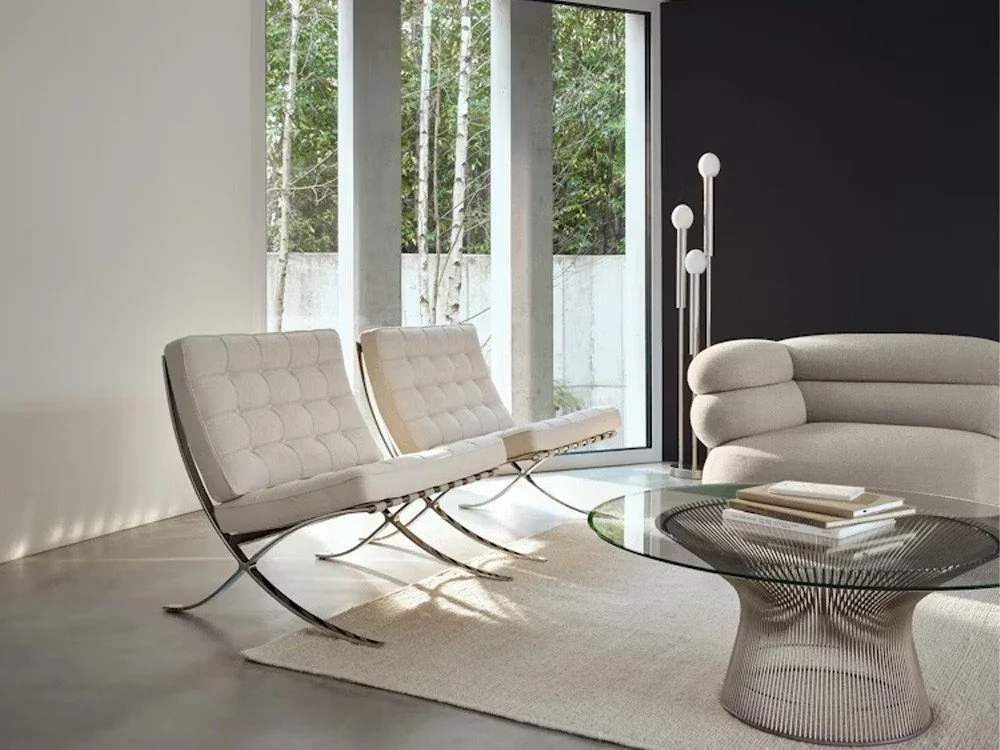
Living room with ivory Barcelona chairs, glass Platner coffee table and neutral sofa.
Few names resonate through the world of modern furniture design like Mies van der Rohe. As both architect and designer, Mies championed a philosophy of “less is more,” stripping away excess to reveal the essential beauty of form and function. His approach transformed furniture pieces into architectural statements, think of the iconic Barcelona Chair, with its sleek stainless steel frame and hand-stitched leather, or the revolutionary Wassily Chair, which introduced the world to the possibilities of chrome-plated tubular steel.
Mies van der Rohe’s influence is unmistakable in the clean lines, tapered legs, and functional elegance that define mid-century modern furniture. By prioritizing innovative materials and a minimalist aesthetic, he inspired generations of designers to create furniture that is both visually striking and deeply practical. His legacy lives on in every modern space that values simplicity, clarity, and purpose - where each chair, table, or sofa is not just a furnishing, but a thoughtful response to the needs of daily life. Today, the hallmarks of his work - sleek profiles, honest construction, and a relentless focus on function - continue to shape the evolution of modern furniture design, ensuring that his vision remains as relevant and inspiring as ever.
Contemporary Furniture Design
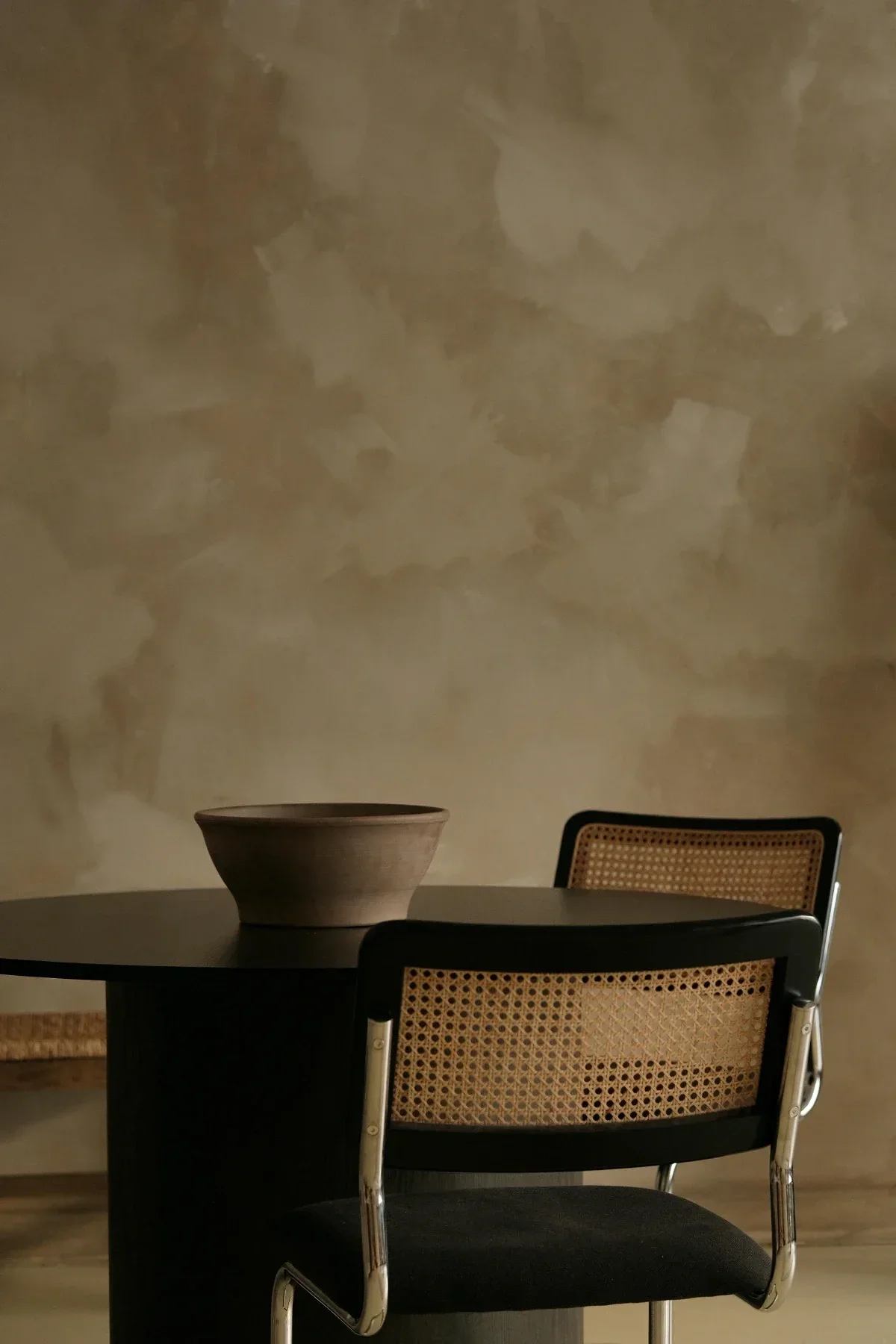
Round black dining table with clay bowl and two black Cesca chairs featuring cane backs, set before a warm plaster wall.
Contemporary furniture design keeps the modernist spirit alive by folding new materials and technologies into its core principles of simplicity, functionality, and quality. Recycled wood, eco-friendly fabrics, and other sustainable materials now sit beside powder-coated steel and tempered glass, proving that style and environmental responsibility can share the same line. Today’s manufacturers play a crucial role by adopting sustainable practices and collaborating closely with designers to bring innovative modernist furniture to market, ensuring that new pieces reflect both environmental values and cutting-edge design. Designers blend influences, Scandinavian warmth, Japanese restraint, and even a touch of traditional joinery to create modern furniture design that adapts to a range of interior design needs without losing its quiet clarity.
Functionality remains paramount: seating that supports long conversations, storage that conceals clutter, and surfaces designed to withstand daily wear. Beauty, however, is never secondary. Advances in materials and fabrication, from precision joinery to engineered composites, continue to refine form without excess. At the same time, the presence of modernist furniture remains unmistakable in contemporary interiors. Iconic silhouettes, clean lines, and material honesty persist, whether through original pieces or contemporary reinterpretations. The result is a design language that moves forward without disconnecting from its origins, where modern furniture design continues to evolve while the principles of modernist furniture remain firmly embedded in how spaces are shaped and lived in today.
Furniture for Living Spaces
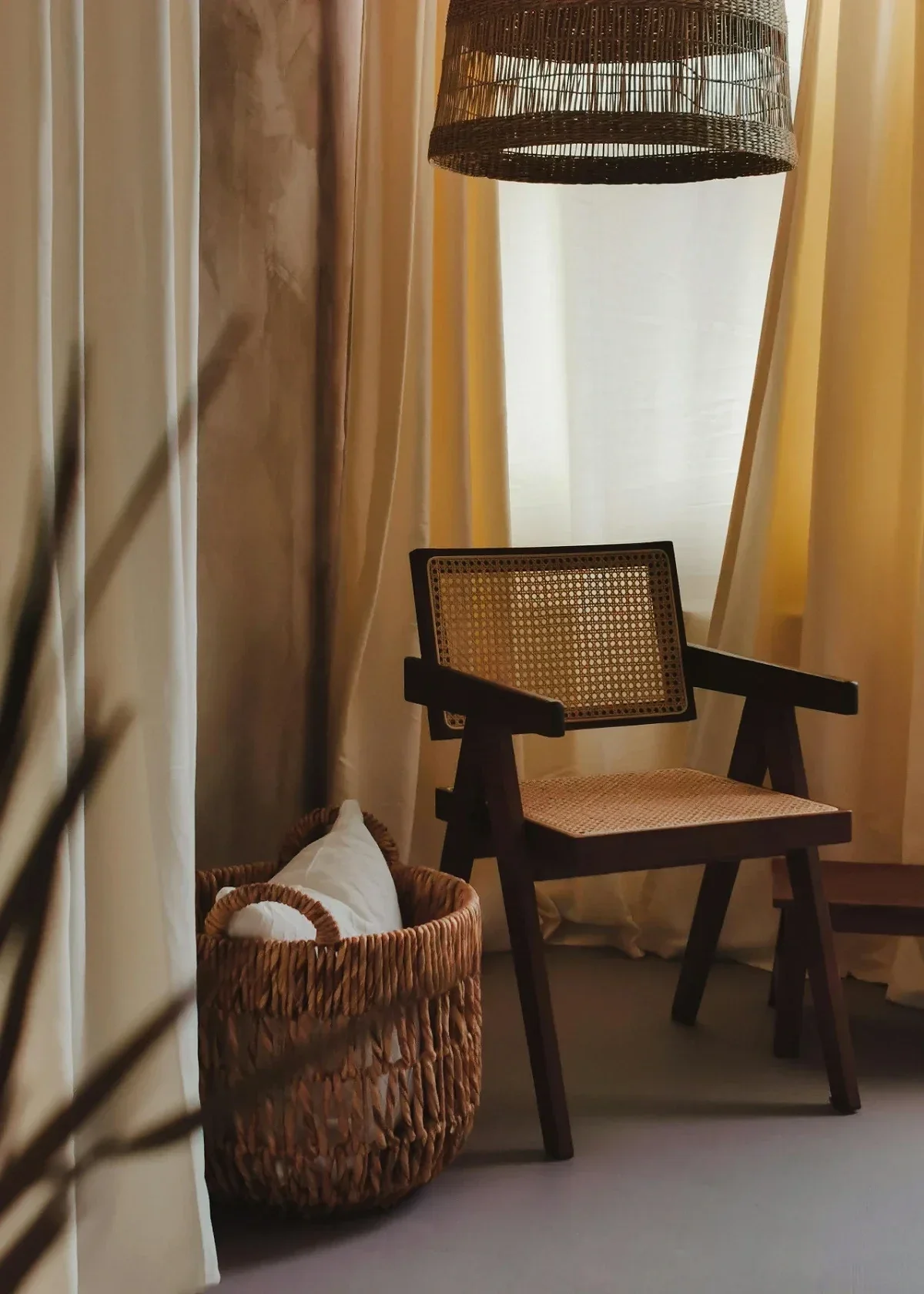
Warmly lit corner with dark wood chair featuring woven rattan seat/back, wicker pendant lamp and basket with cushion.
Living room furniture anchors the daily rhythm of a home, so each piece, sofas that cradle long conversations, chairs angled for reading light, coffee tables sized for shared tea, side tables waiting for a favourite book, honours the modernist trinity of simplicity, functionality, and quality. Natural materials such as warm wood and supple leather bring texture and calm, while glass or steel introduces a refined, weightless edge suited to modern interiors. Arrange seating to respect traffic flow, letting guests drift easily from one vignette to the next, and finish the room with table lamps or a sculptural floor lamp that softens evening light.
Dining room furniture follows the same philosophy. A dining table in oiled oak, smoked glass, or brushed steel becomes the quiet centre of gatherings, surrounded by chairs that balance comfort with clean lines. Size the table to suit family needs, but leave enough negative space for movement, allowing sideboards or wall art to breathe.
In the bedroom, low platform beds and streamlined dressers create a restorative atmosphere, proof that bedroom furniture can feel both tranquil and purposeful. Outdoor furniture carries the ethic outside: powder-coated patio sets, teak lounge chairs, even minimalist planters extend the modernist aesthetic into sunlight. Throughout, consider lighting, pendant or chandelier above, discreet sconces beside, alongside careful floor protection during delivery or setup, ensuring every surface and silhouette endures daily life with grace.
Design and Functionality
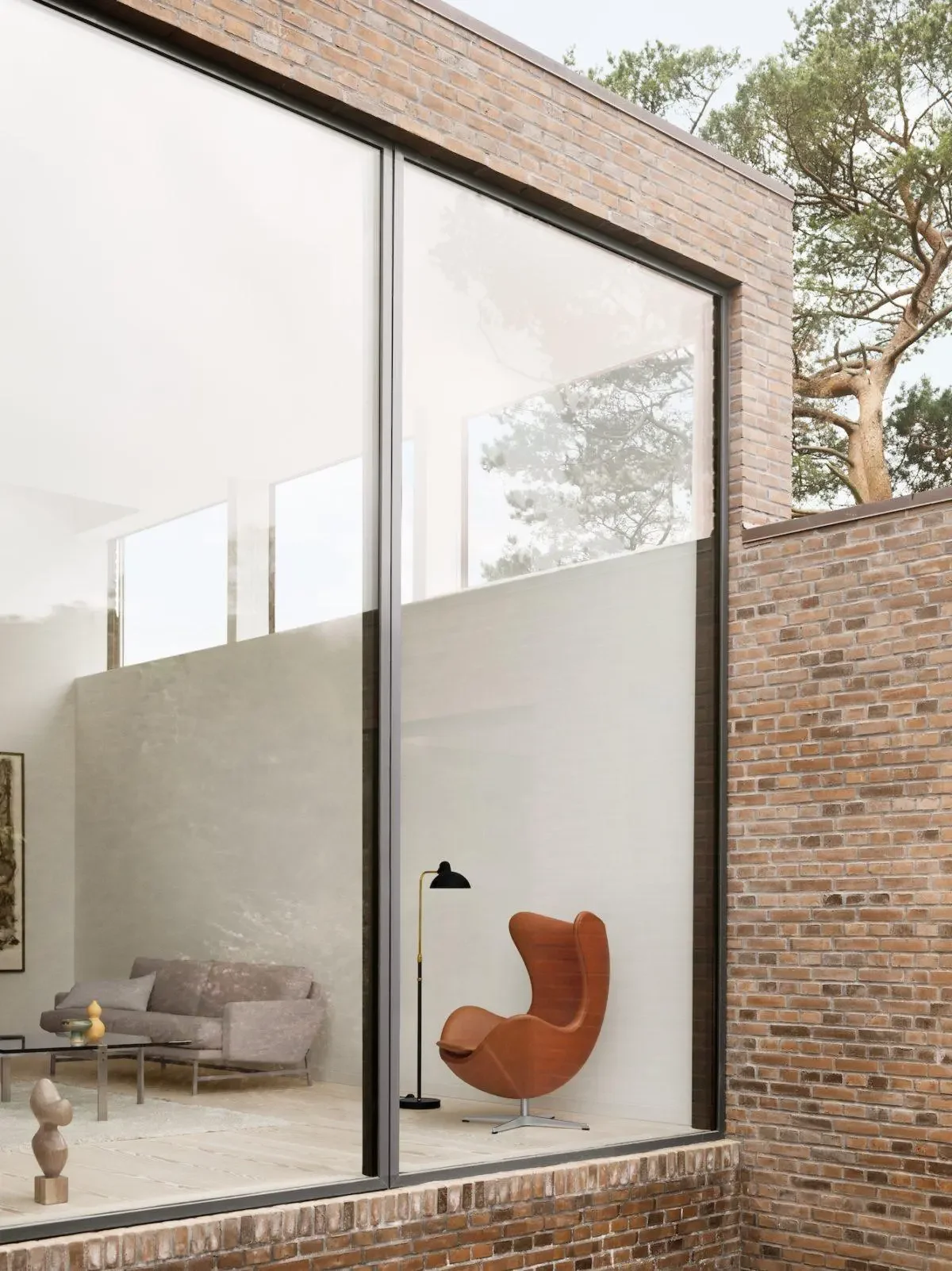
Light-filled modern brick house revealing brown Egg chair, neutral sofa and minimalist living room inside.
Modern furniture design still rests on the promise that form and function can coexist without compromise. Mid century modern furniture exemplified this ideal through clean lines, organic shapes, and high-quality craftsmanship in natural materials like wood, leather, and metal, traits that continue to shape contemporary interiors.
The Industrial Revolution and the daring experiments of the Bauhaus school ushered in tubular steel and systematic mass production techniques, making modern furniture accessible to a broader audience. Pieces were engineered to perform everyday tasks elegantly, turning rooms into canvases where aesthetics and functionality align. Classic examples prove the power of innovative materials: Marcel Breuer’s Wassily chair transforms bent steel into a sculptural form that is both striking and comfortable, while Mies van der Rohe’s Barcelona chair merges stainless steel with tufted leather, an enduring statement of balance. Another example is the Eames Lounge Chair, which combines molded plywood and leather to create a piece that is both iconic and exceptionally comfortable, perfectly illustrating the principles of modernist furniture.
Today, modern furniture design offers everything from sleek sofas to minimalist coffee tables. Features such as tapered legs, geometric patterns, and recycled composites ensure a timeless design that adapts to any room. Accent pieces, side tables, desks, and dressers add versatility, helping create a cohesive and sophisticated interior.
Echoes of De Stijl appear in the use of primary colors and disciplined geometric forms, even as designers adopt new materials and emerging technologies. Whether you buy online or in-store, the variety and accessibility of modern furniture mean you can meet personal style, needs, and budget without sacrificing simplicity, practicality, or elegance.
Ultimately, modern furniture’s enduring success lies in its perfect balance of aesthetics and practicality, qualities that keep these pieces relevant, refined, and indispensable within contemporary interiors.
Living with Modernism
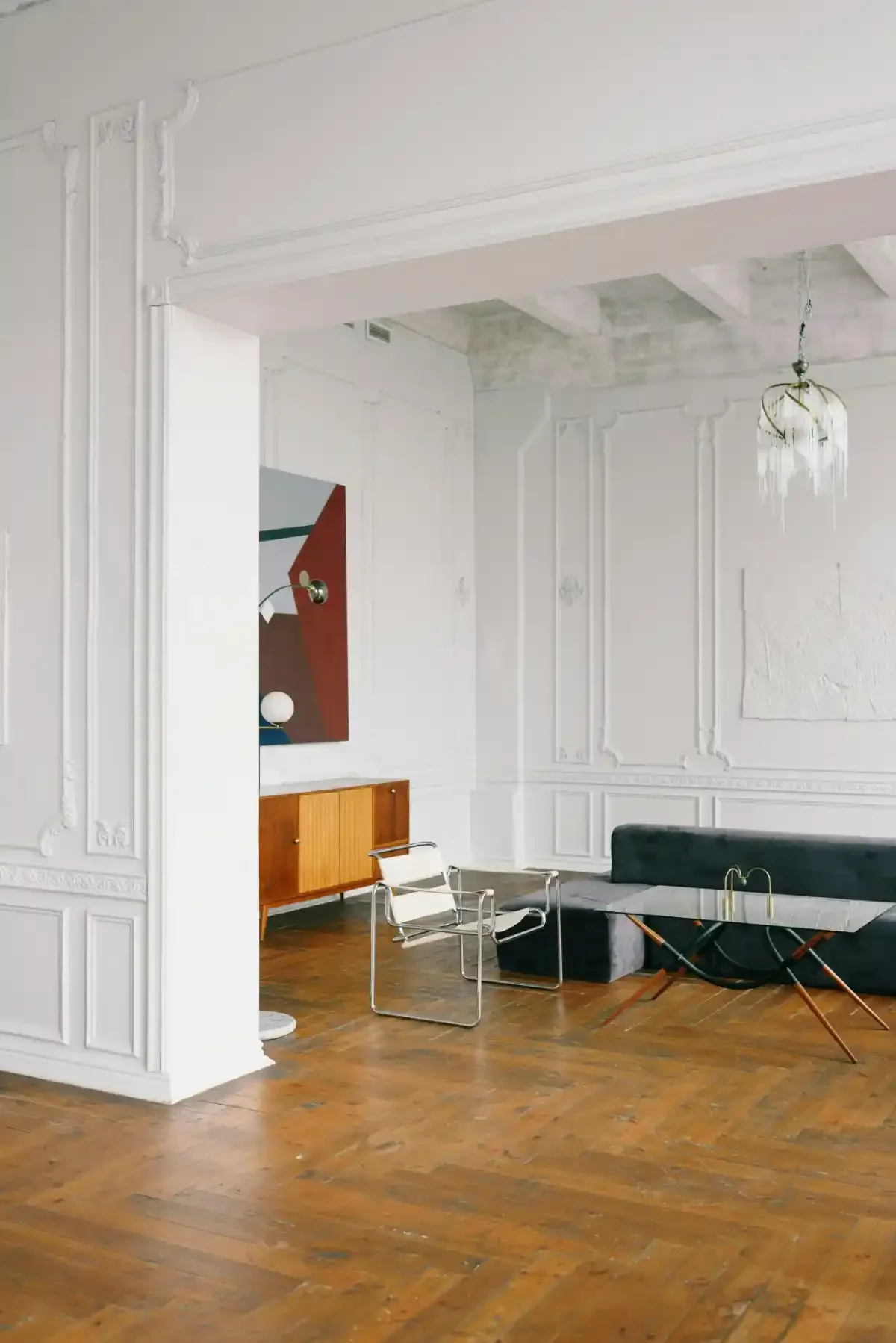
Bright eclectic living room featuring white Wassily chair, mid-century cabinet, moulded walls and parquet flooring.
Modernist furniture is more than a style note, it is a quiet manifesto for intentional living. Choose a few well-crafted pieces, allow negative space to frame them, and watch the room settle into calm efficiency. A Wassily chair near a stack of art books, a low walnut credenza beneath a textured canvas, a slim console where keys and letters land at dusk, each gesture affirms that usefulness and poetry can share the same line. To extend this approach further, consider how material choices, sourcing, and longevity shape a more conscious home, where sustainability is approached with the same level of intention as design. In doing so, the focus shifts from accumulation to curation, where every object is selected not only for how it looks, but for how it endures over time.
related posts