Venice sits on 118 small islands knitted by roughly 400 bridges across 150-odd canals, a city that has been inhabited for more than 1,500 years, and continuously rewritten by every century it survived. The resident population of the historic center has fallen below 50,000, while annual visitor numbers approach 30 million, a ratio that has reshaped what hospitality is asked to do here. The most considered boutique hotels in Venice Italy, have responded by narrowing rather than scaling, returning to material discipline, single-sestiere knowledge, and what designers in the Veneto are now calling Post-Venetian sensibility.
Post-Venetian is not a rejection of the city’s Baroque inheritance so much as a recalibration of it. The framework prizes Neo-Venetian craftsmanship over imported gloss, layered provenance over decorative excess, and the quiet authority of localism over the visual signatures of global hotel chains. Cipollino marble cut in the Veneto. Murano glass commissioned by name. Terrazzo laid by hand. Venetian plaster is finished by artisans who learned the trade from their parents. This guide considers nine boutique hotels in Venice, Italy, that carry that sensibility forward, each through a distinct architectural, material, or familial argument.
Some links in this post are affiliate links. That means we may earn a small commission, at no additional cost to you.
The Evolution of Venetian Luxury, From Baroque to Post-Venetian
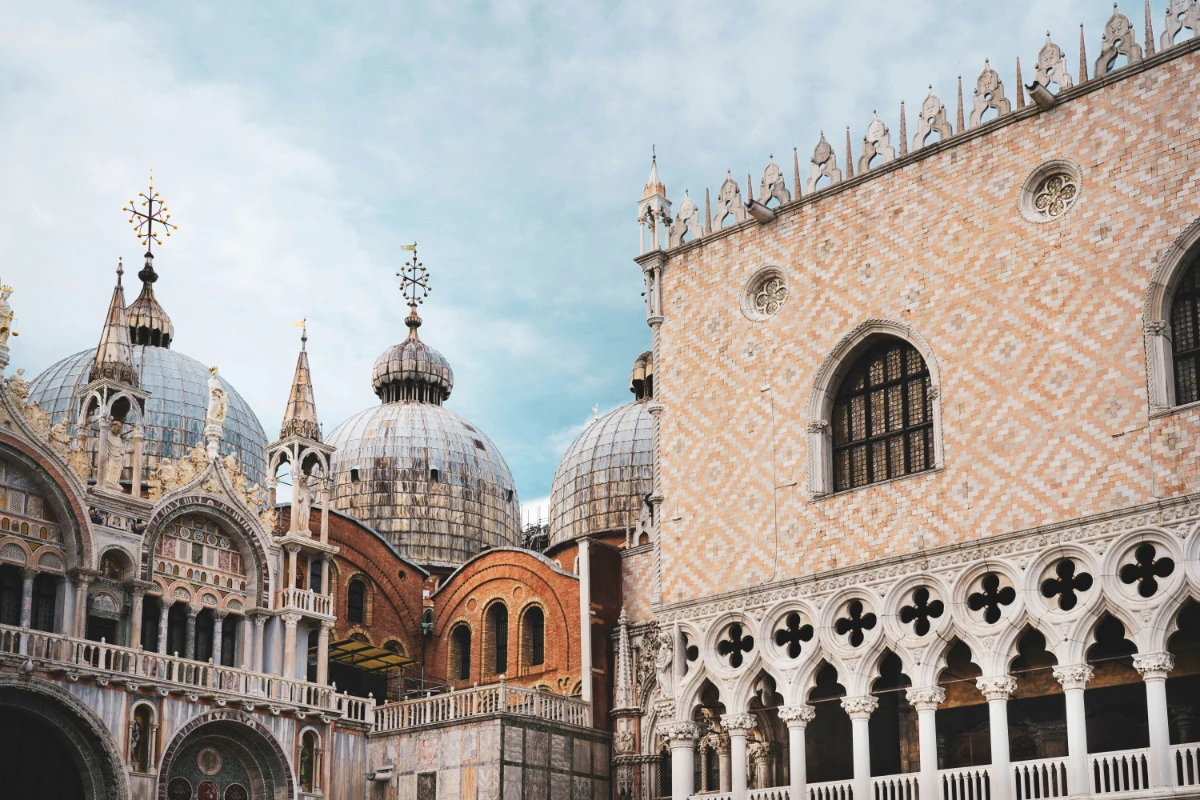
Venetian luxury has always been a language of accumulation. The Republic grew rich on the spice and silk routes between the eleventh and fifteenth centuries, and its palazzi were built to encode that wealth visually: gilded ceilings, polychrome marbles, Tiepolo and Veronese frescoes, Sansovino stonework, and brocade walls heavy enough to mute a room. When grand hotels arrived in the nineteenth century, they inherited this grammar and amplified it for a new clientele arriving by rail. The Baroque palace became the Baroque hotel, and for nearly 150 years, that equation was the definition of Venetian luxury.
What has shifted in the past five years is the reading public for that grammar. Forbes research published in 2025 found that 65 percent of high-net-worth travelers now weigh sustainability as a primary factor in luxury bookings, while Arabian Travel Market reporting from the same year placed hyper-personalization at the center of 80 percent of luxury itinerary decisions. Hotelagio data, tracking Italian inbound luxury, places approximately 25 percent of all luxury tourist spending in Italy on the Veneto and its hotels, a share that has hardened the question of who, exactly, that spending should reward. The answer that the most thoughtful operators are giving is local.
Post-Venetian design reads as a reversal of the accumulative impulse, notable in Venice’s boutique hotels. Material counts are lower, but every material is named: this Cipollino from a specific quarry, this Murano from a specific fornace, this plaster from a specific workshop. Color palettes are pulled from Lagoon Light rather than from imported decorative schemes. Patricia Urquiola’s interiors at Ca’ di Dio articulate a discipline of working with what a place already contains: material, light, and architectural inheritance treated as the starting palette. Dorothée Meilichzon’s work at Il Palazzo Experimental sources nearly every commission from inside a 100-kilometer radius of the lagoon, framing provenance as a structural rule rather than a marketing claim: a hotel that knows where its materials come from is a hotel that knows where it is.
The Post-Venetian framework matters now because Venice itself can no longer afford a hospitality model that treats the city as a backdrop. Acqua alta cycles, residential displacement, and the cruise-traffic restrictions enacted in 2021 have all forced the conversation. The boutique hotels in Venice worth attention in 2026 are the ones that have understood the city is no longer a stage to be dressed but an ecology to be supported.
For a broader view of this destination, these pieces extend the journey:
- Unveiling the Best Places to Go in Italy
- How The Dolomites in Italy Captivates Every Traveller
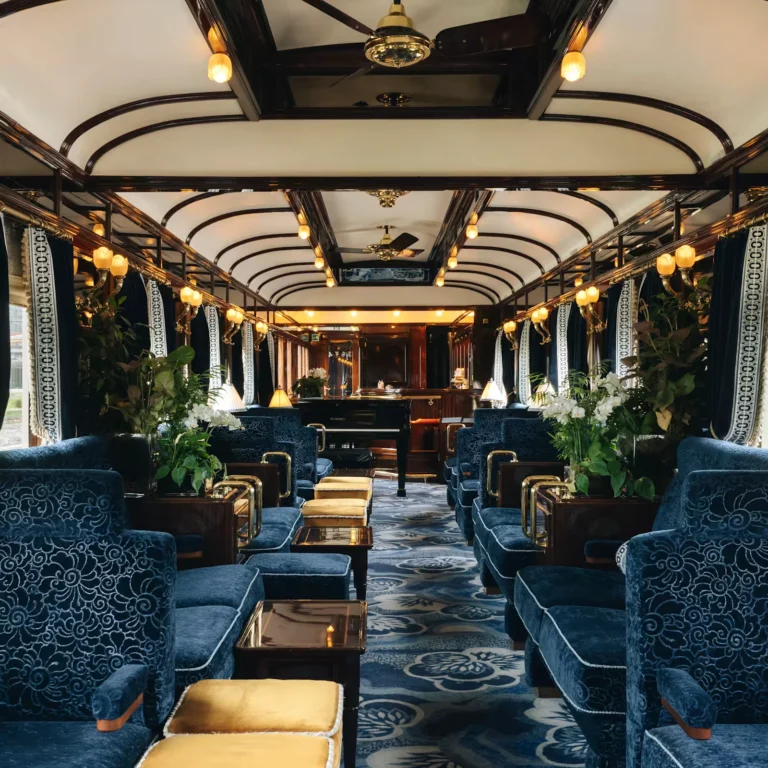
- Inside the Venice Simplon-Orient-Express: A Moving Archive
Which Sestiere in Venice Suits the Considered Traveler
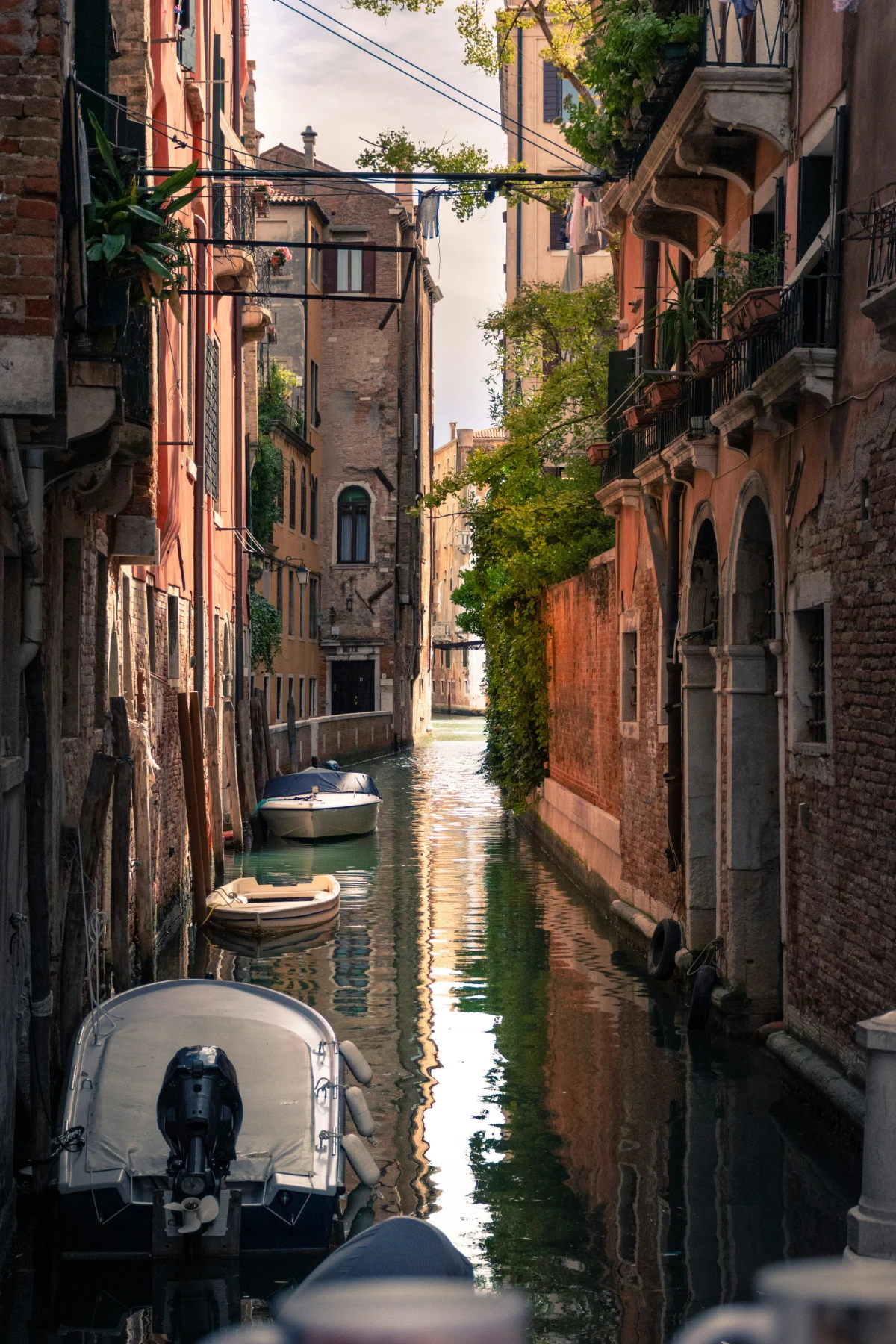
Venice is spread across six sestieri, each with a temperament shaped by its position relative to the Grand Canal, its proximity to the lagoon, and the rhythm of its residential population. The choice of sestiere is, more than anything else, a choice of acoustic and pace.
San Marco
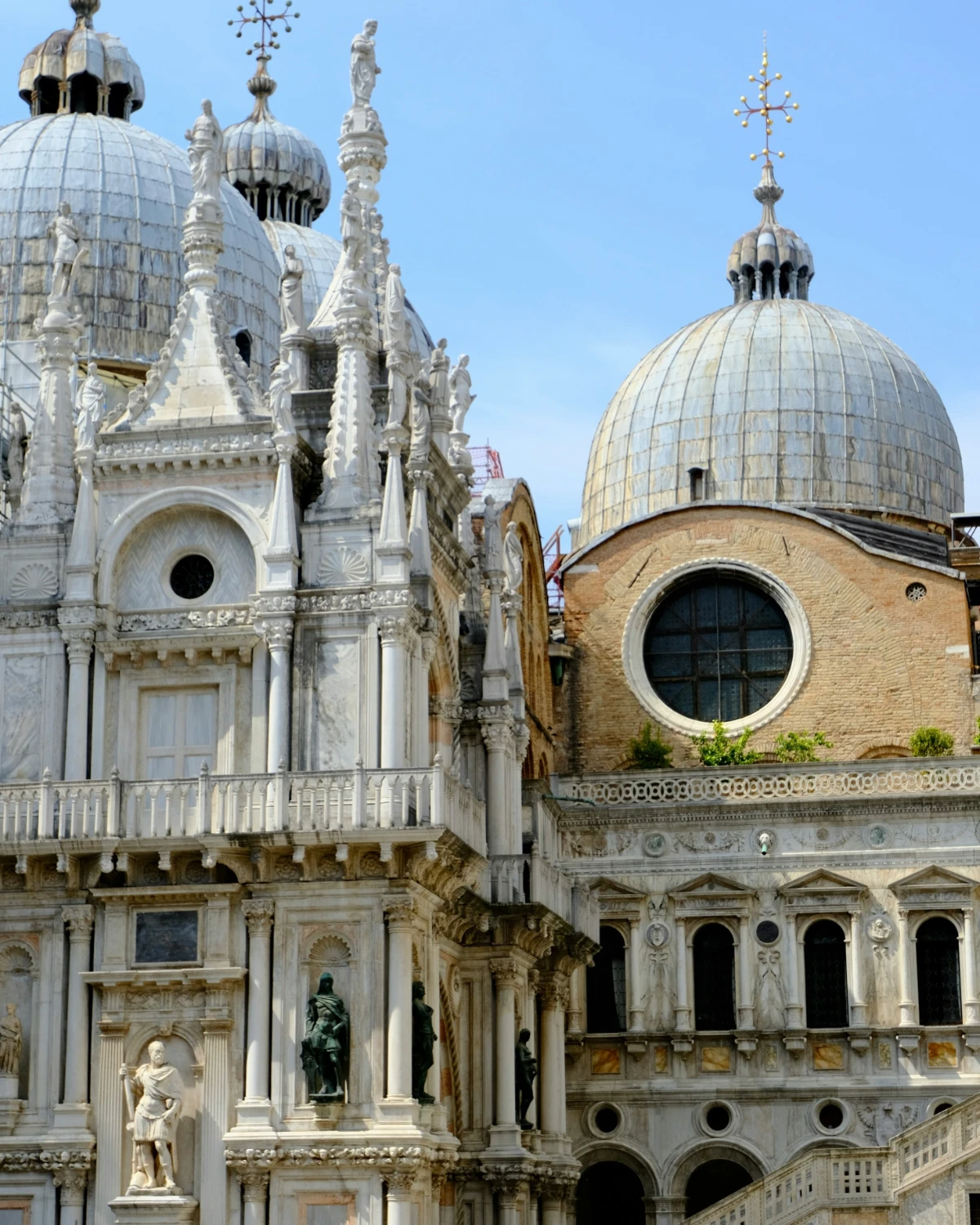
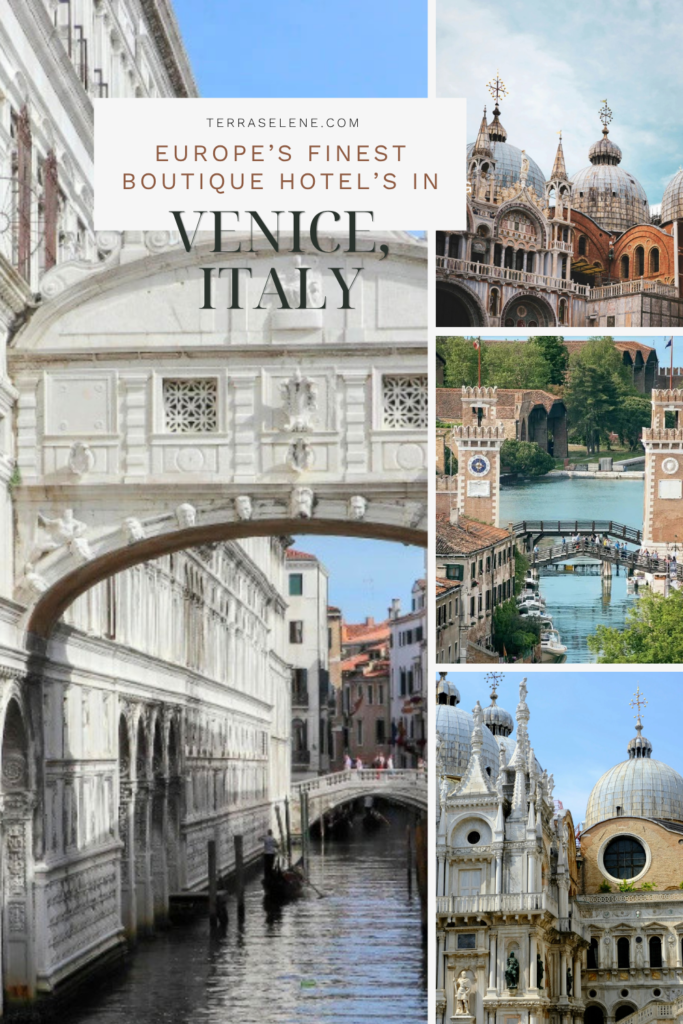
San Marco is the procedural heart of the Republic and the densest concentration of public ceremony in the city. The Basilica, the Doge’s Palace, the Campanile, the Procuratie, and Piazza San Marco itself anchor a sestiere built for spectacle. Day-visitor density is highest here between late morning and mid-afternoon, but the early hours and the long blue evenings return the square to something close to its eighteenth-century cadence. For travelers who want the ceremonial Venice within a short walk, San Marco remains the obvious sestiere.
The Post-Venetian properties here, including Hotel Flora, succeed by building inward from the noise rather than facing into it, holding garden courtyards, residential entrances, and quiet breakfast rooms as the counterweight to the public square outside.
Dorsoduro
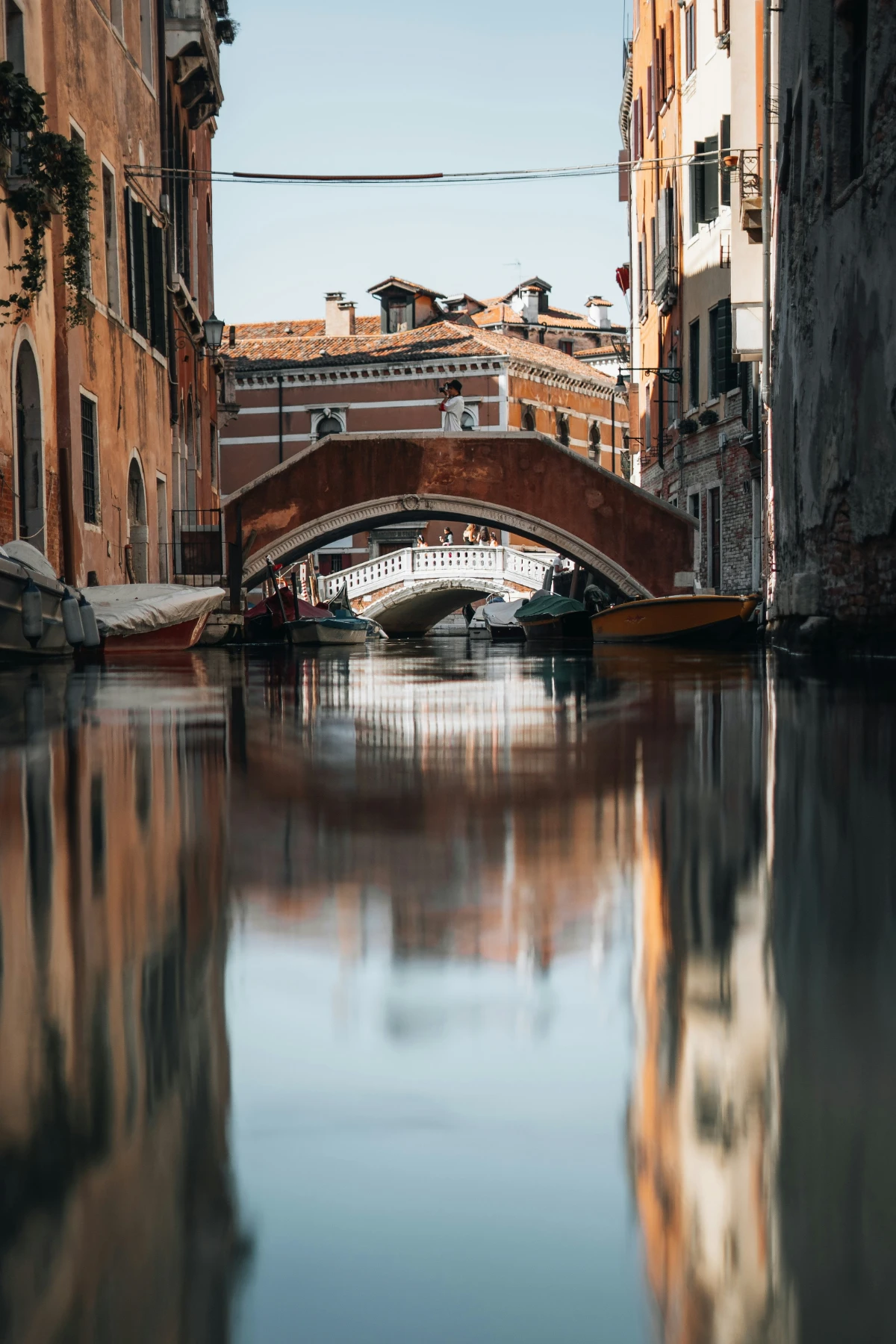
Dorsoduro, the long southern crescent that holds the Accademia, the Peggy Guggenheim Collection, the Punta della Dogana, and Santa Maria della Salute, has been the artistic sestiere of Venice for more than a century. Ca’ Foscari University seeds the neighborhood with students, which keeps the bacari lively into the evening and the rents on the small artisan workshops just sustainable enough to survive.
The Zattere fondamenta along the Giudecca Canal offers the longest unbroken waterside walk in the historic center, and the light on Salute at sunset is the most photographed surface in the city for reasons that precede photography. Dorsoduro suits travelers drawn to contemporary art, late dinners at a wine counter, and a sestiere that still feels lived in.
Cannaregio
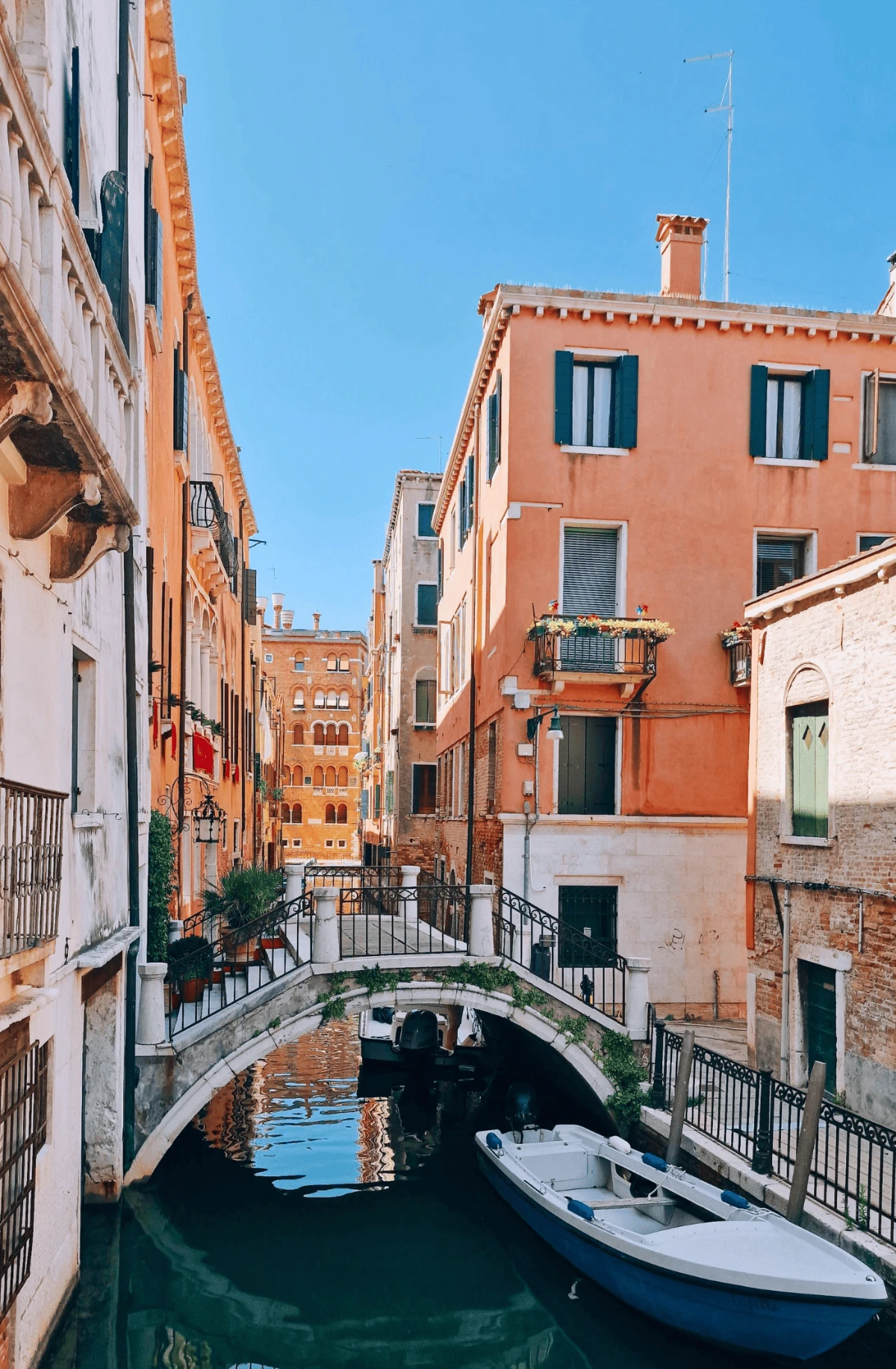
Cannaregio is the long northern sestiere that absorbs most of Venice’s remaining residential life. The broad fondamenta along the Cannaregio Canal, the Misericordia, and the Madonna dell’Orto parish hold a working rhythm that the central sestieri lost decades ago. Bacari here pour wine for neighbors before they pour it for travelers, and the morning markets serve households rather than restaurants.
The walk from the station to San Marco crosses Cannaregio diagonally, which means most day visitors traverse it without registering it. For travelers seeking the residential Venice, the Cannaregio of working canals and quiet evening passages remains the most legible sestiere in the city.
San Polo and Santa Croce
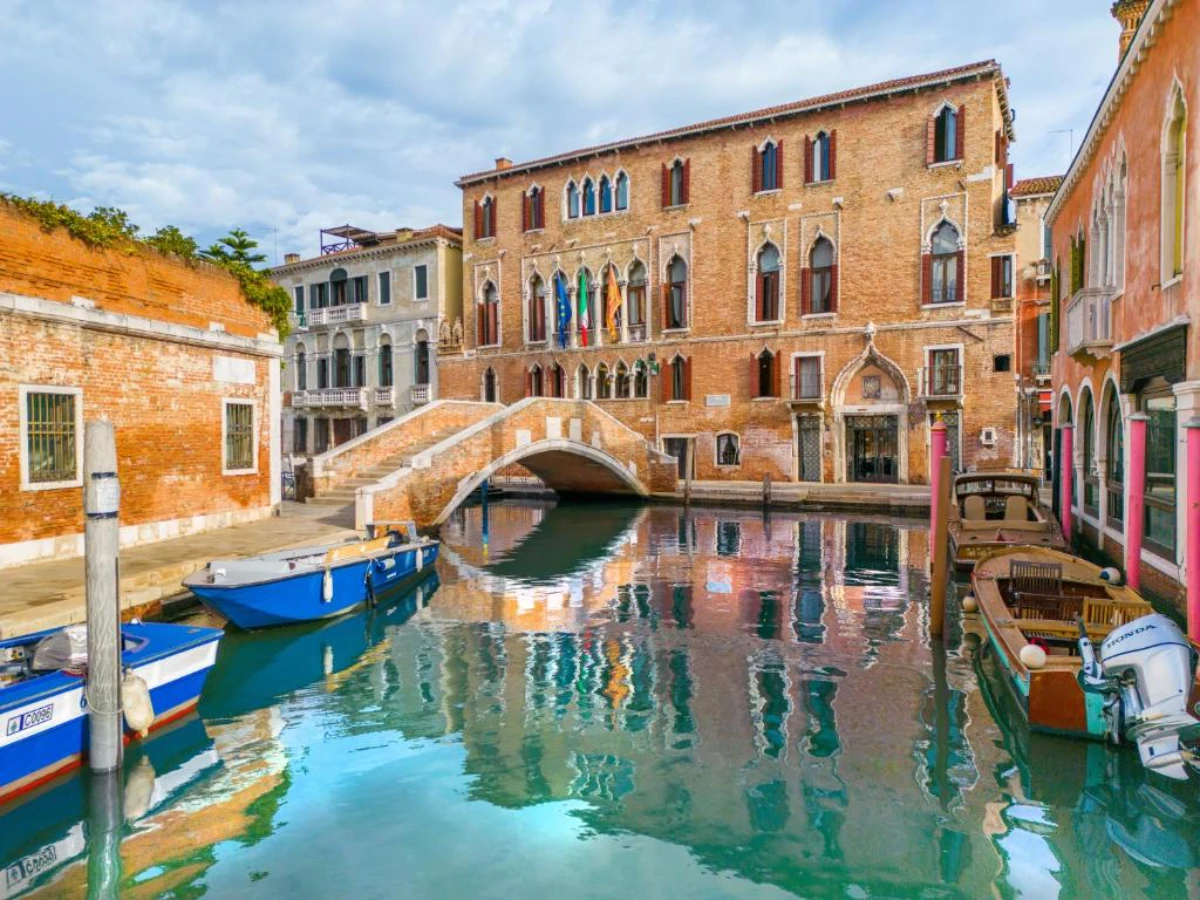
San Polo and Santa Croce share the northwestern bend of the Grand Canal and form, together, the commercial and culinary spine of historic Venice. The Rialto market has stood on the same ground since the eleventh century and still sets the daily price of fish and produce for half the city’s restaurants. The Frari basilica anchors San Polo with Titian’s Assumption above the high altar. Streets here are narrower, the shadows deeper, and the trajectories of daily commerce more legible than in any other part of the historic center.
The Post-Venetian property here, Aman Venice at Palazzo Papadopoli, sits directly on the Grand Canal between two of the city’s busiest crossings and yet manages an interior silence that the sestiere itself cannot offer.
Castello, Including Sant’Elena
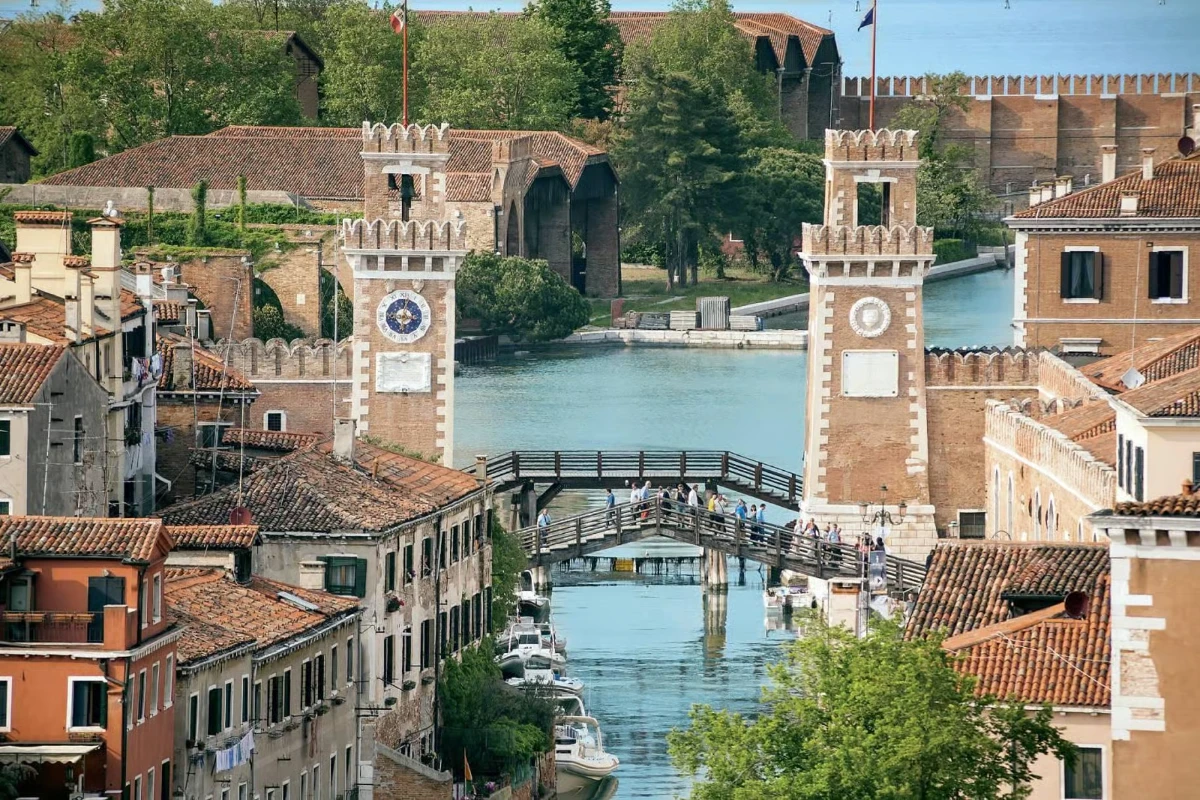
Castello is the largest sestiere by area and the one that holds Venice’s working memory most physically. The Arsenale, the Republic’s medieval shipyard, occupies a vast walled enclave still partly active. The Biennale gardens sit at the sestiere’s eastern edge, opening onto the lagoon. Sant’Elena, the easternmost extension, is residential to the point of feeling provincial. Castello rewards travelers who want long flat walks along the lagoon, the slow architectural archaeology of the Arsenale, and dinners in trattorie that have served the same families for three generations.
Ca’ di Dio sits in the heart of this sestiere, in a thirteenth-century ecclesiastical building whose original function as a pilgrim hostel feels architecturally continuous with what it has become.
Nine Boutique Hotels in Venice at the Working Edge of Venetian Luxury
The boutique hotels in Venice, Italy, considered below advance the Post-Venetian framework through nine distinct moves. Some are matters of material discipline, some of ownership ethos, some of architectural restraint. Read together, they sketch the working edge of Venetian hospitality as it stands in 2026.
Aman Venice
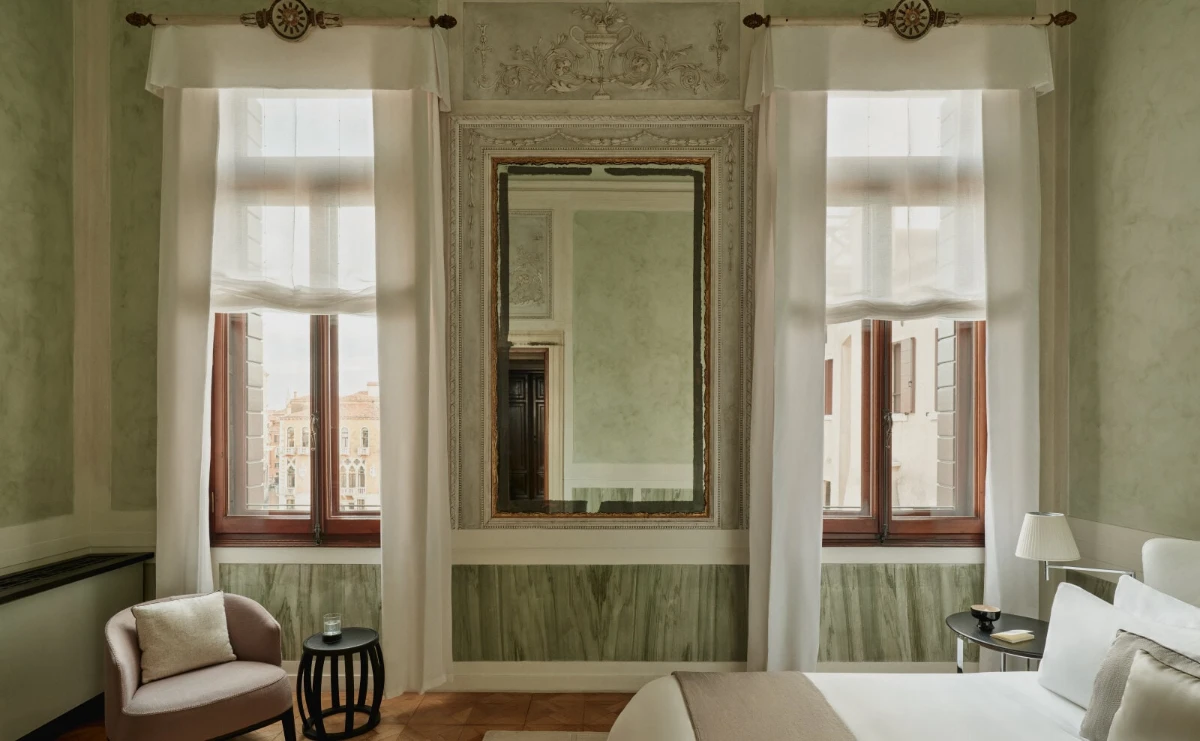
Palazzo Papadopoli faces the Grand Canal on a stretch of San Polo that has been continuously inhabited since the sixteenth century. The palazzo itself was completed in the 1560s for the Coccina family, who commissioned Tiepolo frescoes for the piano nobile and engaged the Sansovino workshop for the architectural detailing of the principal rooms. The building changed hands through the Tiepolo and then the Papadopoli families across the following three centuries, accumulating layers of decorative campaign without losing its sixteenth-century bones. The position at the bend in the Grand Canal places it within walking distance of both the Rialto and San Marco, yet behind its water gate, the acoustic shifts almost immediately. The interior courtyards and the two private gardens, rare in central Venice, absorb the city outside.
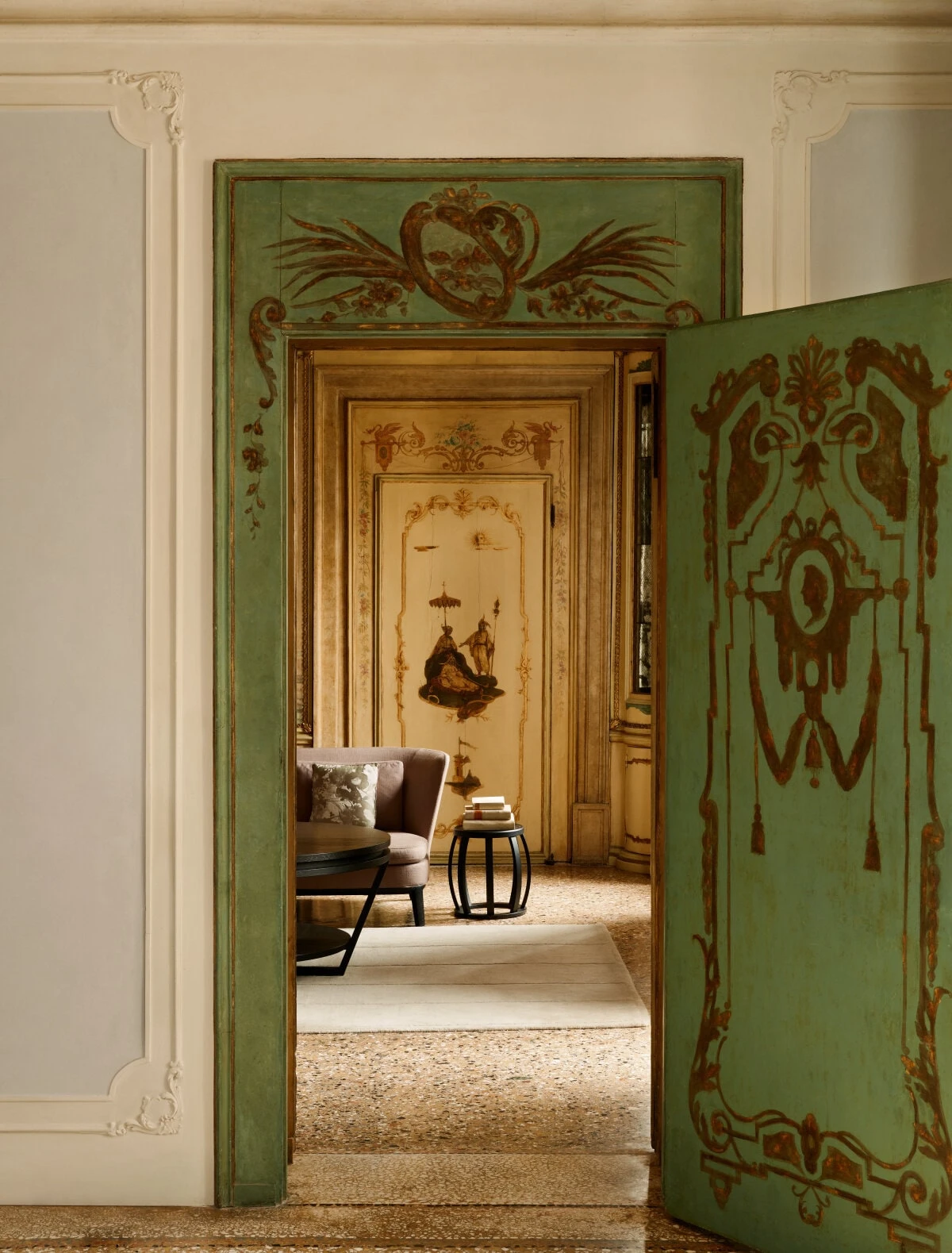
Aman Venice opened in Palazzo Papadopoli in 2013, and the Post-Venetian move here is one of pure restraint. The Tiepolo cycle on the piano nobile remains in situ, conserved rather than reframed. Sansovino stonework, original Cordovan leather walls, and the eighteenth-century stucco campaigns are read as the boutique hotel’s primary design language. Jean-Michel Gathy and the Denniston studio designed the contemporary intervention as a minimalist contrapuntal layer: pale linens, low custom furniture, neutral palettes, almost no decorative ornament added to rooms that already hold three centuries of it. 24 suites occupy the upper floors, several with private canal views and original frescoed ceilings.
Ca’ Maria Adele
Dorsoduro narrows toward its eastern tip into the Punta della Dogana, where the customs house of the Republic now holds Pinault’s contemporary art collection and where Santa Maria della Salute rises across a small canal in Longhena’s seventeenth-century octagonal geometry. The streets immediately behind Salute are some of the quietest in central Venice. These residential lanes empty into the Grand Canal at unexpected angles and hold a handful of small palazzi that have been continuously private for centuries. The light here, refracted off the open basin between Salute and San Giorgio Maggiore, has been the subject of painters from Canaletto to Turner. Dorsoduro’s reputation as an artistic sestiere is built partly on this geography, the way the basin opens at Salute and returns the eye to scale.
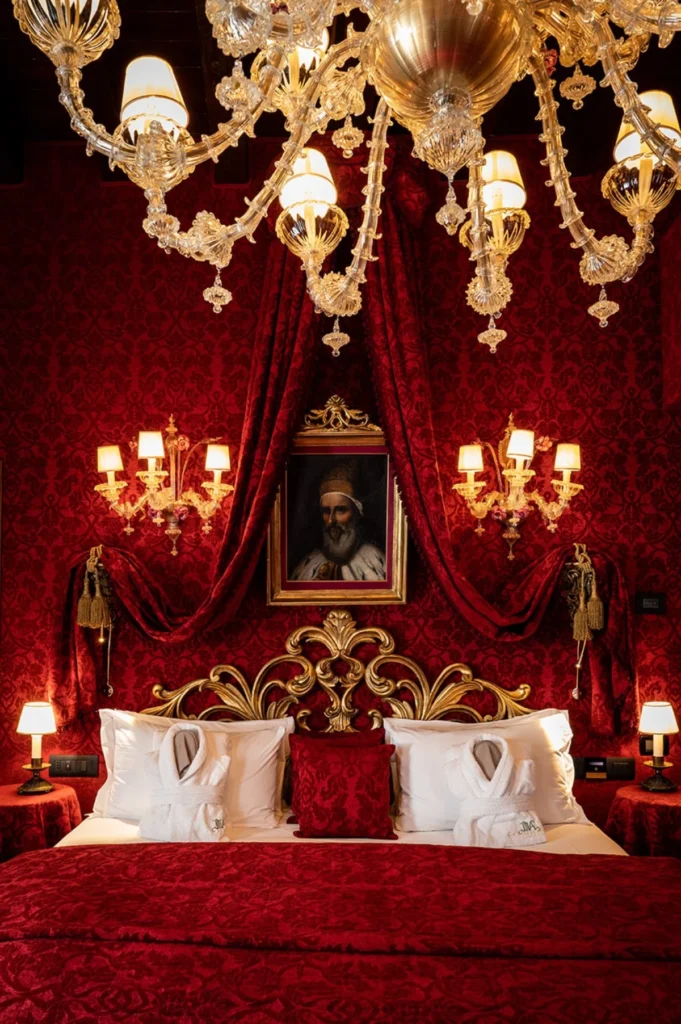
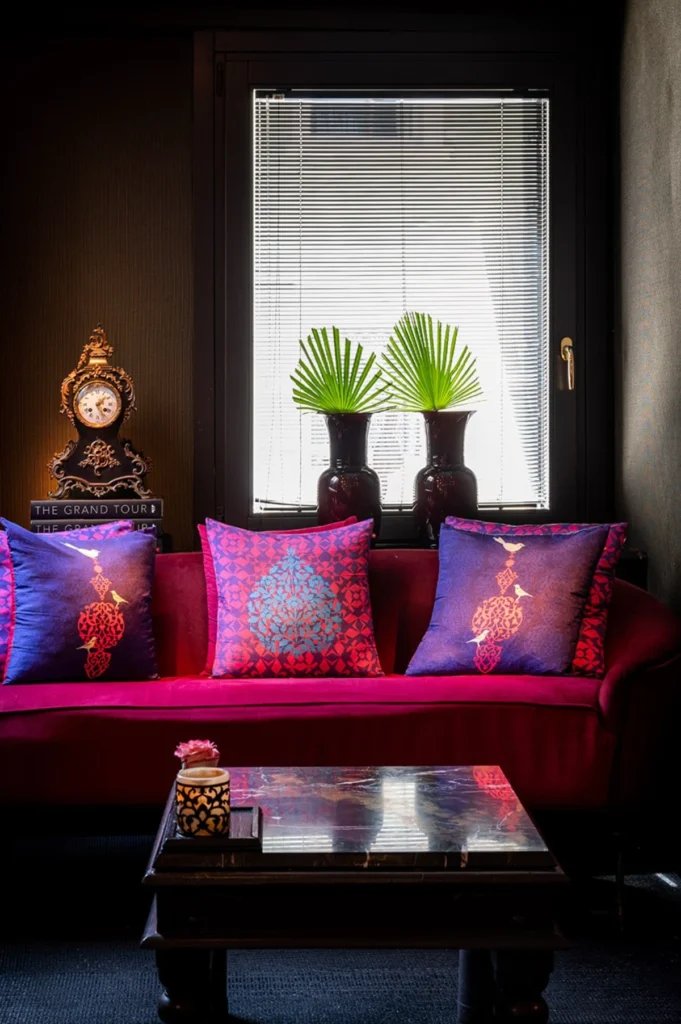
Ca’ Maria Adele occupies a sixteenth-century palazzo a few steps behind Salute and holds 12 rooms, five of them thematic suites. The Post-Venetian discipline here is craft fidelity. Each themed room, the Doge’s Room in deep red and gold, the Oriental in Burmese teak, the Black Room in lacquered surfaces, is executed not as a decorative concept but through named Venetian and Veneto artisans. Bespoke Murano glass commissioned for each suite. Period Fortuny textiles sourced from the Giudecca workshop founded in 1922. Hand-laid Terrazzo finished by a Veneto family workshop. Bed linens from a Vicenza weaving house. The boutique hotel is small enough that the proprietor knows every supplier by first name and large enough that the standard cannot slip.
Ca’ di Dio
Castello opens eastward from Piazza San Marco along the Riva degli Schiavoni and the Riva dei Sette Martiri, the long lagoon-facing promenade that holds some of the city’s most consequential thirteenth- and fourteenth-century ecclesiastical architecture. The Arsenale walls rise inland, and the sestiere’s pace slows perceptibly past the second bridge. The Biennale gardens lie further east, set into a residential quarter that empties in winter and fills again with the architecture and art programs from May through November. Ca’ di Dio itself was founded in 1272 as a hostel for pilgrims and crusaders returning from the Holy Land, a function it served continuously for nearly seven hundred years. The building’s ecclesiastical austerity, low ceilings, plain stone, and narrow corridors have shaped the design grammar of the hotel that now occupies it.
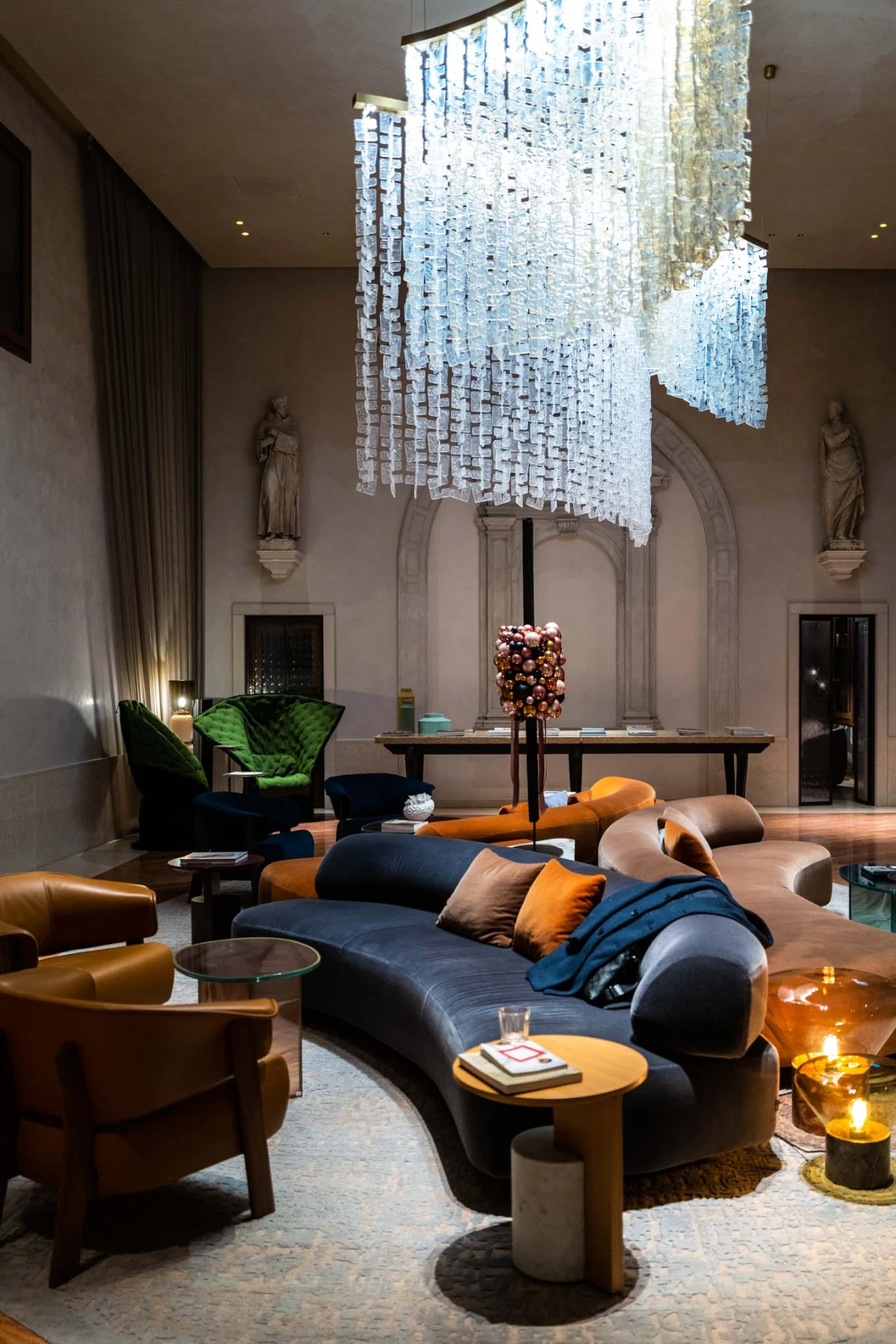
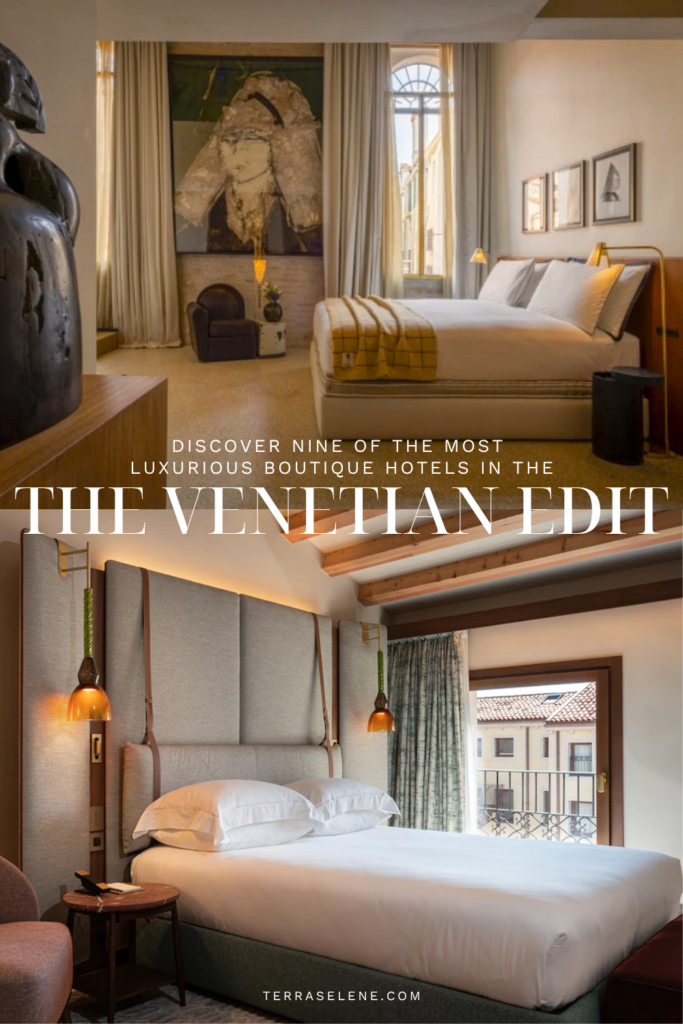
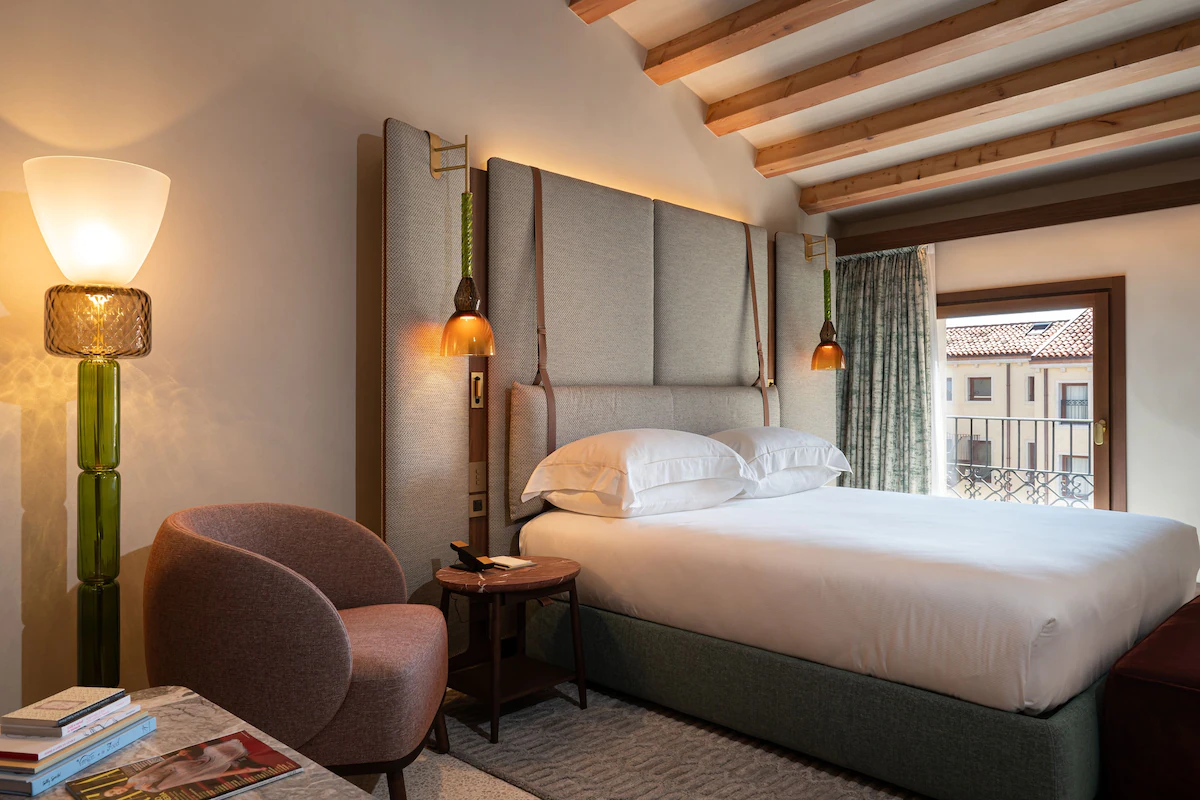
Ca’ di Dio reopened in 2021 after a Patricia Urquiola redesign that has become the framework reference for the Post-Venetian movement. The interiors layer Cipollino marble cut in the Veneto, hand-finished Venetian plaster, custom-woven textiles, and reclaimed timber against the building’s original stone shell. Urquiola has spoken of the project as a sensory archive, a phrase NUVO Magazine traced through the property’s signature scent commissioned exclusively for its public spaces, the custom soundscape in the boutique hotel’s lobby, and the amenity program drawn entirely from small Veneto producers. 66 rooms across the original ecclesiastical footprint. Two restaurants, both with sourcing protocols that map producers within roughly 100 kilometers of the lagoon.
Ca’ Sagredo
The northern stretch of the Grand Canal between the Rialto and Ca’ d’Oro holds some of the most architecturally consequential palazzi in Venice, fifteenth-century Gothic and early Renaissance fronts that anchor the canal’s most photographed sequence. Ca’ Sagredo sits on this stretch, in a position the Republic considered prestigious enough to designate the entire palazzo a Monumento Nazionale, a protective status that requires conservation rather than alteration. The sestiere on this side of the canal is Cannaregio, but the address reads as Grand Canal first and sestiere second. The water entrance opens directly onto the canal at a point where the gondola traffic remains constant from morning through evening, and the building’s water gate gives onto a portego, the long central hall, that retains its fifteenth-century proportions.
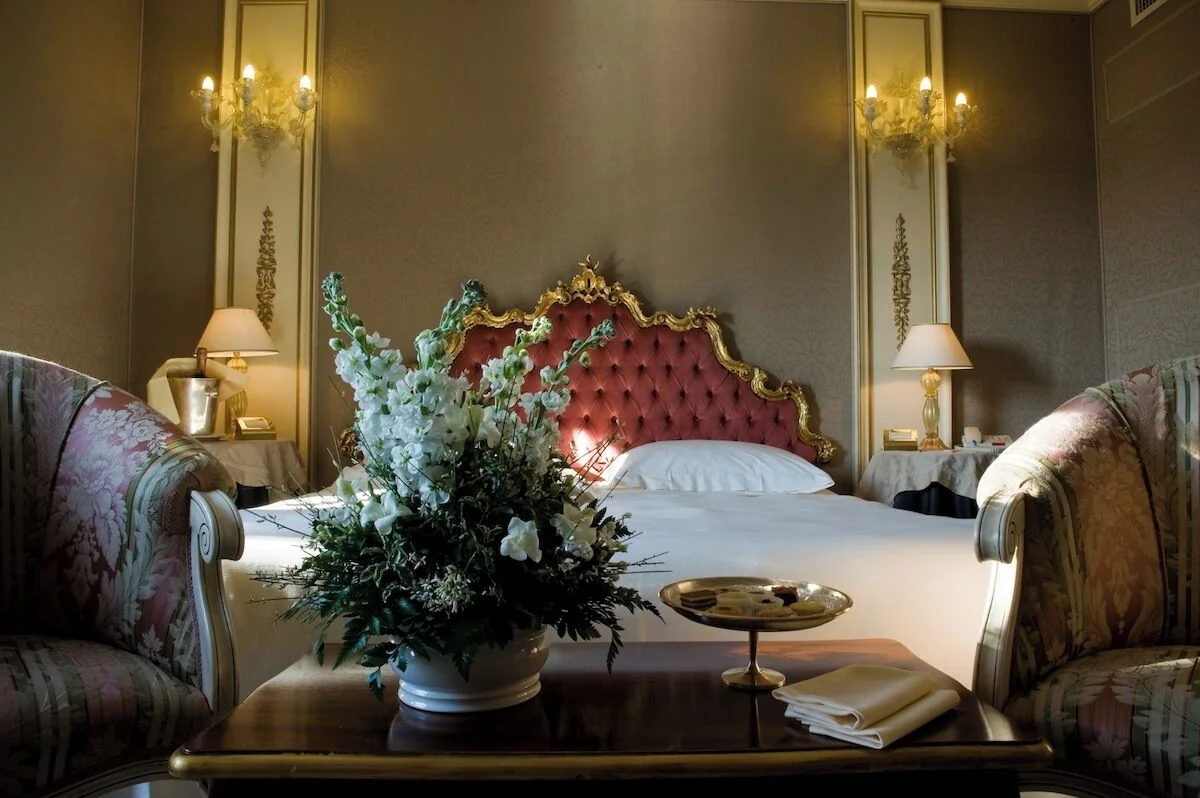
Ca’ Sagredo is the heritage argument in its purest form. The Post-Venetian move here is to refuse redesign almost entirely. The piano nobile holds frescoes by Pietro Longhi, Sebastiano Ricci, and Niccolò Bambini, all preserved in situ, alongside the original eighteenth-century stucco campaign and a monumental staircase frescoed by Pietro Longhi that remains one of the most consequential preserved interiors in any working hotel in Italy. The boutique hotel comprises 42 rooms, several of which occupy frescoed bedchambers. The contemporary intervention is limited to discreet bathroom work, lighting that does not compromise the frescoed surfaces, and bed linens chosen to recede.
Hotel Flora
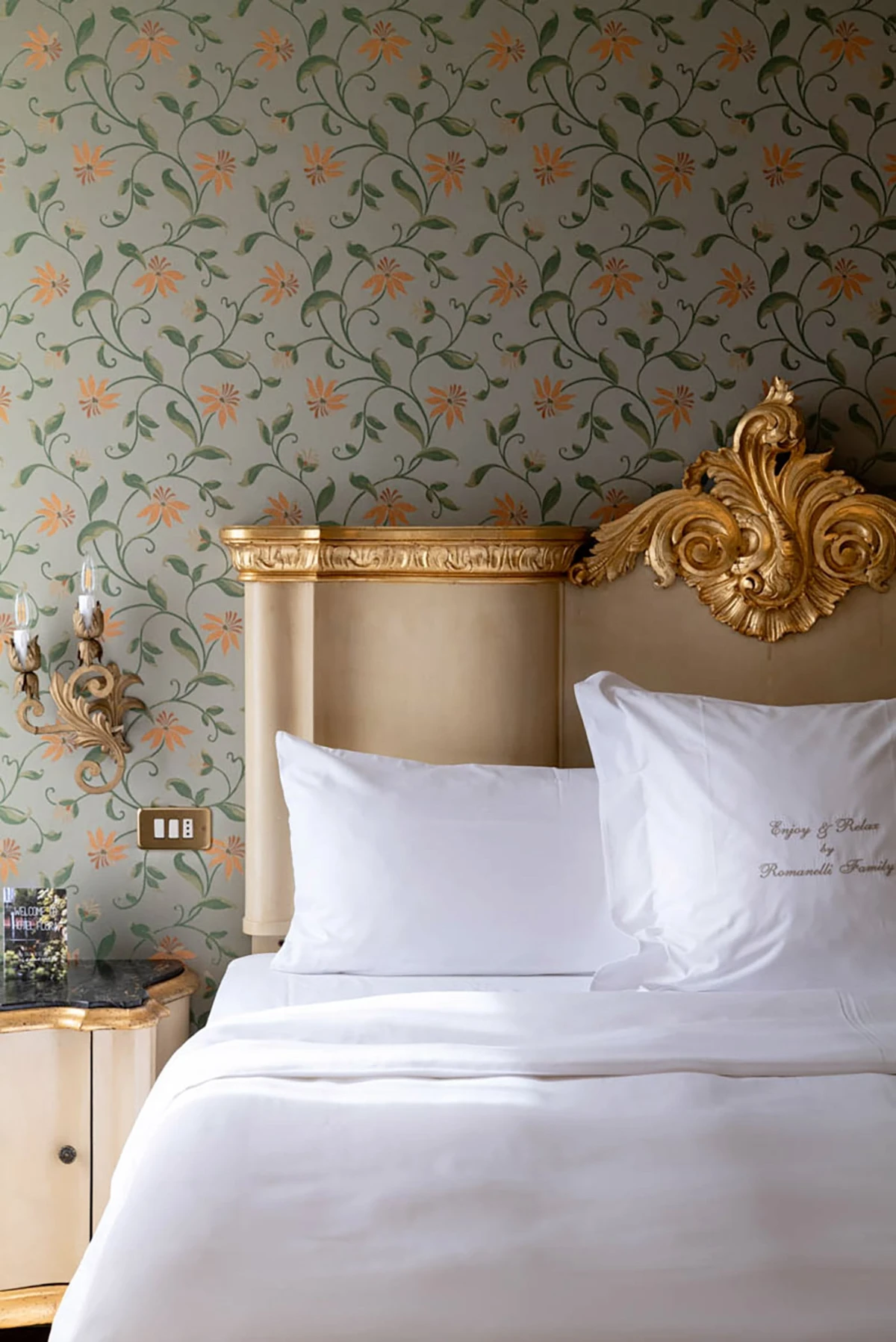
The streets immediately west of Piazza San Marco, threading toward the Frezzeria and Campo Sant’Angelo, hold some of the most discreet residential addresses in the central sestiere. Hotel Flora occupies a small palazzetto on Calle dei Bergamaschi, a quiet lane that opens off the Salizada San Moisè, a short walk from the square. The building has been owned and operated by the Romanelli family for three generations. The property’s garden courtyard, planted with mature wisteria, oleander, and a central fountain, is one of the most beloved private green spaces in central Venice, a remnant of a more residential pattern that the sestiere has largely lost.
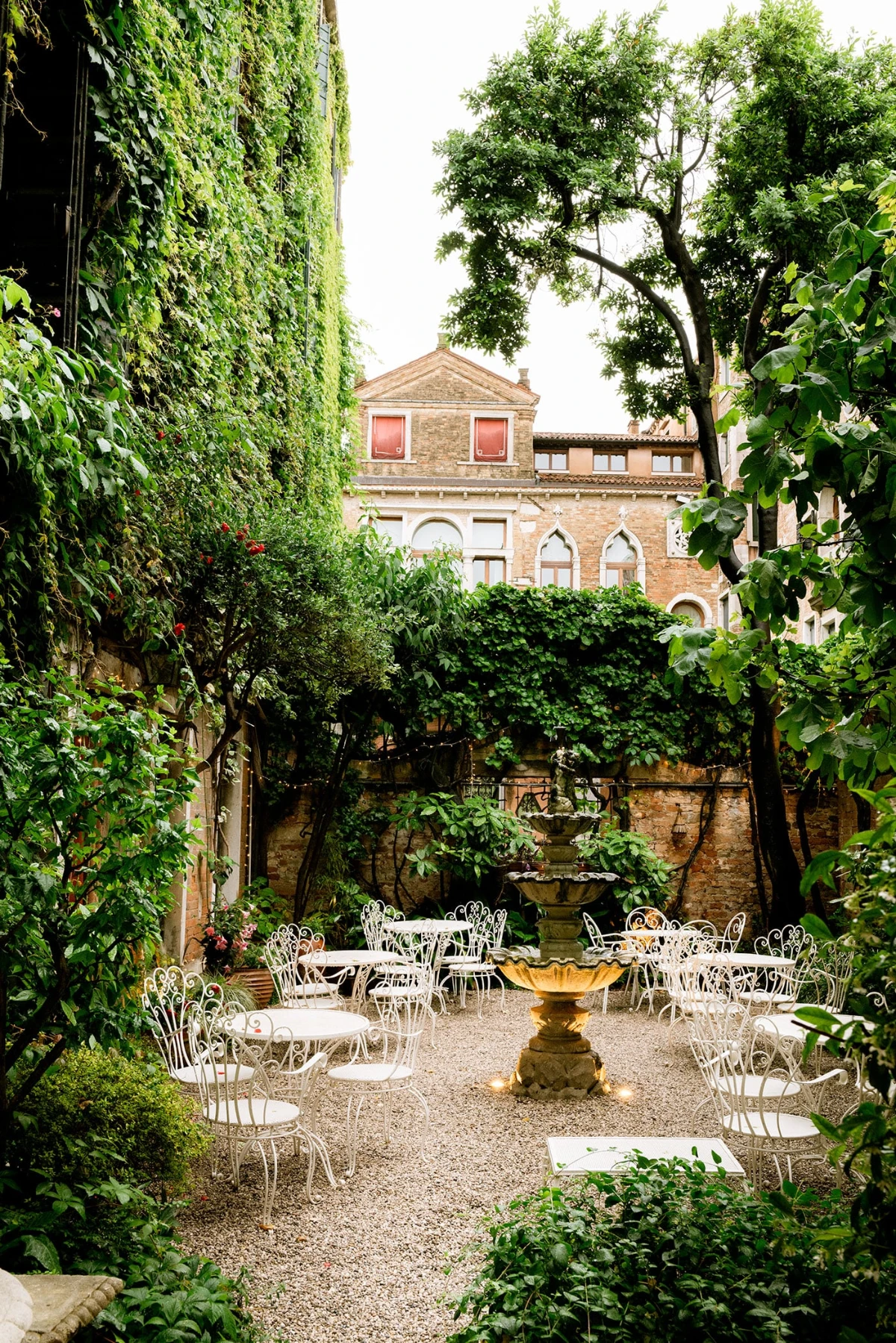
Hotel Flora is the residential argument made by an actual resident family. The Post-Venetian move here is hospitality as continuity of the household. The Romanellis live on the property, and the second and third generations work the desk, the garden, and the small bar in the evening. The 44 rooms have been gradually re-edited rather than redesigned, with materials drawn from Veneto suppliers the family has used for decades. The breakfast program sources from producers in the Euganean Hills and the lagoon islands the Romanellis have known for forty years. This boutique hotel maintains an audited sustainability program covering energy, water, sourcing, and supplier verification.
Il Palazzo Experimental
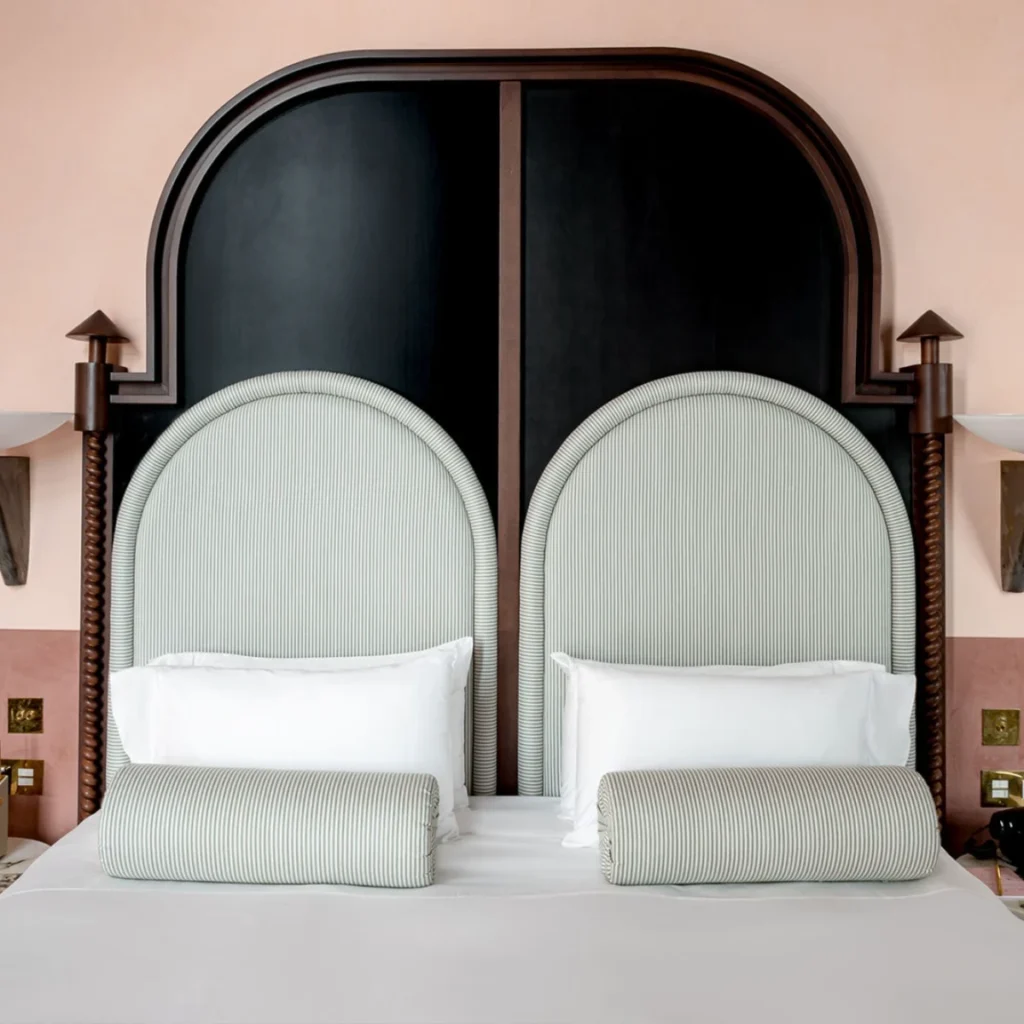
The Zattere is the long fondamenta along the southern edge of Dorsoduro that faces the Giudecca Canal across roughly 350 meters of open water. The wide promenade catches the afternoon sun for longer than any other stretch in the historic center and has been a residential walk for centuries. The palazzi along its length are smaller than those on the Grand Canal but architecturally varied, with sixteenth- and seventeenth-century fronts interleaved with later commercial buildings from the era when the Zattere served as the city’s principal cargo wharf. Il Palazzo Experimental occupies one of the sixteenth-century palazzi about midway along the fondamenta, with a water entrance directly onto the canal and a southern aspect that the design has explicitly used.
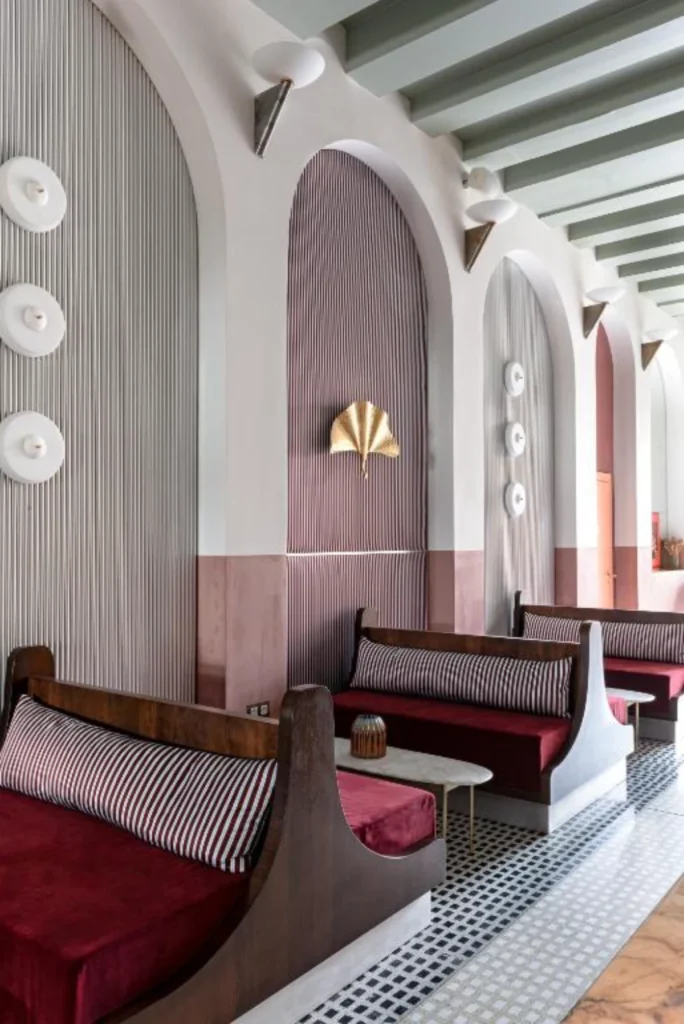
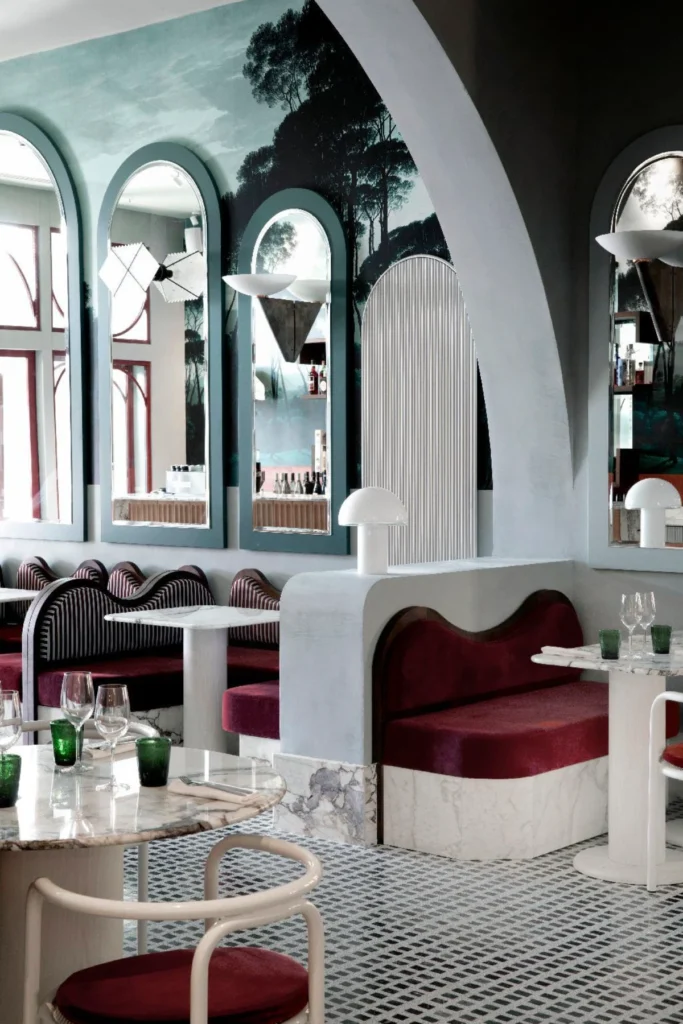
Il Palazzo Experimental, opened in 2019, holds the strictest provenance discipline in the city. Dorothée Meilichzon designed the boutique hotel’s interiors with a stated protocol of keeping every commission within approximately 100 kilometers of Venice. The result reads as a manifesto on what the Veneto can still make. Striped Murano glass in custom colors. Terrazzo laid by Veneto craftsmen in palette ranges drawn from Carlo Scarpa’s Venetian work. Custom-curved bed frames executed by a Treviso workshop. The 32 rooms vary in geometry but cohere in palette, the dusty pinks, sage greens, and pale corals Meilichzon has spoken of as Venetian lagoon colors. The ground-floor restaurant and bar program sources almost exclusively from Veneto producers.
Madama Garden Retreat
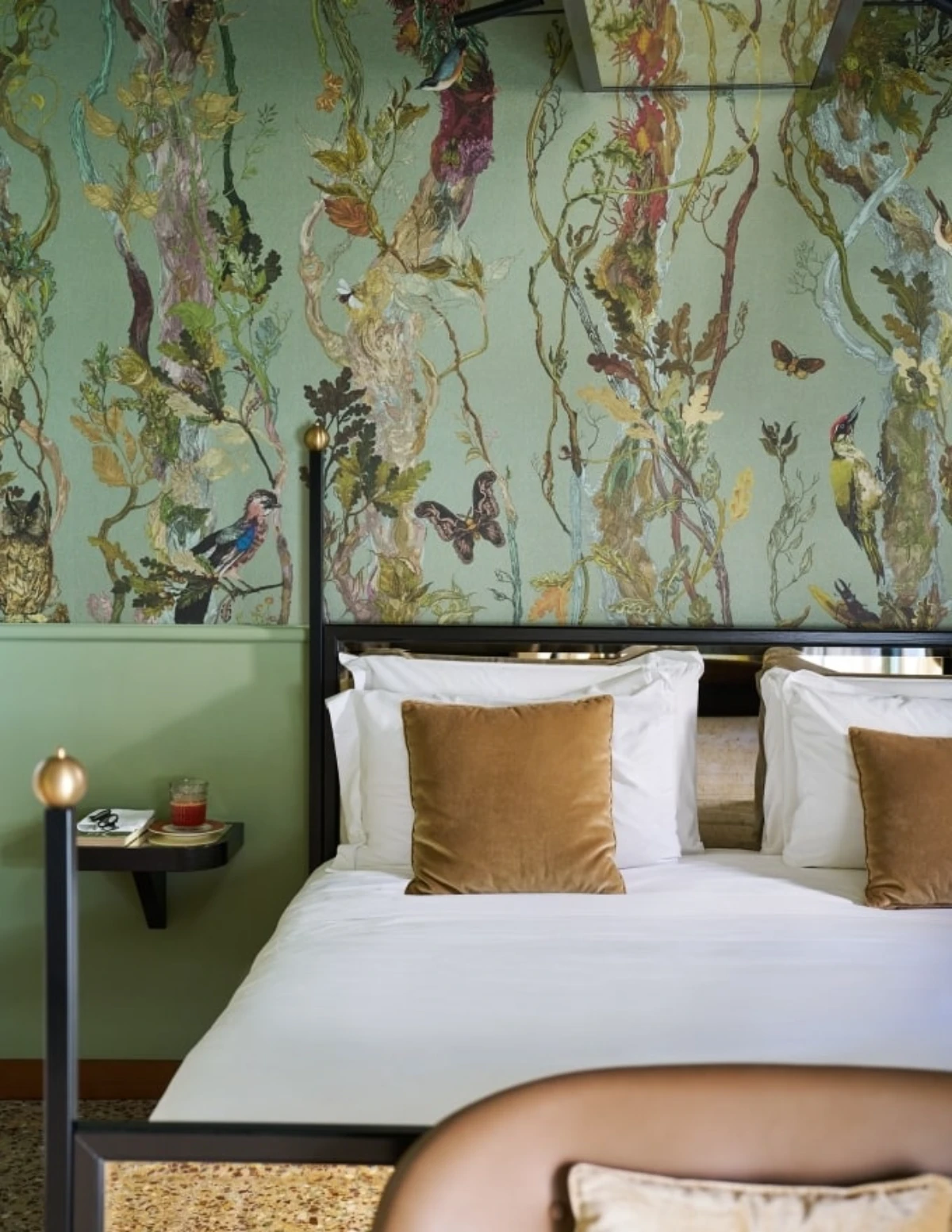
The Rio San Felice runs through northern Cannaregio between the Strada Nova and the Fondamenta della Misericordia, a working canal that holds a handful of small palazzi with rare private gardens. Green space inside the historic center of Venice is, by lagoon arithmetic, almost vanishingly scarce, perhaps 2 percent of the urban footprint. The properties that hold gardens are therefore architecturally exceptional, and Madama Garden Retreat occupies one of them. The building is a nineteenth-century palazzetto with a walled garden that extends along the rio, planted with mature magnolia, citrus, and seasonal beds. The sestiere around it is residential to the point of feeling village-like, with the morning rhythm of bakeries, fishmongers, and small bars.
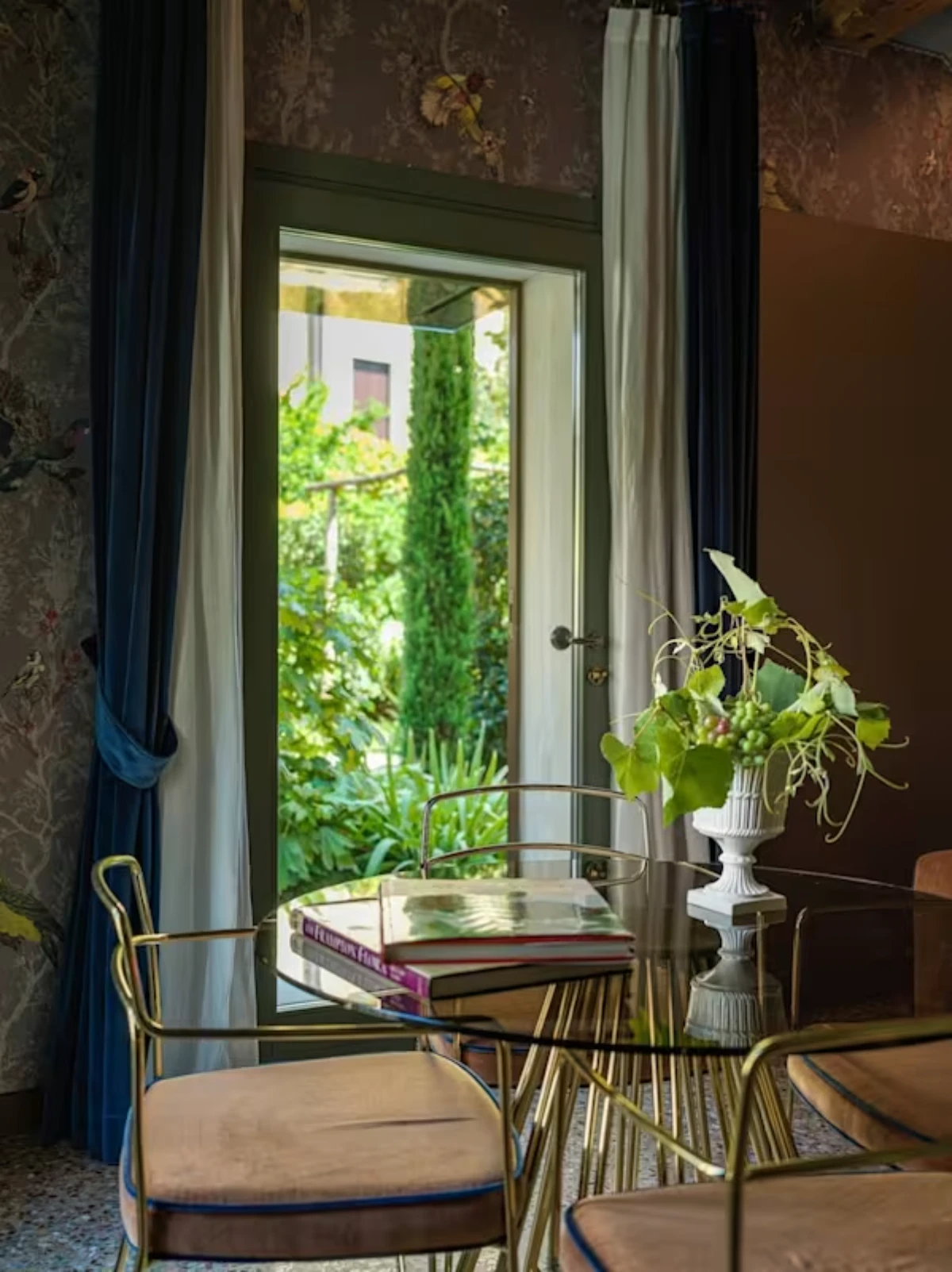
Madama Garden Retreat opened with nine suites and has been recognized by Condé Nast Johansens, Mr and Mrs Smith, and the Michelin Guide for what the boutique property frames as discretion-as-design. Each suite, Dhalia, Paeonia, Iris, Mauve, Tulip, Aster, Tuberose, Camelia, Chartreuse, takes its palette and material detailing from the flower it is named for, executed through small commissions to Veneto textile and ceramic workshops. The architectural argument is the garden itself, used as the property’s primary public room, with breakfast served outdoors in the warm months and a small library facing it through tall glazed doors.
Nolinski Venezia
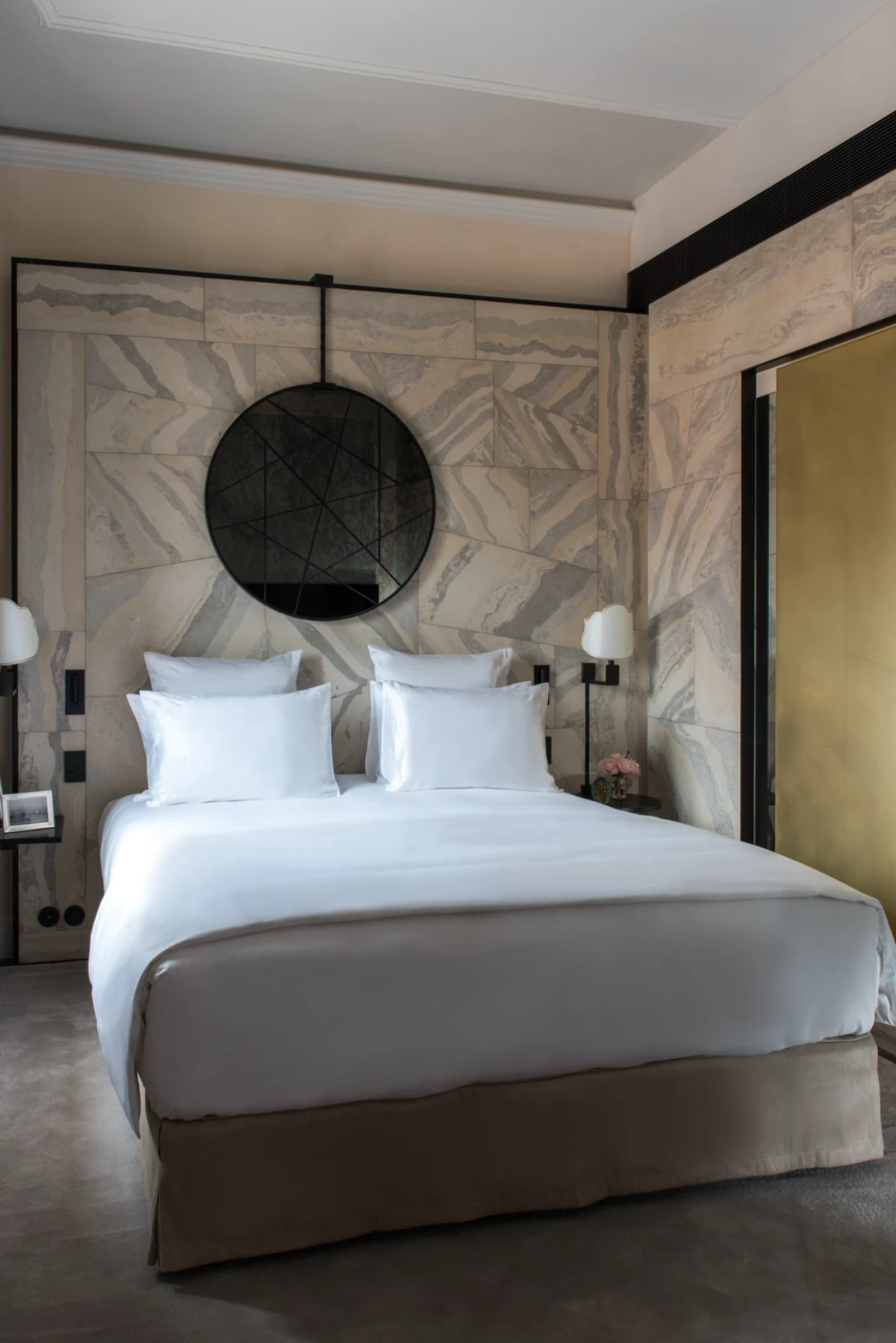
Calle Larga XXII Marzo runs west from Piazza San Marco toward La Fenice, the opera house, a stretch that has functioned for the majority of the past century as San Marco’s commercial spine. Its most architecturally consequential building is the former Bourse de Commerce, Venice’s stock exchange, whose facade carries a sequence of chimera reliefs that Venetian iconography identifies as daughters of Poseidon, a reference to the maritime power on which the Republic was built. The building blends Art Nouveau, Stile Liberty, and modernist detailing across five floors, and its reopening as Nolinski Venezia in 2023 brought a distinctly French editorial sensibility into a building whose civic architectural inheritance had been quietly waiting for it.
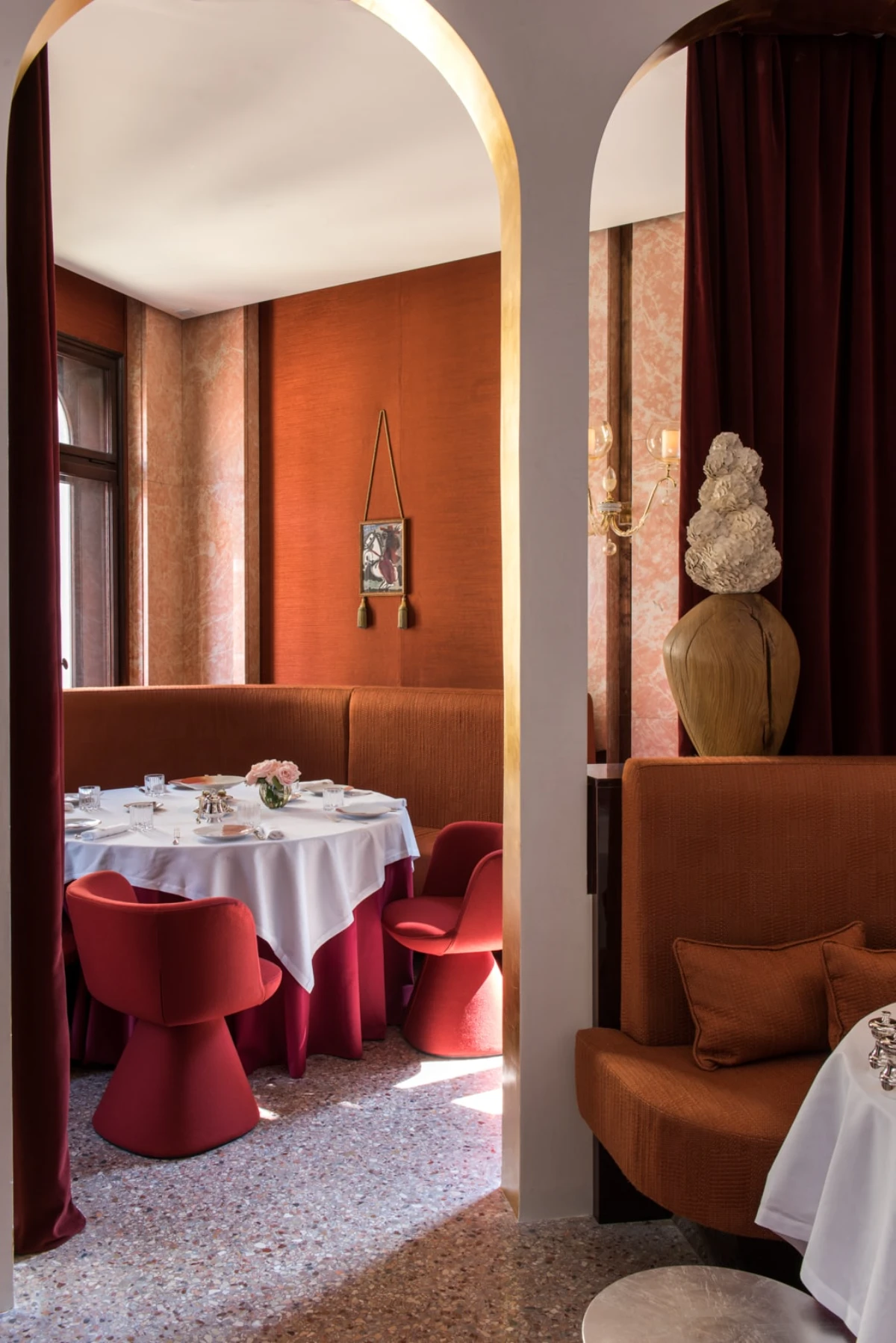
Nolinski Venezia, the Venice opening of the Paris-based Evok Collection, holds 43 rooms, including 13 suites across five floors. The Post-Venetian boutique application here is a cross-cultural editorial dialogue: French interior architects Le Coadic Scotto layer stucco marbro, marmorino, and mango-wood joinery against the building’s Art Nouveau and Stile Liberty bones, with antique and contemporary art curated through every public and private space. The third-floor bar holds a 4,000-volume library and a ceiling fresco by Simon Buret. The rooftop Bassin, a golden pool framed by a 360-degree view of Venetian roofs, and the Ottoman-inspired spa argue for luxury as inhabitation rather than performance. Zeffirino Venezia, the restaurant under chef Mickael Cornelus, applies French culinary technique to Mediterranean ingredients.
The Venice Venice Hotel
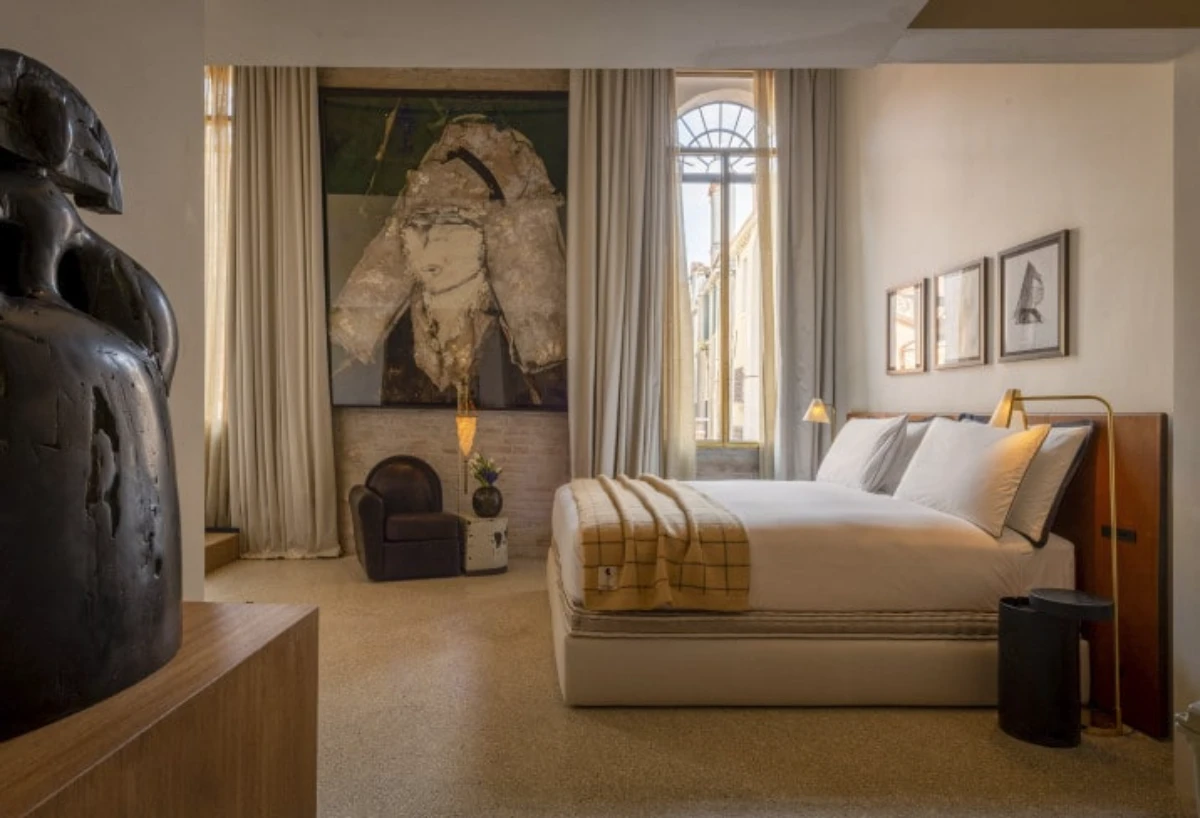
Palazzo Ca’ da Mosto sits on the Grand Canal just north of the Rialto Bridge, in one of the oldest surviving palazzi in the city. The building dates from the twelfth and thirteenth centuries and retains an unmistakable Venetian-Byzantine front, with the rounded arch windows and intricate cornice work of a period when Venice’s eastern trade was at its commercial peak. The palazzo was the birthplace of Alvise Ca’ da Mosto, the fifteenth-century navigator who charted the Cape Verde islands. For most of the twentieth century, the building stood underused. Its reopening as The Venice Venice Hotel in 2020, by an Italian fashion family with a long collecting practice, marked the most architecturally ambitious hotel restoration on the Grand Canal in a generation.
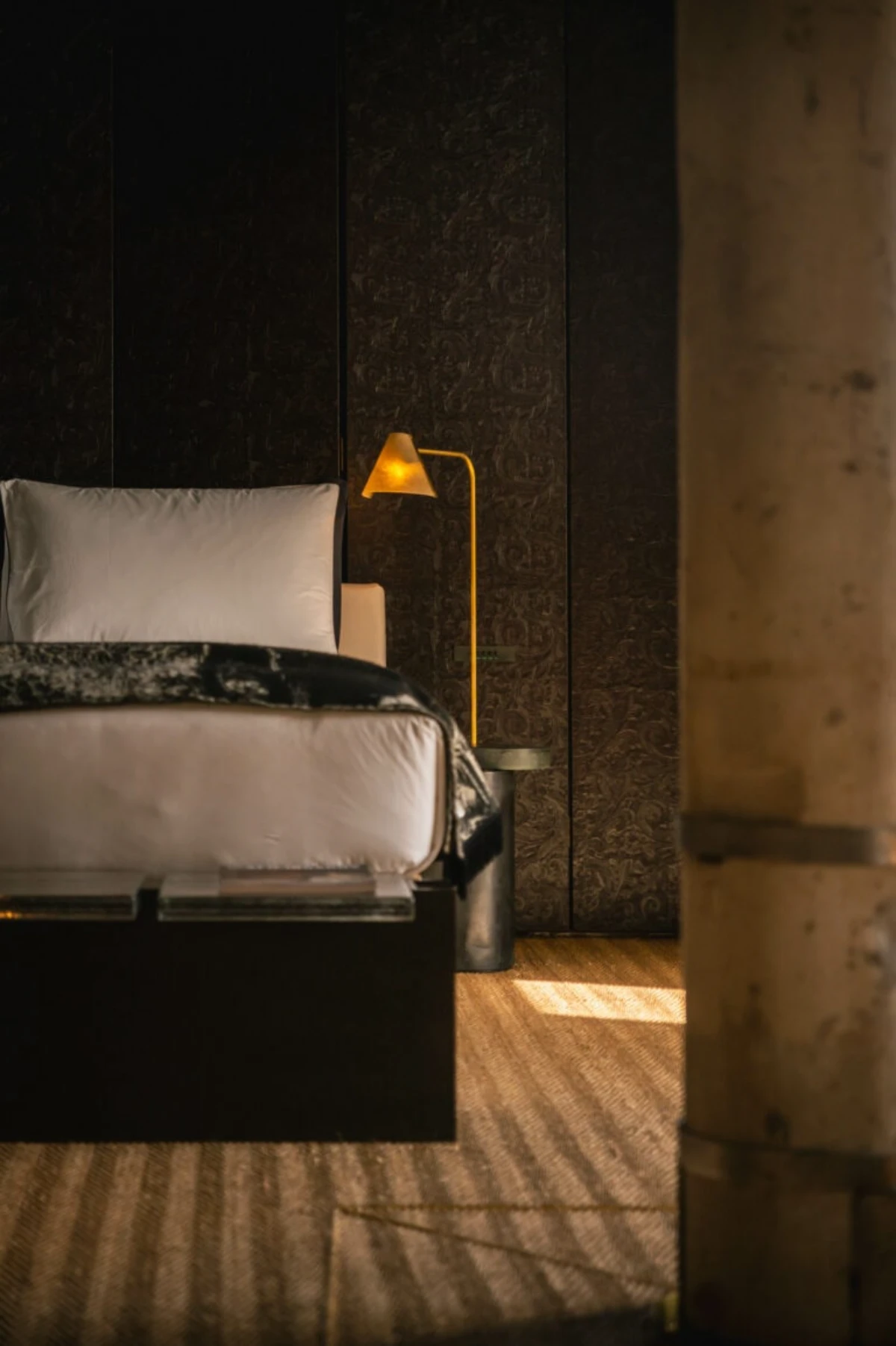
The Venice Venice Hotel is the built manifesto of the Post-Venetian movement. Cipollino marble. Custom Murano glass commissioned in striped, smoked, and reeded forms. Reclaimed Terrazzo. A standing contemporary art collection that rotates through the public floors. A small fashion-adjacent retail program on the ground floor that has been conceived as part of the architectural statement rather than a concession. 55 rooms across the palazzo and an adjacent building, with the Grand Canal suites holding original Venetian-Byzantine window arches as their primary architectural feature. The boutique hotel was conceived explicitly as an argument that Venetian craftsmanship belongs in a contemporary register, with a curatorial program to match.
CURATED TRAVEL
Need help booking a seamless journey to your destination?
Let us plan your itinerary from start to finish, with carefully selected stays, seamless routing, and considered recommendations throughout. As a Fora Travel advisor, we’re able to secure upgrades, added amenities, and preferred access, at no extra cost to you.
The Sensory Archive and the Materials of Post-Venetian Design
What the Post-Venetian framework asks of boutique hotels in Venice Italy, is provenance discipline at every level of material decision. The phrase sensory archive entered Venetian design conversation through the Patricia Urquiola interiors at Ca’ di Dio and the NUVO Magazine coverage that followed. The idea is that a hotel can be read through every sense it engages, not as decoration but as documentation. The lobby’s scent, commissioned and exclusive. The soundscape, low and intentional. The amenities, sourced by name. The materials, traceable by quarry, fornace, and workshop. A sensory archive in this sense is the opposite of a generic luxury template, which is built precisely to feel the same in Macau, Marrakech, and Milan. At the itinerary level, the same sensibility shapes what we call Curated Travel: a journey through the region as a sequence of named workshops, named producers, and named materials rather than a checklist of monuments.
The materials that anchor the Post-Venetian palette are specific to the Veneto and its trade history. Cipollino marble, a metamorphic stone with characteristic green and white banding, is cut from quarries in the eastern Alps and has been used in Venetian construction since the medieval period. Murano glass has been blown on the island since 1291, when the Republic concentrated its glass furnaces there to reduce fire risk in the city, and the fornaci remain family-held in many cases. Terrazzo, the composite of marble chips set in cement or lime binder and polished smooth, is a Venetian invention with documented use from the fifteenth century onward, originally as a flooring solution for the upper stories of palazzi where stone was too heavy. Venetian plaster, the lime-based wall finish polished to a marble-like sheen, traces to the same period and the same logic.
What distinguishes the Post-Venetian use of these materials from the Baroque inheritance is not the materials themselves but the discipline of attribution. A nineteenth-century grand hotel might use Cipollino, Murano, Terrazzo, and Venetian plaster without ever naming a supplier, in part because the materials were so ubiquitous that attribution would have felt redundant. A Post-Venetian boutique property names every supplier, in part because the materials are no longer ubiquitous and in part because the act of naming is the point. The Veneto’s small workshops have closed at a rate that has alarmed the regional craft federations for two decades. Sustained commissions from the hospitality sector are one of the few economic forces that have slowed the closures. The reading public for this kind of provenance has grown alongside a broader interest in slow travel, which gives the Post-Venetian framework an audience prepared to value attribution over volume.
Provenance discipline is, at its strongest, a question of legibility. A traveler who reads a wine list expects to see the producer, the vintage, and the appellation. A traveler who reads a museum artwork label expects to see the artist, the medium, and the date. The Post-Venetian premise is that a boutique hotel’s materials warrant the same legibility, and Meilichzon’s work at Il Palazzo Experimental reads as the clearest application of that premise in Venice. The argument is not academic. The Veneto’s glass, stone, plaster, and textile workshops survive on hospitality contracts at a scale they could not maintain on private residential commissions alone. A Post-Venetian property, named suppliers and all, is a working piece of the regional economy.
Sustainability as a Non-Negotiable in Venice
The HNWI Mandate
Forbes research published in 2025 found that 65 percent of high-net-worth travelers now place sustainability among their primary decision factors when selecting luxury accommodation, a figure that has more than doubled since 2019. The same research notes that high-net-worth travelers are also the demographic most willing to verify sustainability claims through third-party audits, supplier disclosures, and direct conversation with property management. Greenwashing, the use of sustainability language without operational substance, has become a measurable reputational risk for luxury hotels in 2026 in a way it was not a decade ago. The framework that has replaced it in the luxury press is conscious luxury, a phrase used to describe properties whose operational disclosures match their material claims.
Julia Simpson, President and CEO of the World Travel and Tourism Council, has consistently argued that travel and tourism’s footprint, roughly 10 percent of global GDP and a significant share of emissions when full lifecycle accounting is applied, gives the luxury segment disproportionate influence per traveler. Simpson has argued that the segment’s purchasing power can either accelerate the industry’s transition to lower-impact operations or hold it back, and that the next decade will sort operators on that line.
The Arabian Travel Market 2025 research on hyper-personalization adds a second layer to the mandate. 80 percent of luxury travelers now expect itineraries shaped to their specific interests, dietary patterns, and pacing preferences, and a significant share expect those itineraries to align with their sustainability values. The two demands are compounded. A property cannot meet the personalization expectation by offering one set of standardized choices, and it cannot meet the sustainability expectation by greenwashing a standardized program.
The Venice Context
Venice is uniquely positioned to make the sustainability argument concrete because the city’s environmental fragility is visible and continuous. Acqua alta cycles have intensified over the past two decades, with the November 2019 flooding producing the second-highest tide on record. The MOSE flood barrier system became operational in 2020 and has been deployed dozens of times. Cruise traffic restrictions enacted in 2021 redirected the largest vessels away from the Giudecca Canal and the Bacino di San Marco, reducing both wake damage to the foundations of the historic center and air quality impact. The resident population of the historic center has continued to decline, putting pressure on the small businesses, including artisan workshops, that depend on year-round residency. Venice’s case is in many ways the most acute version of a question that runs through the best places to visit in Italy, where the country’s most consequential destinations are also its most fragile.
The boutique hotels in Venice, Italy, operating in the Post-Venetian register have responded with operational specifics rather than marketing language. Ca’ di Dio publishes its supplier list and sources amenities from Veneto producers within a defined radius. Hotel Flora maintains an audited sustainability program covering energy, water, single-use plastics, and supplier verification, with annual third-party review. Il Palazzo Experimental‘s roughly 100-kilometer provenance protocol functions as a built sustainability framework, since the embodied carbon of materials drops substantially when transport distance is minimized. The Venice Venice Hotel‘s contemporary art program partners with Venetian and Veneto-resident artists.
For travelers who want to verify these claims, the practical questions are straightforward. Which suppliers does the property name? Whether the sustainability program is third-party audited. Whether the breakfast and restaurant sourcing maps to specific Veneto producers. Whether the amenity program comes from named regional makers or generic luxury contracts. Whether the property participates in lagoon conservation programs, supports the local artisan federations, or contributes to the residential continuity of its sestiere. A property that can answer these questions in operational detail is a property whose sustainability claim carries weight. A property that answers in generalities is a property still operating in the previous register.
Beyond the Booking
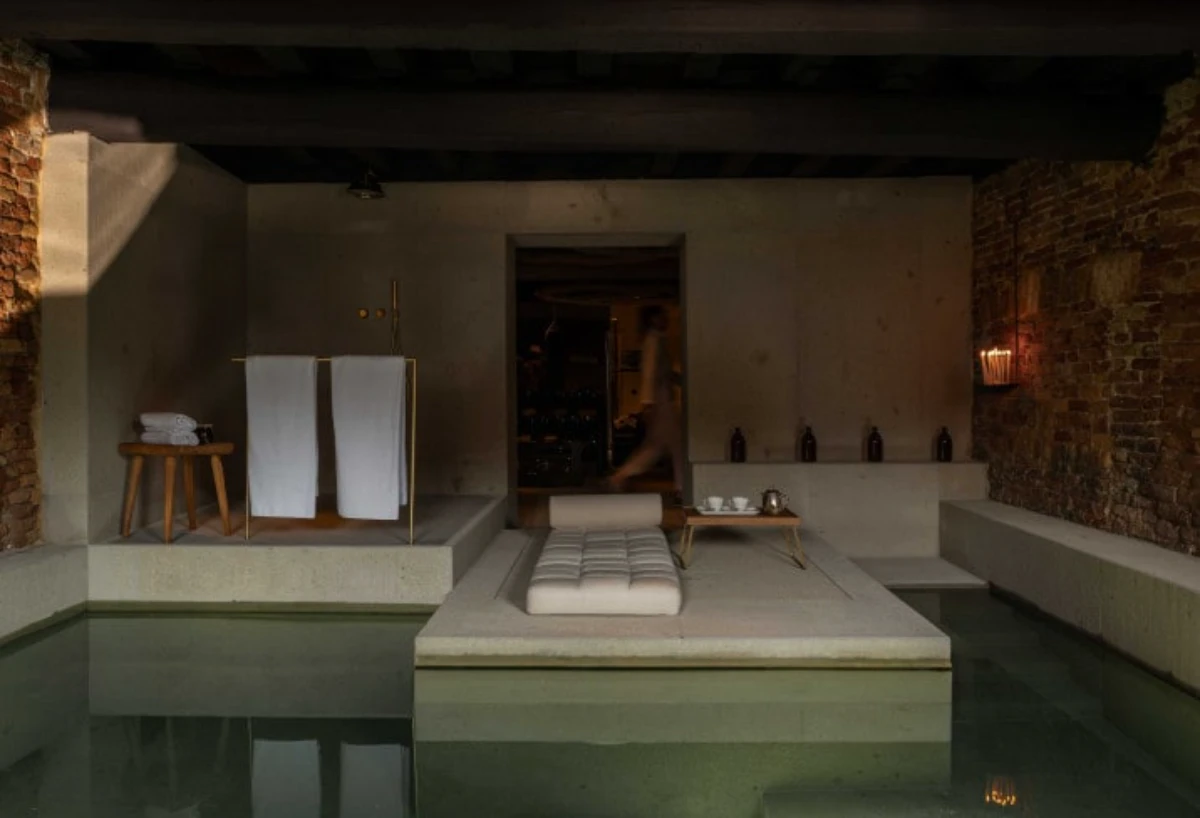
The choice of where to stay in Venice in 2026 is, finally, a choice about what the city’s hospitality economy should reward. The nine boutique stays considered here have made that choice in nine different ways, each through a discipline that the others do not share. Aman Venice‘s restraint against the Tiepolo cycle. Ca’ Maria Adele‘s named artisan thematic craft. Ca’ di Dio‘s sensory archive. Ca’ Sagredo‘s refusal to redesign. Nolinski Venezia‘s Paris-Venice editorial dialogue in the former Bourse. The Romanelli family’s residential continuity across Hotel Flora. Il Palazzo Experimental‘s 100-kilometer provenance. Madama Garden Retreat‘s flowered suites surround a rare central garden. The Venice Venice Hotel‘s built manifesto. Read together, they describe what boutique hotels in Venice, Italy, can look like when Venetian luxury begins, slowly and deliberately, to resemble the city it is set in.
The difference between booking a hotel and inhabiting a place is the difference between consuming a destination and being present to it. A booking ends when the suitcase closes. A curated journey, designed around the rhythms of a sestiere, the workshops of a Veneto craft family, the morning light on Salute, the evening bacaro a Romanelli has known for thirty years, continues to register long after departure. At Terra Selene, we build bespoke itineraries via our Curated Travel service for travelers drawn to that distinction, sequencing Venice into longer Italian arcs that connect the lagoon’s artisan economy to the Dolomites, the Veneto wine country, and the cities of the south through a single editorial sensibility. The Post-Venetian movement is not, in the end, about hotels. It is about what presence in a place looks like when the place itself is asked to remain.
Pin This for Later